Abstract
The experience economy revolution has transformed events into carefully designed emotional encounters that deliver more than entertainment through the promise of identity and social capital and exclusive experiences. Fear of Missing Out (FOMO) functions as a fundamental psychological force that directs consumer engagement, specifically among digitally connected audiences in the present context. Research has studied FOMO in relation to social media and impulsive behavior, yet the conceptual application of FOMO in event design and marketing requires further development. The research fills this knowledge gap through its proposed conceptual framework, which demonstrates how FOMO functions as an intentionally designed element in event marketing strategies. The paper examines how event marketing uses psychological mechanisms from Self-Determination Theory and Social Identity Theory to enhance emotional engagement through social proof and scarcity, exclusivity, and post-event content. The mechanisms operate within the event experience timeline to influence how people feel before events and during them, and after they finish. The marketing and design practices incorporate these triggers to create emotional urgency and influence identity signaling while driving attendance intentions. The framework shows that FOMO functions as a purposefully developed mechanism that connects with fundamental human requirements for relatedness and belonging, and status. The paper develops FOMO as an event experience framework that expands emotional behavior knowledge while creating ethical marketing methods for audience participation. The model serves as a foundation for future research to study FOMO's impact on decision-making processes while reinforcing involvement across physical and digital spaces.
Keywords
- FOMO Search this journal for FOMO (opens in a new tab)
- Experience Economy Search this journal for Experience Economy (opens in a new tab)
- Event Marketing Search this journal for Event Marketing (opens in a new tab)
- Event Attendance Search this journal for Event Attendance (opens in a new tab)
- Consumer Behavior Search this journal for Consumer Behavior (opens in a new tab)
- Social Media Search this journal for Social Media (opens in a new tab)
References
- Abel, J. P., Buff, C. L., & Burr, S. A. (2016). Social media and the fear of missing out: Scale development and assessment. Journal of Business & Economics Research, 14(1), 33–44.
- Agarwal, I., & Kumar, R. (2025). The Psychology of Exclusivity: Drives Luxury Purchases. International Journal of Research Publication and Reviews, 6(3), 5517.
- Aggrawal, P., Jun, S. Y., & Huh, J. H. (2011). Scarcity messages consumer competition perspective. Journal of Advertising, 40(3), 19–30.
- Alabri, A. (2022). Fear of Missing Out (FOMO): The Effects of the Need to Belong, Perceived Centrality, and Fear of Social Exclusion. Human Behavior and Emerging Technologies, 2022, 1.
- Alfina, A., Hartini, S., & Mardhiyah, D. (2023). FOMO related consumer behaviour in marketing context: A systematic literature review. Cogent Business & Management, 10(3).
- Baker, Z. G., Krieger, H., & LeRoy, A. S. (2016). Fear of missing out: Relationships with depression, mindfulness, and physical symptoms. Translational Issues in Psychological Science, 2(3), 275–282.
- Blackwell, D., Leaman, C., Tramposch, R., Osborne, C., & Liss, M. (2017). Extraversion, neuroticism, attachment style, and fear of missing out as predictors of social media use and addiction. Personality and Individual Differences, 116, 69–72.
- Bonsteel, S. (2012). APA PsycNET. The Charleston Advisor, 14(1), 16.
- Braghieri, L., Levy, R., & Makarin, A. (2022). Social Media and Mental Health. American Economic Review, 112(11), 3660.
- Bright, L. F., & Logan, K. (2021). FOMO marketing and event experience: Do social media influencers make a difference? Event Management, 25(1), 63–77.
- Chakrabarti, D. (2024). A Study on How Social Media FOMO (Fear of Missing Out) Impacts the Gen Z Audience. SSRN Electronic Journal.
- Cialdini, R. B. (2009). Influence: Science and practice (Vol. 4, pp. 51–96). Boston: Pearson Education.
- Deci, E. L., & Ryan, R. M. (2000). The "what" and "why" of goal pursuits: Human needs and the self-determination of behavior. Psychological Inquiry, 11(4), 227–268.
- Djafarova, E., & Trofimenko, O. (2019). ‘Instafamous’–credibility and self-presentation of micro-celebrities on social media. Information, Communication & Society, 22(10), 1432–1446.
- Elhai, J. D., Yang, H., Rozgonjuk, D., & Montag, C. (2021). Fear of missing out (FOMO): Overview, theoretical underpinnings, and literature review on relations with severity of negative affectivity and problematic technology use. Brazilian Journal of Psychiatry, 43(2), 203–209.
- Ezzat, A. A., Din, A. E. E., & Abdelmoaty, H. (2023). FOMO and Conformity Consumption: An Examination of Social Media Use and Advertising Online among Egyptian Millennials. OALib, 10(6), 1.
- Hair, J. F., Ringle, C. M., & Sarstedt, M. (2011). PLS-SEM: Indeed, a silver bullet. Journal of Marketing Theory and Practice, 19(2), 139–152.
- Hayran, C., Anik, L., & Gürhan-Canli, Z. (2016). Feeling of Missing Out (FOMO) and Its Marketing Implications.
- Hayran, C., & Gürhan Canli, Z. (2023). High and Low Arousal FOMO (Fear of Missing Out) States and Their Effects on Consumers’ Product and Experience Preferences.
- Hodkinson, C. (2019). ‘Fear of Missing Out’(FOMO) marketing appeals: A conceptual model. Journal of Marketing Communications, 25(1), 65–88.
- Hudson, S., Roth, M. S., Madden, T. J., & Hudson, R. (2015). The effects of social media on emotions, brand relationship quality, and word of mouth: An empirical study of music festival attendees. Tourism management, 47, 68-76.
- Kapferer, J. N. (2015). Kapferer on luxury: How luxury brands can grow yet remain rare. Kogan Page Publishers.
- Liu, D., He, B., Feng, R., Huang, X.-J., & Liu, G. (2024). How social media sharing drives consumption intention: the role of social media envy and social comparison orientation. BMC Psychology, 12(1).
- Milyavskaya, M., Saffran, M., Hope, N., & Koestner, R. (2018). Fear of missing out: Prevalence, dynamics, and consequences of experiencing FOMO. Motivation and Emotion, 42(5), 725.
- Ngo, T. T. A., Nguyen, H. L. T., Nguyen, H., Anh, H. T., Tran, T. H. T., & Hoang, P. L. (2024). A comprehensive study on factors influencing online impulse buying behavior: Evidence from Shopee video platform. Heliyon, 10(15).
- Nolan, K. (2021). Fear of missing out: performance art through the lens of participatory culture. International Journal of Performance Arts and Digital Media, 17(2), 234.
- Packer, J., & Ballantyne, R. (2016). Conceptualizing the visitor experience: A review of literature and development of a multifaceted model. Visitor Studies, 19(2), 128–143.
- Pang, H. (2022). The Negative Impact of Social Media on People’s Lives. Advances in Social Science, Education and Humanities Research.
- Pine, B. J., & Gilmore, J. H. (1999). The Experience Economy.
- Pine, B. J., & Gilmore, J. H. (2022). The Experience Economy: Competing for customer time, attention, and money.
- Przybylski, A. K., Murayama, K., DeHaan, C. R., & Gladwell, V. (2013). Motivational, emotional, and behavioral correlates of fear of missing out. Computers in Human Behavior, 29(4), 1841–1848.
- Schmitt, B. H. (1999). Experiential Marketing: How to Get Customers to Sense, Feel, Think, Act, and Relate to Your Company and Brands. New York, 25.
- Smilansky, S. (2017). Experiential marketing: A practical guide to interactive brand experiences. Kogan Page Publishers.
- Tajfel, H., Turner, J. C., Austin, W. G., & Worchel, S. (1979). An integrative theory of intergroup conflict. Organizational Identity: A Reader, 56(65), 9780203505984–16.
- Vemuri, V. P. (2024). Perspective Chapter: The Impact of Social Media on the Fear of Missing Out (FOMO) among Teenagers Aged between 18 and 25. In IntechOpen eBooks. IntechOpen.
- Wang, X., Sung, B., & Phau, I. (2024). How rarity and exclusivity influence types of perceived value for luxury. Journal of Brand Management, 31(6), 576.
Downloads
No downloads have been recorded for this article yet. Figures appear here once readers begin downloading the full text.
How to Cite
Share this article
License
Copyright (c) 2025 Nurakmal Ramli, Ayu Rohaidah Ghazali, Norhidayah Mohd Rashid, Wan Soraya Wan Abdul Ghani (Author)

This work is licensed under a Creative Commons Attribution 4.0 International License.
Author (s) should affirm that the material has not been published previously. It has not been submitted and it is not under consideration by any other journal. At the same time author (s) need to execute a publication permission agreement to assume the responsibility of the submitted content and any omissions and errors therein. After submission of revised paper in the light of suggestions of the reviewers, the editorial team edits and formats manuscripts to bring uniformity and standardization in published material.
This work will be licensed under Creative Commons Attribution 4.0 International (CC BY 4.0) and under condition of the license, users are free to read, copy, remix, transform, redistribute, download, print, search or link to the full texts of articles and even build upon their work as long as they credit the author for the original work. Moreover, as per journal policy author (s) hold and retain copyrights without any restrictions.
Keywords
- FOMO Search this journal for FOMO (opens in a new tab)
- Experience Economy Search this journal for Experience Economy (opens in a new tab)
- Event Marketing Search this journal for Event Marketing (opens in a new tab)
- Event Attendance Search this journal for Event Attendance (opens in a new tab)
- Consumer Behavior Search this journal for Consumer Behavior (opens in a new tab)
- Social Media Search this journal for Social Media (opens in a new tab)
Section
Published in
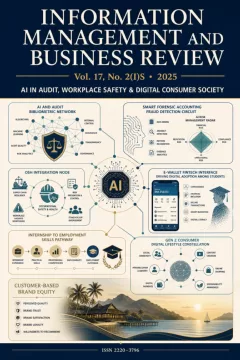 Vol. 17 No. 2(I)S (2025)
AI in Audit, Workplace Safety & Digital Consumer Society
View issue contents
Published
Submissions
Have research to publish? Information Management and Business Review welcomes submissions.
Make a Submission