Abstract
This study examines how internships affect the skill development of undergraduate students enrolled in Universiti Teknologi MARA's (UiTM) Bachelor of Insurance program. The study examines four important aspects: professional development, professional skills, personal growth, and personal capabilities. It is based on the Social Learning Theory. A simple random sample of 58 final-year students who finished a sixmonth internship was given a structured questionnaire with 23 Likert-scale items as part of a quantitative research design. Tests for reliability and normality were performed as part of descriptive and inferential analyses. According to the results, internships greatly improve students' professional skills, personal development, and personal capabilities, with personal capabilities being the aspect that is most highly rated. Even though professional development received positive feedback as well, it varied the most, indicating irregularities in career alignment and mentoring. These findings highlight the importance of internships in developing skills that are relevant to the industry, emotional intelligence, flexibility, and career clarity. According to the study's findings, organized internships are essential for connecting academic understanding with practical experience in the insurance industry. Enhancing supervisor engagement, updating internship results, and promoting closer university-industry collaboration are some of the recommendations. The results provide useful information for educators, employers, and legislators who want to improve internship opportunities and increase the employability of graduates in insurance and related industries.
Keywords
- Internship Search this journal for Internship (opens in a new tab)
- Professional Development Search this journal for Professional Development (opens in a new tab)
- Undergraduate Study Search this journal for Undergraduate Study (opens in a new tab)
- Social Learning Theory Search this journal for Social Learning Theory (opens in a new tab)
- Insurance Industry Search this journal for Insurance Industry (opens in a new tab)
References
- Andrews, L., Barker, M., & Stewart, L. (2020). Student perspectives on work-integrated learning: Factors influencing satisfaction and perceived career readiness. Journal of Teaching and Learning for Graduate Employability, 11(1), 48–65. https://doi.org/10.21153/jtlge2020vol11no1art863
- Anjum, S. (2020). Impact of internship programs on professional and personal development of students. Journal of Education and Educational Development, 7(1), 1–15. https://doi.org/10.22555/joeed.v7i1.1234
- Bawica, K. (2021). Internships and employability: A study of student outcomes. Journal of Career Development Studies, 5(3), 45–59.
- Billett, S. (2020). Integrating practice-based experiences into higher education. Springer. https://doi.org/10.1007/978-94-024-1785-4
- Byrne, B. M. (2016). Structural equation modeling with AMOS: Basic concepts, applications, and programming (3rd ed.). Routledge.
- Chong, S. W., & Yuen, M. (2023). Developing emotional intelligence and adaptability through workplace-based learning: A case study of business interns. Asia Pacific Journal of Cooperative Education, 24(1), 20–34.
- Clarke, M. (2020). Work-integrated learning for student success. Journal of Applied Learning in Higher Education, 10, 15–30.
- DeVellis, R. F. (2017). Scale development: Theory and applications (4th ed.). SAGE Publications.
- Franco Angel, G., Carabali, R., & Velasco, H. (2023). Influence of soft skills on internship performance: Evidence from a large student dataset. Journal of Higher Education Research, 15(4), 300–315. https://doi.org/10.1016/j.jher.2023.02.004
- Galbraith, C., & Mondal, W. (2020). Internships and long-term career paths: A student perspective. Journal of Vocational Behavior, 117, 103344. https://doi.org/10.1016/j.jvb.2020.103344
- George, D., & Mallery, P. (2010). SPSS for Windows step by step: A simple guide and reference (10th ed.). Pearson.
- Gercek, C., & Ozveren, U. (2024). Social learning in internship settings: Enhancing career resources through practice. Career Development International, 29(1), 55–70.
- Ghosh, R., Sanyal, S., & Dutta, A. (2021). Internships and emotional resilience: Evidence from undergraduate experiences. Journal of Work-Applied Management, 13(1), 57–73.
- Gupta, M. (2021). Internship access and equity in professional education. Education and Training, 63(6), 759–774. https://doi.org/10.1108/ET-11-2020-0333
- Hair, J. F., Black, W. C., Babin, B. J., & Anderson, R. E. (2020). Multivariate data analysis (8th ed.). Cengage Learning.
- Hora, M. T., Parrott, E., & Her, P. (2020). How internships enhance students’ career readiness: A mixed-methods study. Journal of Applied Research in Higher Education, 12(4), 725–741. https://doi.org/10.1108/JARHE-03-2020-0067
- Jackson, D., & Wilton, N. (2023). Career development, learning and employability: Challenges for higher education. Studies in Higher Education, 48(1), 1–17. https://doi.org/10.1080/03075079.2021.2020680
- Jackson, D., & Bridgstock, R. (2021). Employability and work-integrated learning: Research-informed practice. Higher Education Research & Development, 40(5), 903–917. https://doi.org/10.1080/07294360.2020.1815661
- Jackson, D., Tomlinson, M., & Goldsmith, K. (2020). Employability, work readiness, and the graduate identity: The role of higher education. Journal of Higher Education Policy and Management, 42(3), 275–289. https://doi.org/10.1080/1360080X.2020.1754787
- Jiang, H., & Guo, X. (2022). Student dissatisfaction in internships: A misalignment of goals. Asia Pacific Journal of Cooperative Education, 23(1), 25–34.
- Kline, R. B. (2016). Principles and practice of structural equation modeling (4th ed.). Guilford Press.
- Lee, C. D. (2020). Social learning and the workplace: Understanding how undergraduate internships promote skill acquisition. Journal of Work-Based Learning, 12(2), 145–159.
- McChesney, K., & Aldridge, J. M. (2021). Professional learning and the quality of internship experiences: The intern perspective. Teaching and Teacher Education, 98, 103251. https://doi.org/10.1016/j.tate.2020.103251
- Muzamil, A., & Shiraz, M. (2022). Internships and university students' employability skills: An empirical analysis. Journal of Education and Work, 35(3), 267–282.
- Nguyen, T. H., Le, Q. T., & Doan, M. H. (2021). Enhancing employability skills through internship programs: A study of Vietnamese business students. Journal of Education and Learning, 10(3), 45–55
- OECD. (2021). Skills for jobs: Resilience and employability in the post-pandemic world. OECD Publishing. https://doi.org/10.1787/skills-for-jobs-2021
- Okolie, U. C., Njoku, C. O., & Nwajiuba, C. A. (2020). Graduate employability: Work readiness and internship opportunities in developing economies. Education + Training, 62(3), 305–321. https://doi.org/10.1108/ET-01-2020-0011
- Pianda, D., Hilmiana, H., Widianto, S., & Sartika, D. (2024). The impact of internship experience on the employability of vocational students: a bibliometric and systematic review. Cogent Business & Management, 11(1). https://doi.org/10.1080/23311975.2024.2386465
- Smith, J., & Lee, A. (2022). Soft skills of business students about higher education internships. International Journal of Work-Integrated Learning, 23(2), 101–115. https://doi.org/10.1234/ijwil.v23i2.5678
- Tan, C. Y., Aziz, N., & Nor, M. N. M. (2022). The influence of internship experience on graduate employability: Evidence from Malaysian universities. International Journal of Academic Research in Business and Social Sciences, 12(6), 101–115. https://doi.org/10.6007/IJARBSS/v12-i6/13525
- Tavakol, M., & Dennick, R. (2011). Making sense of Cronbach's alpha. International Journal of Medical Education, 2, 53–55. https://doi.org/10.5116/ijme.4dfb.8dfd
- Tomlinson, M. (2021). Graduate employability: A review of conceptual and empirical themes. Higher Education Policy, 34, 431–451. https://doi.org/10.1057/s41307-020-00118-4
- Tran, L. T., & Soejatminah, S. (2022). Enhancing student employability through work-integrated learning: A transformative learning approach. Asia Pacific Journal of Education, 42(3), 345–360. https://doi.org/10.1080/02188791.2021.1885095
- Wan, X., Lee, C., & Lim, J. (2024). The role of internships in shaping student competencies and personal growth. Journal of Experiential Learning, 9(1), 51–68.
- Yeong, W. Y., Kam, P. L., & Boo, Y. L. (2024). Employer perspectives on internship quality and graduate readiness in Singapore. Asian Journal of Work-Integrated Learning, 10(2), 95–110.
- Yorke, M. (2019). Employability in higher education: What it is – what it is not. The Higher Education Academy.
Downloads
No downloads have been recorded for this article yet. Figures appear here once readers begin downloading the full text.
How to Cite
Share this article
License
Copyright (c) 2025 Rosmi Yuhasni Mohamed Yusuf, Muhammad Hafiz Yaakub, Afizul Mohamood (Author)

This work is licensed under a Creative Commons Attribution 4.0 International License.
Author (s) should affirm that the material has not been published previously. It has not been submitted and it is not under consideration by any other journal. At the same time author (s) need to execute a publication permission agreement to assume the responsibility of the submitted content and any omissions and errors therein. After submission of revised paper in the light of suggestions of the reviewers, the editorial team edits and formats manuscripts to bring uniformity and standardization in published material.
This work will be licensed under Creative Commons Attribution 4.0 International (CC BY 4.0) and under condition of the license, users are free to read, copy, remix, transform, redistribute, download, print, search or link to the full texts of articles and even build upon their work as long as they credit the author for the original work. Moreover, as per journal policy author (s) hold and retain copyrights without any restrictions.
Keywords
- Internship Search this journal for Internship (opens in a new tab)
- Professional Development Search this journal for Professional Development (opens in a new tab)
- Undergraduate Study Search this journal for Undergraduate Study (opens in a new tab)
- Social Learning Theory Search this journal for Social Learning Theory (opens in a new tab)
- Insurance Industry Search this journal for Insurance Industry (opens in a new tab)
Section
Published in
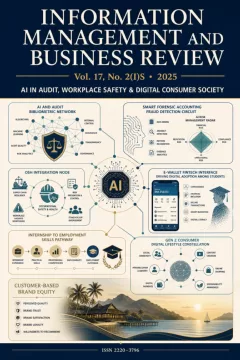 Vol. 17 No. 2(I)S (2025)
AI in Audit, Workplace Safety & Digital Consumer Society
View issue contents
Published
Submissions
Have research to publish? Information Management and Business Review welcomes submissions.
Make a Submission