Abstract
The integration of digital technologies into everyday life has significantly influenced how young people engage with democratic processes, though the implications remain uneven and contested. Digital platforms offer opportunities for civic participation, activism, and political education; however, they also pose risks, including misinformation, polarization, and digital access inequalities, which raise concerns about the inclusivity of youth democracy. This study examines the role of digital technologies in shaping youth democratic engagement, with particular attention to civic participation, digital citizenship, and the challenges of digital environments. Using Scopus AI (search conducted on 11 September 2025), the review applied a narrative review approach combining a structured search string, summary and expanded summary analysis, concept mapping, topic expert profiling, and identification of emerging themes to synthesize literature across disciplines. The findings show that digital culture fosters new forms of engagement through online activism, global networks, while digital citizenship predicts both local and global participation. Nonetheless, challenges including misinformation, online harassment, and ethical concerns about technological determinism limit the democratizing potential of these tools. Emerging themes emphasize the importance of digital competence, innovations in digital democracy, youth-led digital activism, and the transformation of the public sphere. The study concludes that digital technologies present both opportunities and challenges for youth democracy, highlighting the need for educational reforms to strengthen digital literacy, policy interventions to ensure equitable access, and safeguards to protect democratic quality. These provide theoretical contributions to understanding democracy in the digital age and practical guidance for policymakers, educators, and civic organizations.
Keywords
- Digital Citizenship Search this journal for Digital Citizenship (opens in a new tab)
- Youth Democracy Search this journal for Youth Democracy (opens in a new tab)
- Civic Participation Search this journal for Civic Participation (opens in a new tab)
- Digital Activism Search this journal for Digital Activism (opens in a new tab)
- Digital Literacy Search this journal for Digital Literacy (opens in a new tab)
References
- Akmal, M. (2018). The roles of digital democracy in political education for the young generation. Emerald Reach Proceedings Series, 1, 43–48. https://doi.org/10.1108/978-1-78756-793-1-00071 DOI: https://doi.org/10.1108/978-1-78756-793-1-00071
- Armour, K. M., Goodyear, V. A., & Sandford, R. (2020). The digital age challenge: Preparing physical and health educators to understand and support “online” youth. In K. M. Armour (Ed.), School physical education and teacher education: Collaborative redesign for the 21st century (pp. 219–237). Routledge. DOI: https://doi.org/10.4324/9780429330186-9
- Arndt, A. E., & Davis, K. C. (2010). Multiple means: Identifying literacy learning experiences of at-risk youth in community informatics contexts. International Conference on Society and Information Technologies (ICSIT 2010) Proceedings, 1, 111–120.
- Asimakopoulos, G., Antonopoulou, H., Giotopoulos, K., & Halkiopoulos, C. (2025). Impact of information and communication technologies on democratic processes and citizen participation. Societies, 15(2), 15-40. https://doi.org/10.3390/soc15020040 DOI: https://doi.org/10.3390/soc15020040
- Baranov, N. (2021). “Digital Panopticon” as an objective reality of the global world: The dilemma between social control and civic engagement. In R. Bolgov, V. Atnashev, Y. Gladkiy, A. Leete, A. Tsyb, S. Pogodin, & A. Znamenski (Eds.), Proceedings of Topical Issues in International Political Geography (pp. 22–30). Springer. https://doi.org/10.1007/978-3-030-78690-8_3 DOI: https://doi.org/10.1007/978-3-030-78690-8_3
- Boulianne, S., & Theocharis, Y. (2020). Young people, digital media, and engagement: A meta-analysis of research. Social Science Computer Review, 38(2), 111–127. https://doi.org/10.1177/0894439318814190 DOI: https://doi.org/10.1177/0894439318814190
- Caron, C., Raby, R., Mitchell, C., Théwissen-LeBlanc, S., & Prioletta, J. (2019). How are civic cultures achieved through youth social-change-oriented vlogging? A multimodal case study. Convergence, 25(4), 694–713. https://doi.org/10.1177/1354856518795094 DOI: https://doi.org/10.1177/1354856518795094
- Marchi, R., & Clark, L. S. (2021). Social media and connective journalism: The formation of counterpublics and youth civic participation. Journalism, 22(2), 285-302. DOI: https://doi.org/10.1177/1464884918807811
- Cleofas, J. V. (2025). Kabataang Pinoy online: Digital citizenship and global civic engagement among Filipino young netizens. Journal of Applied Youth Studies, 8(2), 173–192. https://doi.org/10.1007/s43151-025-00165-2 DOI: https://doi.org/10.1007/s43151-025-00165-2
- Coulter, B. (2018). Preserving rich experience in the digital age. In Dewey and education in the 21st century: Fighting back (pp. 21–35). Emerald. https://doi.org/10.1108/978-1-78743-625-120181008 DOI: https://doi.org/10.1108/978-1-78743-625-120181008
- Dias Fonseca, T. (2019). The Internet as a global playground: Young citizens and informal spaces of agency, a Portuguese case study. Mind, Culture, and Activity, 26(4), 353-370. https://doi.org/10.1080/10749039.2019.16832 DOI: https://doi.org/10.1080/10749039.2019.1683208
- Duche-Pérez, A. B., Vera-Revilla, C. Y., Gutiérrez-Aguilar, O. A., Montesinos-Chávez, M. C., Valdivia-Loaiza, A. H., & Flores-Vilca, I. V. (2024). In D. B Ibáñez, L. M. Castro, A. Espinosa, I. Puentes-Rivera, & P. C. López-López (Eds.), Communication and applied technologies. ICOMTA 2023 (Smart Innovation, Systems and Technologies, 375, pp. 549–558). Springer Nature Singapore. https://doi.org/10.1007/978-981-99-7210-4_51 DOI: https://doi.org/10.1007/978-981-99-7210-4_51
- Escofet, A. (2020). Service-learning and digital technologies: A possible relationship? RIED-Revista Iberoamericana de Educación a Distancia, 23(1), 169–182. https://doi.org/10.5944/ried.23.1.24680 DOI: https://doi.org/10.5944/ried.23.1.24680
- Farmer, L. (2018). Pro-active digital citizenship: Strategies for educators. In Handbook of research on positive scholarship for global K-20 education (pp. 62–79). IGI Global. https://doi.org/10.4018/978-1-5225-5667-1.ch005 DOI: https://doi.org/10.4018/978-1-5225-5667-1.ch005
- Fischli, R., & Muldoon, J. (2024). Empowering digital democracy. Perspectives on Politics, 22(3), 819–835. https://doi.org/10.1017/S1537592724000409 DOI: https://doi.org/10.1017/S1537592724000409
- González-Mohino, M., Rodríguez-Domenech, M. Á., Callejas-Albiñana, A. I., & Castillo-Canalejo, A. (2023). Empowering critical thinking: The role of digital tools in citizen participation. Journal of New Approaches in Educational Research, 12(2), 258–275. https://doi.org/10.7821/naer.2023.7.1385 DOI: https://doi.org/10.7821/naer.2023.7.1385
- Gwaka, L. T. (2018). Digital technologies and youth mobility in rural Zimbabwe. Electronic Journal of Information Systems in Developing Countries, 84(3), e12025. https://doi.org/10.1002/isd2.12025 DOI: https://doi.org/10.1002/isd2.12025
- Helbing, D., Mahajan, S., Fricker, R. H., Musso, A., Hausladen, C. I., Carissimo, C., Carpentras, D., Stockinger, E., Argota Sanchez-Vaquerizo, J., Yang, J. C., Ballandies, M. C., Korecki, M., Dubey, R. K., & Pournaras, E. (2023). Democracy by design: Perspectives for digitally assisted participatory upgrades of society. Journal of Computational Science, 71, 102061. https://doi.org/10.1016/j.jocs.2023.102061 DOI: https://doi.org/10.1016/j.jocs.2023.102061
- Kahne, J., & Middaugh, E. (2012). Digital media shapes youth participation in politics. Phi Delta Kappan, 94(3), 52-56. DOI: https://doi.org/10.1177/003172171209400312
- Liu, T. C. (2022). Using digital technology to enhance youth participatory evaluation. Evaluation, 28(4), 540-554. https://doi.org/10.1177/13563890221124713 DOI: https://doi.org/10.1177/13563890221124713
- Maseko, M. M. (2024). Digital transformation in Africa: Is democracy under threat? In N. S. Tshishonga & I. Tshabangu (Eds.), Democratization of Africa and its impact on the global economy (pp. 333–354). IGI Global. https://doi.org/10.4018/979-8-3693-0477-8 DOI: https://doi.org/10.4018/979-8-3693-0477-8.ch019
- Papaioannou, T. (2013). Media and civic engagement: The role of Web 2.0 technologies in fostering youth participation. In D. Lemish (Ed.), The Routledge International Handbook of Children, Adolescents and Media (pp. 351–358). Routledge. https://doi.org/10.4324/9780203366981-60 DOI: https://doi.org/10.4324/9780203366981-60
- Pavan, E., & Earl, J. (2025). Young people, digital and social media, and progressive politics. In Handbook of Progressive Politics (pp. 389–407). Edward Elgar. https://doi.org/10.4337/9781800880641.00033 DOI: https://doi.org/10.4337/9781800880641.00033
- Peart, M., Cubo-Delgado, S., & Gutiérrez-Esteban, P. (2022). Exploring the role of digital and socio-civic skills for promoting youth participation and digital citizenship. European Journal of Educational Research, 11(2), 697–709. https://doi.org/10.12973/eu-jer.11.2.697 DOI: https://doi.org/10.12973/eu-jer.11.2.697
- Sala, J. F. A. (2021). The challenges of the digital transformation of democracy. Recerca, 26(2), 1–15. https://doi.org/10.6035/recerca.4660 DOI: https://doi.org/10.6035/recerca.4660
- Saud, M., & Margono, H. (2021). Indonesia’s rise in digital democracy and the youth’s political participation. Journal of Information Technology and Politics, 18(4), 443–454. https://doi.org/10.1080/19331681.2021.1900019 DOI: https://doi.org/10.1080/19331681.2021.1900019
- Sampaio, I. V., Robinson, L., Moles, K., & Pangrazio, L. (2024). Introduction to youth, digital media, and civic engagement. First Monday, 29(5), 1–15. https://doi.org/10.5210/fm.v29i5.13322 DOI: https://doi.org/10.5210/fm.v29i12.13839
- Savirimuthu, J. (2012). Online child safety: Law, technology and governance. Palgrave Macmillan. https://doi.org/10.1057/9780230361003 DOI: https://doi.org/10.1057/9780230361003
- Šimková, K., & Kárníková, L. (2024). It is the best tool we have, but that doesn’t mean it’s a good tool: Czech civically engaged youth actors on tackling the ambiguity of using digital media. Media & Jornalismo, 24(45), e4501-e4501. https://doi.org/10.14195/2183-5462_45_1 DOI: https://doi.org/10.14195/2183-5462_45_1
- Soyipov, S., Khaitov, F., Shukurova, F., Rashidova, K., Aliyeva, M., Yuldasheva, G., Berdiyeva, N., & Jumanov, A. (2024). Digital democracy: How technology can drive higher voter turnout in elections. Indian Journal of Information Sources and Services, 14(4), 22–28. https://doi.org/10.51983/ijiss-2024.14.4.04 DOI: https://doi.org/10.51983/ijiss-2024.14.4.04
- Zaremohzzabieh, Z., Ahrari, S., Krauss, S. E., Abu Samah, A., & Omar, S. Z. (2020). Youth work and digital technologies: Future directions for research, practice, and policy. In Z. Zaremohzzabieh, S. Ahrari, S. E. Krauss, A. Abu Samah, & S. Z. Omar (Eds.), Youth work in a digital society (pp. 21–40). Routledge. DOI: https://doi.org/10.4018/978-1-7998-2956-0.ch002
Downloads
Full-text downloads recorded for this article, by month.
No downloads have been recorded for this article yet. Figures appear here once readers begin downloading the full text.
How to Cite
Share this article
License
Copyright (c) 2025 Irwana Nooridayu Muhamad Hakimi, Azmil Mohd Tayeb, Noorayuni Rusli, Mohamad Ili Afiq Ibrahim (Author)

This work is licensed under a Creative Commons Attribution 4.0 International License.
Author (s) should affirm that the material has not been published previously. It has not been submitted and it is not under consideration by any other journal. At the same time author (s) need to execute a publication permission agreement to assume the responsibility of the submitted content and any omissions and errors therein. After submission of revised paper in the light of suggestions of the reviewers, the editorial team edits and formats manuscripts to bring uniformity and standardization in published material.
This work will be licensed under Creative Commons Attribution 4.0 International (CC BY 4.0) and under condition of the license, users are free to read, copy, remix, transform, redistribute, download, print, search or link to the full texts of articles and even build upon their work as long as they credit the author for the original work. Moreover, as per journal policy author (s) hold and retain copyrights without any restrictions.
Keywords
- Digital Citizenship Search this journal for Digital Citizenship (opens in a new tab)
- Youth Democracy Search this journal for Youth Democracy (opens in a new tab)
- Civic Participation Search this journal for Civic Participation (opens in a new tab)
- Digital Activism Search this journal for Digital Activism (opens in a new tab)
- Digital Literacy Search this journal for Digital Literacy (opens in a new tab)
Section
Published in
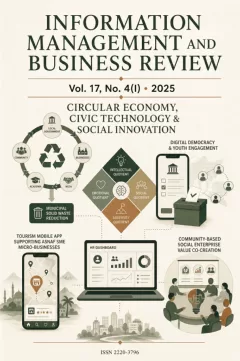 Vol. 17 No. 4(I) (2025)
Circular Economy, Civic Technology & Social Innovation
View issue contents
Published
Submissions
Have research to publish? Information Management and Business Review welcomes submissions.
Make a Submission