Abstract
This study addresses persistent challenges in municipal solid waste systems, namely low diversion and uneven resource recovery, by examining how stakeholder engagement (with communities, suppliers, and regulators) supports the adoption of circular economy (CE) practices and how operational change, often termed green process innovation, drives measurable waste outcomes. The central hypothesis is that CE adoption mediates the relationship between stakeholder engagement and waste reduction. Using a narrative review oriented to concept development, records were retrieved from the Scopus database (articles and reviews, 2000–2025, English) with a reproducible query targeting stakeholder engagement, CE, policy/strategy, and organizational settings. After de-duplication, titles/abstracts and full texts were screened for relevance to engagement, CE adoption, and waste outcomes or proxies; data were extracted into a conceptcentric matrix and synthesized via integrative thematic analysis. Primary outcomes were diversion rate, secondary material yield, and contamination reduction. The synthesis reveals two pathways: (1) a direct association whereby engagement mobilizes source separation, social acceptance of reuse/repair, and takeback participation; and (2) a stronger, mediated pathway in which engagement enables CE adoption, such as design for disassembly, industrial symbiosis, organics valorization, and optimized recycling–recovery portfolios that directly improves diversion and recovery. Governance capacity, policy coherence, and digital readiness strengthen these effects. Overall, stakeholder engagement improves waste outcomes primarily by deepening and routinizing CE adoption, with supportive governance and policy environments amplifying gains. The resulting framework offers testable propositions and practical guidance for municipalities and firms seeking scalable circular outcomes.
Keywords
- Circular Economy Adoption Search this journal for Circular Economy Adoption (opens in a new tab)
- Green Process Innovation Search this journal for Green Process Innovation (opens in a new tab)
- Municipal Solid Waste Search this journal for Municipal Solid Waste (opens in a new tab)
- Stakeholder Engagement Search this journal for Stakeholder Engagement (opens in a new tab)
- Waste Reduction Search this journal for Waste Reduction (opens in a new tab)
References
- Adedayo-Ojo, A. A., Shad, M. K., & Poon, W. C. (2025). Circular economy in the oil and gas industry: A data-driven bibliometric analysis. Circular Economy and Sustainability, 5(4), 3465–3527. https://doi.org/10.1007/s43615-025-00579-3
- Al-Najjar, B., Salama, A., & Abed, A. (2025). From Compliance to Commitment: Examining the Influence of Corporate Governance and Social Performance on Firms’ Circular Economy Initiatives. Journal of Business Ethics, 1-24. https://doi.org/10.1007/s10551-025-06111-9
- Baumeister, R. F., & Leary, M. R. (1997). Writing narrative literature reviews. Review of general psychology, 1(3), 311-320. https://doi.org/10.1037/1089-2680.1.3.311
- Bertanza, G., Mazzotti, S., Gomez, F. H., Nenci, M., Vaccari, M., & Zetera, S. F. (2021). Implementation of circular economy in the management of municipal solid waste in an Italian medium-sized city: A 30-year lasting history. Waste Management, 126, 821-831.
- Braun, V., & Clarke, V. (2006). Using thematic analysis in psychology. Qualitative research in psychology, 3(2), 77-101
- DiMaggio, P. J., & Powell, W. W. (1983). The iron cage revisited: Institutional isomorphism and collective rationality in organizational fields. American Sociological Review, 48(2), 147-160.
- Ddiba, D., Andersson, K., Koop, S. H., Ekener, E., Finnveden, G., & Dickin, S. (2020). Governing the circular economy: Assessing the capacity to implement resource-oriented sanitation and waste management systems in low-and middle-income countries. Earth System Governance, 4, 100063. https://doi.org/10.1016/j.esg.2020.100063
- Esposito, B., Sica, D., Supino, S., & Malandrino, O. (2024). Measuring the impact of circular economy performance on financial performance: The moderating role of stakeholder engagement. Business Strategy and the Environment, 33(6), 5109–5126. https://doi.org/10.1002/bse.3744
- Freeman, R. E. (2010). Strategic management: A stakeholder approach. Cambridge University Press.
- Fobbe, L., & Hilletofth, P. (2023). Moving toward a circular economy in manufacturing organizations: the role of circular stakeholder engagement practices. The International Journal of Logistics Management, 34(3), 674-698.
- Geissdoerfer, M., Savaget, P., Bocken, N. M. P., & Hultink, E. J. (2017). The circular economy—A new sustainability paradigm? Journal of Cleaner Production, 143, 757–768. https://doi.org/10.1016/j.jclepro.2016.12.048
- Ghisellini, P., Cialani, C., & Ulgiati, S. (2016). A review on circular economy: The expected transition to a balanced interplay of environmental and economic systems. Journal of Cleaner Production, 114, 11–32. https://doi.org/10.1016/j.jclepro.2015.09.007
- Hart, S. L. (1995). A natural-resource-based view of the firm. Academy of Management Review, 20(4), 986-1014.
- Kirchherr, J., Reike, D., & Hekkert, M. (2017). Conceptualizing the circular economy: An analysis of 114 definitions. Resources, Conservation and Recycling, 127, 221–232. https://doi.org/10.1016/j.resconrec.2017.09.005
- Kunal, K., Arun, C. J., Selvakumar, V., Venkatakrishnan, S., Anand, S. T., & Madeshwaren, V. (2025). Adoption of circular economy principles: An empirical study of green strategies in manufacturing organizations. International Journal of Accounting and Economics Studies, 12(4), 113–119. https://doi.org/10.14419/3k4e3441
- Iaquaniello, G., Centi, G., Salladini, A., Palo, E., & Perathoner, S. (2018). Waste to chemicals for a circular economy. Chemistry–A European Journal, 24(46), 11831-11839.
- Mitchell, R. K., Agle, B. R., & Wood, D. J. (1997). Toward a theory of stakeholder identification and salience: Defining the principle of who and what really counts. Academy of Management Review, 22(4), 853-886.
- Muriuki, T. E., Ayuya, O. I., & Oloo, B. O. (2024). Towards a circular production system in the coconut value chain: actor, roles, linkage and constraints in Kilifi County, Kenya. Cogent Social Sciences, 10(1), 2362903. https://doi.org/10.1080/23311886.2024.2362903
- Negrete-Cardoso, M., Rosano-Ortega, G., Álvarez-Aros, E. L., Tavera-Cortés, M. E., Vega-Lebrún, C. A., & Sánchez-Ruíz, F. J. (2022). Circular economy strategy and waste management: a bibliometric analysis in its contribution to sustainable development, toward a post-COVID-19 era. Environmental Science and Pollution Research, 29(41), 61729-61746.
- Page, M. J., McKenzie, J. E., Bossuyt, P. M., Boutron, I., Hoffmann, T. C., Mulrow, C. D., ... & Moher, D. (2021). The PRISMA 2020 statement: an updated guideline for reporting systematic reviews. BMJ, 372.
- Palafox-Alcantar, P. G., Hunt, D. V. L., & Rogers, C. D. F. (2021). Current and future professional insights on cooperation towards circular economy adoption. Sustainability, 13(18), Article 10436. https://doi.org/10.3390/su131810436
- Palea, V., Gordano, S., & Migliavacca, A. (2025). Do firms practice what they preach? Corporate performance-communication decoupling on environmental SDGs and the impact of sustainability-oriented governance mechanisms. Sustainability Accounting, Management and Policy Journal, 16(7), 98-127.
- Saha, K., Farhanj, Z., & Kumar, V. (2025). A Systematic Review of Circular Economy Literature in Healthcare: Transitioning from a ‘Post-Waste ‘Approach to Sustainability. Journal of Cleaner Production, 145427.
- Salles, A., Cervantes, C., & Bragança, L. (2024). Assessing the impacts of urban circular economy practices on economic growth, environmental sustainability, and social benefits: A case study analysis. In Lecture Notes in Civil Engineering (Vol. 489, pp. 482–490). Springer. https://doi.org/10.1007/978-3-031-57800-7_44
- She, Y., Udawatta, N., Liu, C., & Tokede, O. (2025). A conceptual framework for implementing the circular economy to minimize construction and demolition waste generation: Engagement of project stakeholders. In Lecture Notes in Civil Engineering, 563(433–445). Springer. https://doi.org/10.1007/978-981-96-2904-6_33
- Snyder, H. (2019). Literature review as a research methodology: An overview and guidelines. Journal of Business Research, 104, 333-339. https://doi.org/10.1016/j.jbusres.2019.07.039
- Teece, D. J., Pisano, G., & Shuen, A. (1997). Dynamic capabilities and strategic management. Strategic management journal, 18(7), 509-533.
- Toboso-Chavero, S., Zisopoulos, F. K., de Jong, M., & Schraven, D. (2025). Critical review of methodological tools and trends for assessing the performance of inclusive circular cities. Cleaner Environmental Systems, 100275.
- Webster, J., & Watson, R. T. (2002). Analyzing the past to prepare for the future: Writing a literature review. MIS Quarterly, 13-23. https://doi.org/10.2307/4132319
- Whittemore, R., & Knafl, K. (2005). The integrative review: updated methodology. Journal of Advanced Nursing, 52(5), 546-553.
Downloads
No downloads have been recorded for this article yet. Figures appear here once readers begin downloading the full text.
How to Cite
Share this article
License
Copyright (c) 2025 Azyyati Anuar, Mohd Rizaimy Shahrudin, Daing Maruak Sadek, Hafizah Hammad Ahmad Khan, Azlyn Ahmad Zawawi, Noorlailahusna Mohd Yusof, Abdul Rashid Mohd Ghazalli (Author)

This work is licensed under a Creative Commons Attribution 4.0 International License.
Author (s) should affirm that the material has not been published previously. It has not been submitted and it is not under consideration by any other journal. At the same time author (s) need to execute a publication permission agreement to assume the responsibility of the submitted content and any omissions and errors therein. After submission of revised paper in the light of suggestions of the reviewers, the editorial team edits and formats manuscripts to bring uniformity and standardization in published material.
This work will be licensed under Creative Commons Attribution 4.0 International (CC BY 4.0) and under condition of the license, users are free to read, copy, remix, transform, redistribute, download, print, search or link to the full texts of articles and even build upon their work as long as they credit the author for the original work. Moreover, as per journal policy author (s) hold and retain copyrights without any restrictions.
Keywords
- Circular Economy Adoption Search this journal for Circular Economy Adoption (opens in a new tab)
- Green Process Innovation Search this journal for Green Process Innovation (opens in a new tab)
- Municipal Solid Waste Search this journal for Municipal Solid Waste (opens in a new tab)
- Stakeholder Engagement Search this journal for Stakeholder Engagement (opens in a new tab)
- Waste Reduction Search this journal for Waste Reduction (opens in a new tab)
Section
Published in
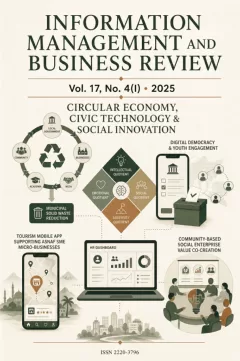 Vol. 17 No. 4(I) (2025)
Circular Economy, Civic Technology & Social Innovation
View issue contents
Published
Submissions
Have research to publish? Information Management and Business Review welcomes submissions.
Make a Submission