Abstract
This study examines resident satisfaction within the Program Perumahan Rakyat (PPR), a primary government initiative in Malaysia designed to provide the B40 low-income group with affordable and sustainable housing. As housing is recognized as a fundamental human right essential for social and economic stability, evaluating the success of such public programs through the lens of resident well-being is critical for future urban planning. The purpose of this research is to assess the level of satisfaction among residents regarding their living conditions and the facilities provided under the program. Guided by Maslow’s hierarchy of needs, the study focuses on three key dimensions: physical characteristics of the housing unit, safety needs, and social needs. Data was collected from 212 residents at PPR Paya Nahu, Kedah, using a quantitative approach. The findings indicate that while all variables correlate positively with resident satisfaction, the physical characteristics of the house—such as unit size, layout, and ventilation—emerge as the most influential factors. Conversely, safety needs recorded the lowest satisfaction levels, highlighting significant concerns regarding security and criminal activity in the area. This research contributes a holistic, need-based model to the literature on public housing, offering a structure for policymakers and managers to design more effective interventions that balance physical functionality with security and community cohesion.
Keywords
- Public Housing Search this journal for Public Housing (opens in a new tab)
- Physical Housing Characteristics Search this journal for Physical Housing Characteristics (opens in a new tab)
- Program Perumaham Rakyat Search this journal for Program Perumaham Rakyat (opens in a new tab)
- Safety Needs Search this journal for Safety Needs (opens in a new tab)
- Maslow Hierarchy of Needs Search this journal for Maslow Hierarchy of Needs (opens in a new tab)
- Malaysia Search this journal for Malaysia (opens in a new tab)
References
- Abdul Ghani, S. (2008). Neighborhood factors in private low-cost housing in Malaysia. Habitat International, 32(4), 485–494. https://doi.org/10.1016/j.habitatint.2008.01.002 DOI: https://doi.org/10.1016/j.habitatint.2008.01.002
- Aimi, A.A., & Nor Hafizah, M.H. (2020). Determinants of residential satisfaction towards People Housing Program at PPR Melana Indah (Fasa 1), Johor Bahru. Journal of Administrative Science, 17(2), 92–108. https://ir.uitm.edu.my/id/eprint/47373/
- Awang, M., Rahman, M. A. A., Musa, M. K., Ahmad, F. H., & Hamidon, N. (2019). Exploring issues and problems perceived by occupants of Malaysian affordable housing. International Journal of Innovative Technology and Exploring Engineering (IJITEE), 8(8S), 106–110. https://www.ijitee.org/wp-content/uploads/papers/v8i8s/H10680688S19.pdf
- Dam?a, C. I., & Jornet, A. (2021). The unit of analysis in learning research: Approaches for imagining a transformative agenda. Learning, Culture and Social Interaction, 31, 100407. https://doi.org/10.1016/j.lcsi.2021.100407 DOI: https://doi.org/10.1016/j.lcsi.2020.100407
- Durrheim, K. (2004). Research design. In M. Terre Blanche & K. Durrheim (Eds.), Research in practice: Applied methods for the social sciences (pp. 29–53). University of Cape Town Press
- Goh, A. T., &Yahaya, A. (2011). Public low-cost housing in Malaysia: Case studies on PPR low-cost flats in Kuala Lumpur. Journal of Design and Built Environment, 8(1).
- Huang, Z., & Du, X. (2015). Assessment and determinants of residential satisfaction with public housing in Hangzhou, China. Habitat International, 47, 218–230. https://doi.org/10.1016/j.habitatint.2015.01.025 DOI: https://doi.org/10.1016/j.habitatint.2015.01.025
- Husna, S. and Nurizan, Y. (1987). Housing provision and satisfaction of low-income households in Kuala Lumpur. Habitat International, 11(4), 27-38. https://doi.org/10.1016/0197-3975(87)90006-3 DOI: https://doi.org/10.1016/0197-3975(87)90006-3
- Izzad Thaqif, H. (2022, July 22). “Malu dikaitkan dengan nama Colombia.” Berita Harian. https://www.bharian.com.my/berita/nasional/2022/07/979181/malu-dikaitkan-dengan-nama-colombia
- Khazanah Research Institute (2023). PPR Resident Satisfaction Index
- Krejcie, R. V., & Morgan, D. W. (1970). Sample size determination table. Educational and Psychological Measurement, 30, 607-610 DOI: https://doi.org/10.1177/001316447003000308
- Md. Asrul Nasid & Nurul Fatihah (2024). KEPUASAN PENGHUNI PROGRAM PERUMAHAN RAKYAT TERHADAP FASILITI: MITOS ATAU REALITI? BERNAMA. https://www.bernama.com/bm/tintaminda/news.php?id=2298616
- Mohammad Abdul, M., Mansor, I., & Yong Razidah, R. (2010). Assessment of residential satisfaction of newly designed public low-cost housing in Kuala Lumpur, Malaysia. Habitat International, 34(1), 18–27. doi.org/10.1016/j.habitatint.2009.04.002 DOI: https://doi.org/10.1016/j.habitatint.2009.04.002
- Murthy, S. N., & Bhojanna, U. (2009). Business research methods. Excel Books India.
- Mustaqim, Y. (2012). Kepuasan Penduduk Program Perumahan Rakyat Terhadap Kualiti Perumahan Kajian Kes: Projek Perumahan Rakyat Sri Iskandar, Pasir Pelangi, Johor Bharu dan Projek Perumahan Rakyat Desa Mutiara, Tebrau, Johor Bharu. Tesis Master, Universiti Teknologi Malaysia. http://eprints.utm.my/34636/5/MustaqimYusofMFAB2012.pdf
- National Affordable Housing Policy. (2019). Prime Minister’s Office of Malaysia. https://www.pmo.gov.my/2019/07/national-affordable-housing-policy/
- Norjanna, J., & Lau, J. L. (2024). FAKTOR MEMPENGARUHI KEPUASAN PERUMAHAN DALAM KALANGAN PENDUDUK RUMAH KOS RENDAH (PPR) DI TAWAU, SABAH. Jurnal Pengguna Malaysia, 36, 55–80. Retrieved from https://jpmjurnal.com/jpm/article/view/84
- Norazmawati, M. N., & Siti Nur Fatihah, M. (2021). Good housing conditions: A study on residents' satisfaction in low-cost housing at Flat Buluh Kubu, Kota Bharu, Kelantan. Jurnal Alam Bina, 25(1), 1–12.
- Othman, Y. (2022). 400 rumah “Flat Columbia” Sungai Petani diserbu polis. Utusan Malaysia. https://www.utusan.com.my/nasional/2022/07/400-rumah-flat-columbia-sungai-petani-diserbu-polis/
- Raslim, F. M., Ibrahim, B. B., Ariffin, H.L.T., & Yong, F. (2020). Affordable Housing: Singapore Housing Policies Analysis and Its Implementation in Malaysia. International Journal of Management (IJM), 11(7),1028.
- Sekaran, U., & Bougie, R. (2016). Research Methods for Business: A Skill-Building Approach (7th ed.).
- UN-Habitat. (2010). Fact sheet no. 21: Adequate housing as a component of the right to an adequate standard of living. https://unhabitat.org/sites/default/files/documents/2019/05/fact_sheet_21_adequate_housing_final_2010.pdf
- Zawawi, Z., Azizan, S. I., Muhamad Hakimi, N. I., Rusli, N., Mohd Yusof, N. & Zamhury, N. (2019). Kajian kes: sosio ekonomi penduduk Projek Perumahan Rakyat (PPR) Paya Nahu, Sungai Petani Kedah. Voice of Academia (VOA), 15(3), 50-58. https://ir.uitm.edu.my/id/eprint/35265/
Downloads
Full-text downloads recorded for this article, by month.
No downloads have been recorded for this article yet. Figures appear here once readers begin downloading the full text.
How to Cite
Share this article
License
Copyright (c) 2026 Intan Syahriza Azizan, Atiqah Jasmi, Nur Ain Izzati Mohd Nasir, Nur Hasya Alya Kamarol Zaman, Nurul Asyiqin Abd Aziz, Junaida Ismail (Author)

This work is licensed under a Creative Commons Attribution 4.0 International License.
Author (s) should affirm that the material has not been published previously. It has not been submitted and it is not under consideration by any other journal. At the same time author (s) need to execute a publication permission agreement to assume the responsibility of the submitted content and any omissions and errors therein. After submission of revised paper in the light of suggestions of the reviewers, the editorial team edits and formats manuscripts to bring uniformity and standardization in published material.
This work will be licensed under Creative Commons Attribution 4.0 International (CC BY 4.0) and under condition of the license, users are free to read, copy, remix, transform, redistribute, download, print, search or link to the full texts of articles and even build upon their work as long as they credit the author for the original work. Moreover, as per journal policy author (s) hold and retain copyrights without any restrictions.
Keywords
- Public Housing Search this journal for Public Housing (opens in a new tab)
- Physical Housing Characteristics Search this journal for Physical Housing Characteristics (opens in a new tab)
- Program Perumaham Rakyat Search this journal for Program Perumaham Rakyat (opens in a new tab)
- Safety Needs Search this journal for Safety Needs (opens in a new tab)
- Maslow Hierarchy of Needs Search this journal for Maslow Hierarchy of Needs (opens in a new tab)
- Malaysia Search this journal for Malaysia (opens in a new tab)
Section
Published in
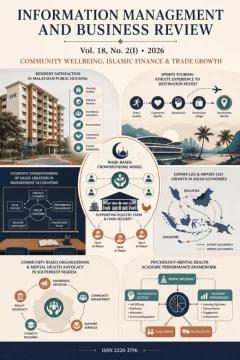 Vol. 18 No. 2(I) (2026)
Community Wellbeing, Islamic Finance & Trade Growth
View issue contents
Published
Submissions
Have research to publish? Information Management and Business Review welcomes submissions.
Make a Submission