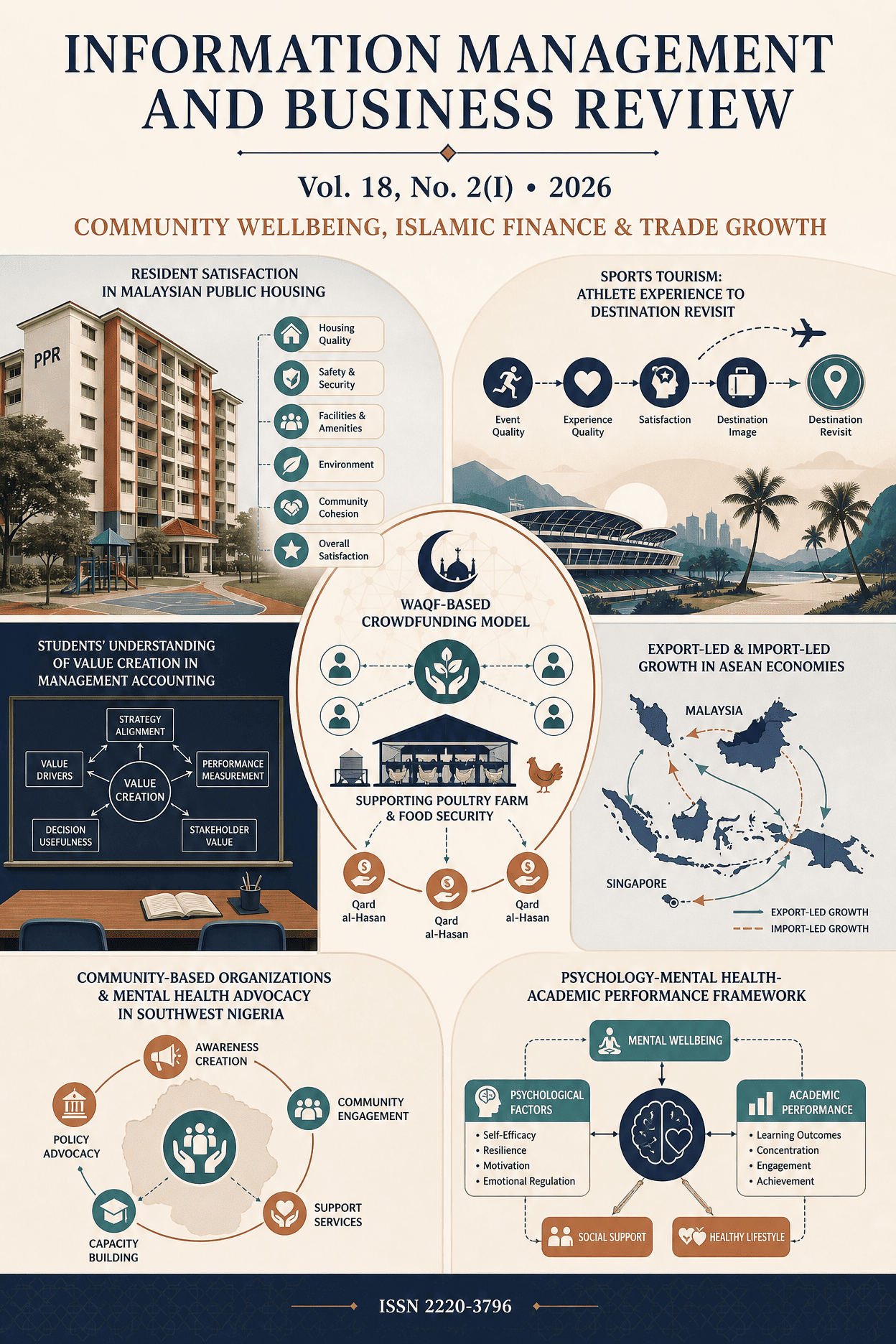
Articles

  • Article 1 in this issue

    Determinants of Resident Satisfaction in Public Housing: A Case Study of Program Perumahan Rakyat (PPR) Paya Nahu, Malaysia

    • Author: Intan Syahriza Azizan, Atiqah Jasmi, Nur Ain Izzati Mohd Nasir, Nur Hasya Alya Kamarol Zaman, Nurul Asyiqin Abd Aziz, Junaida Ismail

    This study examines resident satisfaction within the Program Perumahan Rakyat (PPR), a primary government initiative in Malaysia designed to provide the B40 low-income group with affordable and sustainable housing. As housing is recognized as a fundamental human right essential for social and economic stability, evaluating the success of such public programs through the lens of resident well-being is critical for future urban planning. The purpose of this research is to assess the level of satisfaction among residents regarding their living conditions and the facilities provided under the program. Guided by Maslow’s hierarchy of needs, the study focuses on three key dimensions: physical characteristics of the housing unit, safety needs, and social needs. Data was collected from 212 residents at PPR Paya Nahu, Kedah, using a quantitative approach. The findings indicate that while all variables correlate positively with resident satisfaction, the physical characteristics of the house—such as unit size, layout, and ventilation—emerge as the most influential factors. Conversely, safety needs recorded the lowest satisfaction levels, highlighting significant concerns regarding security and criminal activity in the area. This research contributes a holistic, need-based model to the literature on public housing, offering a structure for policymakers and managers to design more effective interventions that balance physical functionality with security and community cohesion.

    Pages 1-10

    PDF - Determinants of Resident Satisfaction in Public Housing: A Case Study of Program Perumahan Rakyat (PPR) Paya Nahu, Malaysia (opens in a new tab)
  • Article 2 in this issue

    Waqf-Based Crowdfunding for Non-Ruminant Livestock: A Qard al-Hasan Model for Sustainable Food Security in Malaysia

    • Author: Rahmawati Mohd Yusoff, Wan Amir Azlan Wan Haniff, Zulhazmi Yusof, Azhani Arshad, Sharifah Zubaidah Syed Abdul Kader, Redwan Yasin

    This study looks into the possibility of waqf-based crowdfunding as a different way to get money to help develop non-ruminant livestock, especially poultry, in Malaysia. Even though the sector is becoming increasingly important to national food security, farmers face significant financial challenges, including high capital costs and limited access to traditional financing. At the same time, waqf funds are still not being used enough in productive sectors. This study finds important legal, institutional, and operational problems by using a qualitative method that combines doctrinal and non-doctrinal analysis, such as interviews and a Focus Group Discussion (FGD). The results show that there is a regulatory gap and broken governance that make it hard to implement waqf crowdfunding. In response, the study suggests a model that combines one-time waqf funding for infrastructure with Qard al-Hasan funding for operations. This model provides a long-term, Shariahcompliant solution that helps farmers, increases access to financial services, and helps improve food security .

    Pages 11-18

    PDF - Waqf-Based Crowdfunding for Non-Ruminant Livestock: A Qard al-Hasan Model for Sustainable Food Security in Malaysia (opens in a new tab)
  • Article 3 in this issue

    A Study on the Influence of Sports Experience on Tourism Behaviors

    • Author: Chao-Chin Liu, Shumin Chang, Azdel Abdul Aziz, Che-Jen Chuang, Xuanmin Zhu

    Sports participation has gradually become a core component of modern tourism development. Both sports activities and tourism consumption place a high value on experiential perception and active participant involvement. This paper aims to explore the effect of individual sports experience on tourists’ overall travel experience, satisfaction level, willingness to engage in sports tourism, and destination revisit intention in the background of domestic tourism. Based on existing scholarly findings, this study developed measurement scales for key research variables and surveyed Taiwan residents aged 18 and above who had travelled domestically in the past year. Through purposive sampling, 695 valid responses were collected for empirical analysis. The analytical results reveal that sports experience is significantly and positively correlated with tourism experience, tourist satisfaction, sports tourism participation willingness, and revisit intention. This study further verifies that experiential participation in sports plays a vital role in shaping tourists’ behavioral tendencies and their subjective evaluation of tourism destinations.

    Pages 19-32

    PDF - A Study on the Influence of Sports Experience on Tourism Behaviors (opens in a new tab)
  • Article 4 in this issue

    Exploring Students’ Early Understanding of Value Creation in Management Accounting: A Qualitative Classroom-Based Study

    • Author: Raja Adzrin Raja Ahmad, Noor Hidayah Ab Aziz, Nurul Azlin Azmi, Nor Balkish Zakaria

    This study investigates how students at the beginning of the learning process develop the knowledge of value creation in management accounting following a simple lesson in the classroom. The study has been carried out using a qualitative classroom-based design by analysing the written responses of 24 students enrolled in a Management Accounting class. The data were gathered using open-ended questions that elicited responses from the students regarding the definition of value creation, the role of management accounting information in managerial decision making and suggestions for teaching methods to enhance their understanding of management accounting information. Thematic analysis was used to analyse the responses. The findings reveal that the students' early knowledge of value creation was predominantly financially related, with the majority of students linking value creation with profit, costs, benefits and efficient use of resources. Other students showed more of a sense of the wider picture by making connections between value creation and customers, stakeholders, quality, sustainability and long-term business performance. Students also saw management accounting information as a support to cost analysis, pricing, profitability and decision making. Students recommended that using real-world examples, practice exercises, providing a clearer explanation, summarizing content, and speaking more slowly would help them understand the material. The study reveals that students are starting to understand that there is more to value creation than just money and that management accounting has a broader and more practical dimension as a decision-making tool.

    Pages 33-46

    PDF - Exploring Students’ Early Understanding of Value Creation in Management Accounting: A Qualitative Classroom-Based Study (opens in a new tab)
  • Article 5 in this issue

    The Export-Led and Import-Led Growth Hypothesis Test in Malaysia, Indonesia and Singapore

    • Author: Mohd Shahrol Nizam Mt Nor, Norimah Rambeli

    There are various discussions on the hypothesis of export-led growth, but due to different methods, the results are controversial. Nonetheless, this research aims to examine the short-run and long-run relationships between exports, imports, services, and economic growth of Malaysia, Indonesia and Singapore in the time range from January 2010 to December 2021. The dynamic analysis approach utilized in this study is the Vector Error Correction Model (VECM) to investigate whether Malaysia, Indonesia and Singapore are export-led growth (ELGH) or import-led growth hypothesis (ILGH) during the selected period. The findings indicate that, in addition to imports and economic growth, both countries show that there is a bilateral relationship between exports and economic growth in the short-run and long run. Thus, international trade is the engine of rapid growth, where the hypothesis of export-oriented growth and the hypothesis of importoriented growth are reasonable. Therefore, the policymakers should ease the trade barrier to encourage trade liberalization and foreign investment, besides controlling the trade services.

    Pages 47-66

    PDF - The Export-Led and Import-Led Growth Hypothesis Test in Malaysia, Indonesia and Singapore (opens in a new tab)
  • Article 6 in this issue

    Community-Based Organizations’ Service Delivery in Civic Leadership Engagement Towards Mental Health Awareness in The South-West Zone, Nigeria

    • Author: Ronke Iyabo ADEDUNTAN, Bernadette Erobere IREWOLE

    Mental health is foundational to human productivity and national development. Grassroots civic actors are essential to bridge the health service where there is scarcity. Quality health service delivery, therefore, is not just for hospitals and elites, but rather it requires multidimensional collaboration with community-based organizations (CBOs) via visionary leadership. This study explored the roles of civil organizations in mental health advocacy in Nigeria’s Southwest geo-political zone. Three research questions and one hypothesis were evaluated using a descriptive survey design. A multistage and convenient sampling technique was used, resulting in 200 samples. Researchers engaged a self-designed, 15-item questionnaire for data collection. The study’s contribution showed that community-based organizations significantly contribute to mental health support at 71.5%, bridging the health gap in rural areas. CBO's effectiveness was rated strong at 79.4% level. Furthermore, the report established that groups collaborate with public health centers to enhance mental health support in the Southwest of Nigeria. Based on the findings, the study recommended that policymakers in the health sector should formally incorporate CBOs' roles as an essential, assistive service for mental health in rural communities. There should also be a strategic public-private partnership with a designed framework to increase funding and capacity-building for organizations. The study concluded that the professional delivery capacity of groups requires training and retraining in prioritizing mental health advocacy to enhance citizens’ capacity for nation-building in Nigeria.

    Pages 67-75

    PDF - Community-Based Organizations’ Service Delivery in Civic Leadership Engagement Towards Mental Health Awareness in The South-West Zone, Nigeria (opens in a new tab)
  • Article 7 in this issue

    Conceptual Framework on the Interplay Between Basic Psychology, Mental Health and Academic Performance

    • Author: Noor Hasniza Haron, Mazurina Mohd Ali, Maz Ainy Abdul Azis

    Academic performance is a multidimensional parameter that extends beyond cognitive ability and includes emotional, behavioural, and psychological aspects of students’ learning. It is the product of the knowledge and skills students possess and is the basis for them to pursue a higher education and career as well as lifelong learning. While most of us think of cognitive capabilities as the main determinants of academic success, there is growing evidence that psychological characteristics and mental health are equally important as well. In this paper, we conceptualise the interplay of the basic psychological characteristics, such as cognitive skills, personality and motivation, and mental health factors (e.g., anxiety, depression and emotional wellbeing), and what influences students' academic achievement in school. By incorporating all of the psychological theories (i.e., Self-Determination Theory, Social Cognitive Theory and Broaden-and-Build Theory), we have developed an integrated theory to explain the interplay of psychological and mental health in academic achievement. This paper contributes to the literature through the application of these theoretical frameworks to show how self-efficacy, self-regulated learning, and affective states are the most important mediating factors in psychological attributes and mental health in academic achievement. It also challenges conventional educational paradigms in the sense that emotional well-being and psychological resilience are cognitive and academic success factors rather than just the outcome of an individual's achievement. This conceptual paper provides a powerful overview of psychological factors in academic performance and is very useful to students (and higher education institutions) and policymakers for improving student well-being and academic performance.

    Pages 76-85

    PDF - Conceptual Framework on the Interplay Between Basic Psychology, Mental Health and Academic Performance (opens in a new tab)