Abstract
This study looks into the possibility of waqf-based crowdfunding as a different way to get money to help develop non-ruminant livestock, especially poultry, in Malaysia. Even though the sector is becoming increasingly important to national food security, farmers face significant financial challenges, including high capital costs and limited access to traditional financing. At the same time, waqf funds are still not being used enough in productive sectors. This study finds important legal, institutional, and operational problems by using a qualitative method that combines doctrinal and non-doctrinal analysis, such as interviews and a Focus Group Discussion (FGD). The results show that there is a regulatory gap and broken governance that make it hard to implement waqf crowdfunding. In response, the study suggests a model that combines one-time waqf funding for infrastructure with Qard al-Hasan funding for operations. This model provides a long-term, Shariahcompliant solution that helps farmers, increases access to financial services, and helps improve food security .
Keywords
- Qard Search this journal for Qard (opens in a new tab)
- Blended Finance Search this journal for Blended Finance (opens in a new tab)
- Shariah-Compliant Investment Search this journal for Shariah-Compliant Investment (opens in a new tab)
- CAPEX Search this journal for CAPEX (opens in a new tab)
- SDG Search this journal for SDG (opens in a new tab)
References
- Abd Rahman, A. A., & Awang, A. B. (2018). Exploring the dynamics of cash Waqf: A critical analysis of its implementation in Malaysia. Intellectual discourse, 1109-1128.
- Abdullah, R., Basir, K. H., & Abdul Halim, N. H. (2022). Challenges of Waqf Land Development in Brunei Darussalam. In Islamic Philanthropy: Exploring Zakat, Waqf, and Sadaqah in Islamic Finance and Economics (pp. 75-91). Cham: Springer International Publishing.
- Aldeen, K. N., Ratih, I. S., & Herianingrum, S. (2020). Contemporary issues on cash waqf: A review of the literature. International Journal of Islamic Economics and Finance (IJIEF), 3(2), 119-144.
- Azganin, H., Kassim, S., & Sa'ad, A. A. (2021). Proposed waqf crowdfunding models for small farmers and the required parameters for their application. Islamic Economic Studies, 29(1), 2-17.
- Avedta, S. (2023). Review of Waqf in the Ottoman Empire. Islamic Economics and History, 2(1).
- Azlan, W. A., Haniff, W., Hakimah, A., Halim, A., & Ismail, R. (2019). Equity crowdfunding in Malaysia: Legal and Sharia challenges.
- Daud, D. (2019). The role of Islamic governance in the reinforcement of waqf reporting: SIRC Malaysia case. Journal of Islamic Accounting and Business Research, 10(3), 392-406.
- Ghazali, N. M., & Mamat, N. (2023). Discrepancy of cash waqf meaning: A critical review with special focus on selected Shariah resolutions. International Journal of Academic Research in Business and Social Sciences, 13(7), 19-38.
- Haniff, W. A. A. W., Markom, R., Ismail, W. M. A. B. W., & Zainoddin, A. I. (2023). Optimising under-utilised waqf assets in Malaysia through social entrepreneurship. International Journal of Asian Social Science, 13(1), 1-13.
- Haniff, W. A. A., Yasin, R., Mohd Yusoff, R., Ab Halim, A. H., Markom, R., & Abd Rashid, A. H. (2025). Integrating Islamic Fintech and Smart Contracts for Enhancing Governance in Waqf Asset Management. Advances in Social Sciences Research Journal, 12(09), 77–84. https://doi.org/10.14738/assrj.1209.19183
- Haniff, W. A. A. W., Annuar, A., Okonjo, J., Yusoff, R. M., & Ab Halim, A. H. (2024). Fostering Business Sustainability Through the Integration of Charitable Endowment (Waqf) and Equity Crowdfunding: Perspectives from Malaysia and the United Kingdom. In The Digital Edge: Transforming Business Systems for Strategic Success: Volume 2 (pp. 497-506). Cham: Springer Nature Switzerland.
- Ibrahim, H., Amir, A., & Masron, T. A. (2013). Cash waqf: An innovative instrument for economic development. International Review of Social Sciences and Humanities, 6(1), 1-7.
- Iman, N., Santoso, A., & Kurniawan, E. (2021). Wakif's behavior in money waqf: An approach to the theory of planned behavior. Ekuilibrium: Jurnal Ilmiah Bidang Ilmu Ekonomi, 16(1), 12-23.
- Lahuri, S. B., & Lutfiah, A. (2024). Optimization of Cash Waqf-Based Crowdfunding: An Alternative Finance for Quality Education. Journal of Islamic Economics and Finance Studies, 5(1), 153-172.
- Marjaei, S., Yazdi, F. A., & Chandrashekara, M. (2019). MAXQDA and Its Application to LIS Research. Library Philosophy and Practice, 1-9.
- Qurrata, V. A., Yusida, E., Hussain, N. E., Merlinda, S., Purnamasari, V., & Seprillina, L. (2021). Effectiveness of cash waqf management in improving community welfare: Challenges and opportunities. Review of Integrative Business and Economics Research, 10, 342-359.
- Syamsuri, S., bin Lahuri, S., Bakri, W., Fatoni, A., & Wibowo, H. S. (2021). Strategy for improving the quality of waqf institutions through good waqf governance. Al-Iktisab: Journal of Islamic Economic Law, 5(1), 22-36.
- Suhaili, N. A., & Palil, M. R. (2016). Crowdfunding: A collaborative waqf-based internet platform. International Journal of Business, economics and law, 11(5), 41-46.
- Syamsul, E. M., & Munir, M. M. (2023). Digital Platform; Real-time Monitoring and Performance Analysis of Waqf Funds. Journal I-Philanthropy: A Research Journal on Management of Zakat and Waqf, 3(2), 131-137.
Downloads
No downloads have been recorded for this article yet. Figures appear here once readers begin downloading the full text.
How to Cite
Share this article
License
Copyright (c) 2026 Rahmawati Mohd Yusoff, Wan Amir Azlan Wan Haniff, Zulhazmi Yusof, Azhani Arshad, Sharifah Zubaidah Syed Abdul Kader, Redwan Yasin (Author)

This work is licensed under a Creative Commons Attribution 4.0 International License.
Author (s) should affirm that the material has not been published previously. It has not been submitted and it is not under consideration by any other journal. At the same time author (s) need to execute a publication permission agreement to assume the responsibility of the submitted content and any omissions and errors therein. After submission of revised paper in the light of suggestions of the reviewers, the editorial team edits and formats manuscripts to bring uniformity and standardization in published material.
This work will be licensed under Creative Commons Attribution 4.0 International (CC BY 4.0) and under condition of the license, users are free to read, copy, remix, transform, redistribute, download, print, search or link to the full texts of articles and even build upon their work as long as they credit the author for the original work. Moreover, as per journal policy author (s) hold and retain copyrights without any restrictions.
Keywords
- Qard Search this journal for Qard (opens in a new tab)
- Blended Finance Search this journal for Blended Finance (opens in a new tab)
- Shariah-Compliant Investment Search this journal for Shariah-Compliant Investment (opens in a new tab)
- CAPEX Search this journal for CAPEX (opens in a new tab)
- SDG Search this journal for SDG (opens in a new tab)
Section
Published in
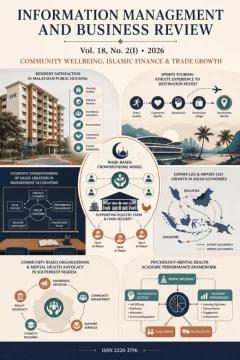 Vol. 18 No. 2(I) (2026)
Community Wellbeing, Islamic Finance & Trade Growth
View issue contents
Published
Submissions
Have research to publish? Information Management and Business Review welcomes submissions.
Make a Submission