Abstract
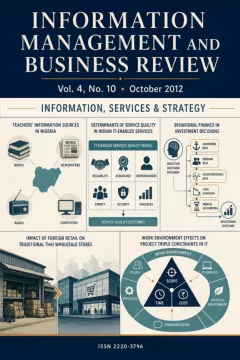
The study examined sources of information for teachers in social studies and their level of usage in secondary schools. The design of this study was descriptive of survey type. Data was collected from twentyfour (24) secondary schools and was randomly selected from Abeokuta north local government and Abeokuta south local government area of Ogun state, Nigeria. Ninety-seven (97) secondary schools female and male teachers of different age- grades, qualifications and experience were used as sample. Questionnaire was made use of for data collection. The questionnaire was the close-ended likert- type technique that expresses degree of agreement or disagreement with he supplied statement. Data was analyzed using standard deviation, students- t-test statistics, mean and rank order. The findings of the study revealed that, teachers’ sources of information for social studies include reference materials, newspapers, journals, literary materials, historical monuments and artefacts, television, textbooks, resource person, magazines, pamphlet, bulletins and radio. Computer component, such as e-mail, file transfer protocol, World Wide Web (www) rarely used by social studies teachers. Recommendations were made which includes computer training be provided for social studies teachers at all level of education in Nigeria and modern information centers with integrated circuits and digital communication to link schools should be provided at local levels for the use of teachers, particularly for social studies teachers.
Keywords
- Information Search this journal for Information (opens in a new tab)
- Social Studies Teachers Search this journal for Social Studies Teachers (opens in a new tab)
- Communication Search this journal for Communication (opens in a new tab)
- Sources Search this journal for Sources (opens in a new tab)
- Computer Component Search this journal for Computer Component (opens in a new tab)
References
- Adekeye, R. B. (2008). Social Studies Curriculum Lecture Materials on SSE 402 Unpublished
- Adekunle, M. O. (2003). Sources of Information for Social Studies Teachers and Challenges for Computer Education. Nigerian Journal of Social Studies , VIII, 13-16.
- Adeyanju, J. L. (2003). Teachers Perception of the Effects and use of Learning Aids in Teaching: A Case Study of Winneba Basic and Secondary Schools in Ghana. Retrieved from internet www.google.com on 10th July 2008.
- Ahmed, Y. A. & Ahmed, H. A. (2005). Utilization and Benefits of Instructional Media in Teaching Social Studies Courses as Perceived by Omani Students. Malaysian Online Journal of Instructional Technology, 2(1), 1823-1144.
- Akintunde, S. A. (2003). The Social Studies Teacher and Global Information Dissemination I the Classroom. Nigerian Journal of Social Studies, VIII, 108-113.
- Anyanwu, J. M. (2003). The Effectiveness of Instructional Materials in Teaching of Social Studies in Some Selected Post Primary School in Owerri Educational Zone Imo State. (B.ed) Research Project Unpublished.
- Babalola, J. E. (1999). The Computer as an Instructional Medium I the Benedict Niyi Teaching/Learning Process. Students in Education , 3(152), 25-32.
- Ololube, N. P. (2006). Teachers Instructional Material Utilization Competencies in Secondary Schools in SubSaharan Africa: Professional and Non-Professional Teachers’ Perspective. In Conference Proceedings of the 6th International Educational Technology Conference from www.goggle.com/search.
- Osakewe, E. O. & Itejare, P. O. (1993). Social Studies for Tertiary Students in Nigeria. Enugu, New Age Publishers.
- Osofisan, A. O. (1998). Interest Information Super Highway. Nigeria Journal of Library Achieves and Information Science , 10(1), 34-41.
- Radlowed, D. (1986). Computer and Information Society, New York, McGraw Hill Books Inc.
- Shinbanda, G. G. (2002). Managing and Strategizing Africa’s Information in Global Computerization. African Journal of Library Achieves and Information Science , 10(1) 34–41.
- Yusuf, M. O. (1998). A Study of the Dimensions of Teachers Attitude towards Computer Education in Nigeria Secondary Schools. Nigerian Journal of Computer Literacy , 21(1), 47-58.
Downloads
No downloads have been recorded for this article yet. Figures appear here once readers begin downloading the full text.
How to Cite
Share this article
License
Copyright (c) 2012 Adediran Adekunle Amos, Y. Abdukareem (Author)

This work is licensed under a Creative Commons Attribution 4.0 International License.
Author (s) should affirm that the material has not been published previously. It has not been submitted and it is not under consideration by any other journal. At the same time author (s) need to execute a publication permission agreement to assume the responsibility of the submitted content and any omissions and errors therein. After submission of revised paper in the light of suggestions of the reviewers, the editorial team edits and formats manuscripts to bring uniformity and standardization in published material.
This work will be licensed under Creative Commons Attribution 4.0 International (CC BY 4.0) and under condition of the license, users are free to read, copy, remix, transform, redistribute, download, print, search or link to the full texts of articles and even build upon their work as long as they credit the author for the original work. Moreover, as per journal policy author (s) hold and retain copyrights without any restrictions.
Keywords
- Information Search this journal for Information (opens in a new tab)
- Social Studies Teachers Search this journal for Social Studies Teachers (opens in a new tab)
- Communication Search this journal for Communication (opens in a new tab)
- Sources Search this journal for Sources (opens in a new tab)
- Computer Component Search this journal for Computer Component (opens in a new tab)
Section
Published
Submissions
Have research to publish? Information Management and Business Review welcomes submissions.
Make a Submission