Articles

  • Article 1 in this issue

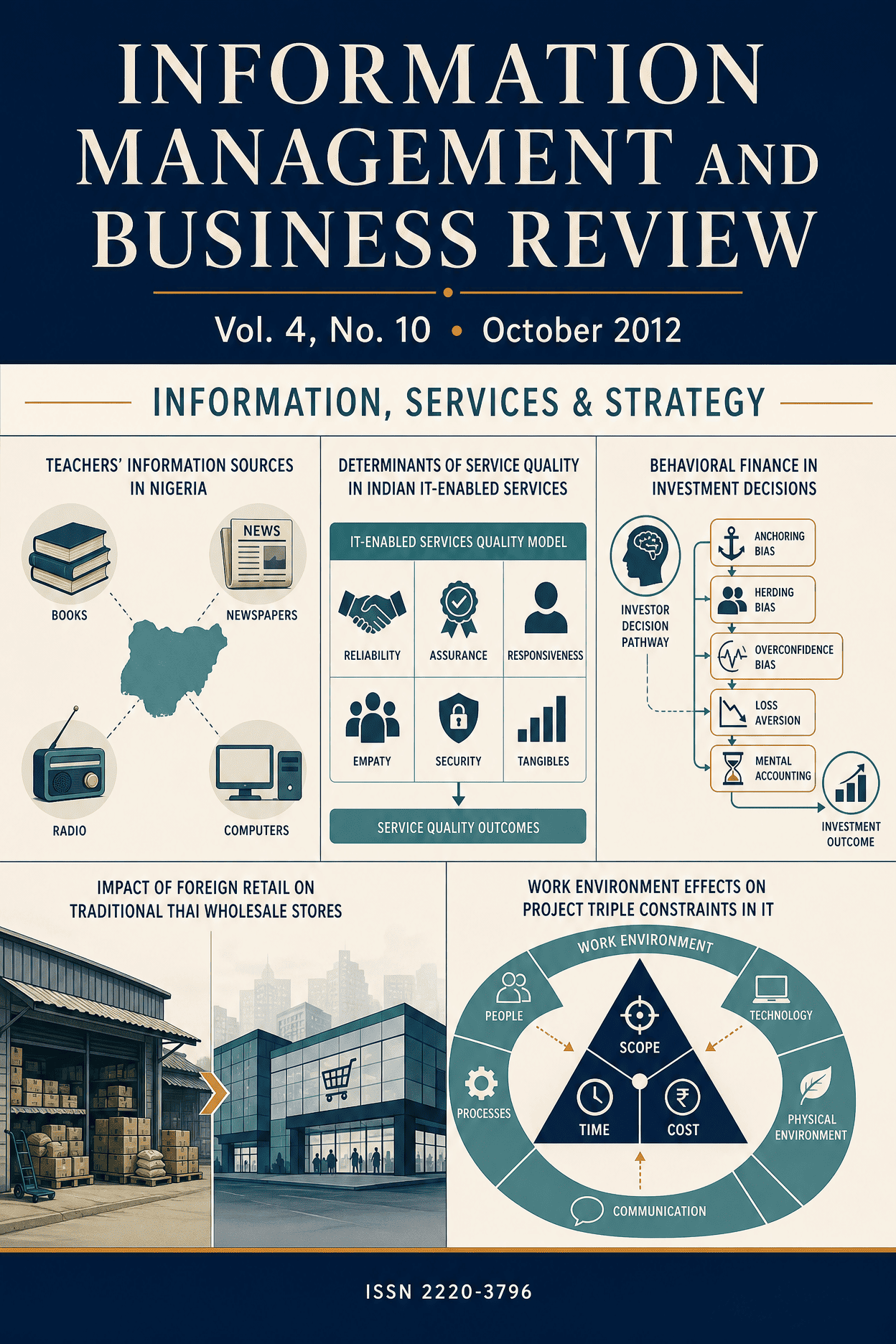
    Sources of Information for Social Studies Teachers and their Level of usage in Abeokuta, Ogun State Nigeria

    • Author: Adediran Adekunle Amos, Y. Abdukareem

    The study examined sources of information for teachers in social studies and their level of usage in secondary schools. The design of this study was descriptive of survey type. Data was collected from twentyfour (24) secondary schools and was randomly selected from Abeokuta north local government and Abeokuta south local government area of Ogun state, Nigeria. Ninety-seven (97) secondary schools female and male teachers of different age- grades, qualifications and experience were used as sample. Questionnaire was made use of for data collection. The questionnaire was the close-ended likert- type technique that expresses degree of agreement or disagreement with he supplied statement. Data was analyzed using standard deviation, students- t-test statistics, mean and rank order. The findings of the study revealed that, teachers’ sources of information for social studies include reference materials, newspapers, journals, literary materials, historical monuments and artefacts, television, textbooks, resource person, magazines, pamphlet, bulletins and radio. Computer component, such as e-mail, file transfer protocol, World Wide Web (www) rarely used by social studies teachers. Recommendations were made which includes computer training be provided for social studies teachers at all level of education in Nigeria and modern information centers with integrated circuits and digital communication to link schools should be provided at local levels for the use of teachers, particularly for social studies teachers.

    Pages 517-522

    PDF - Sources of Information for Social Studies Teachers and their Level of usage in Abeokuta, Ogun State Nigeria (opens in a new tab)
  • Article 2 in this issue

    Determinants of Service Quality in High-end IT Enabled Services: An Indian Perspective

    • Author: Vandana Srivastava, Subhash Datta, A. Sharfuddin, Sanjeev Kishore

    IT enabled Services (ITeS) have charted tremendous growth in India over the last two decades. Over the years, the service domain has evolved to include high-end services as well as traditional services. Along with fresh opportunities, the evolving service landscape brings new challenges for the service providers, with quality being the prime challenge. As the nature of services change, new determinants of service quality emerge. Towards this aim, this research paper presents a fresh perspective of determinants of service quality in high-end ITeS by integrating elements from traditional service quality models and frameworks with issues related to technology and organizational relationship management. The research involves a two-phase study. Findings from the literature survey and a qualitative study are used to identify the determinants of service quality and to create a hypothetical model. Based on data collected from senior executives of Indian service providers, the second phase of the study presents a regression model of the determinants. The combined linear effects of the determinants were found to account for 76.8% of the variation in success of high-end ITeS projects. The regression model highlights the critical and significant role played by Knowledge Management, Technology Management and Service Design and Delivery in service quality. The findings further highlight the potential of mechanisms for capturing and re-using organizational learning in reducing service quality gaps. The strategic implications presented in the paper will provide a starting point for service providers aiming to engage in providing high-end IT-enabled Services.

    Pages 523-531

    PDF - Determinants of Service Quality in High-end IT Enabled Services: An Indian Perspective (opens in a new tab)
  • Article 3 in this issue

    Implication of Behavioral Finance in Investment Decision-making Process

    • Author: Agha Jahanzeb, Saqib Muneer, Saif-ur-Rehman

    Behavioral finance is a structure that supplements some parts of standard finance and replaces other parts. It portrays the behavior of investors and management in decision-making; it illustrates the outcomes of interactions between investors and managers in financial and capital markets. As decisionmaking is an art to undertake complex situations and investors make irrational decisions during their investments. Therefore, it is a unique art to choose a certain alternative from various alternatives available. Although behavioral finance does not claim that every investor would suffer from similar illusion, instead it sheds light on to take necessary initiatives to avoid such illusions, which influence the process of decision-making, particularly while making investments.

    Pages 532-536

    PDF - Implication of Behavioral Finance in Investment Decision-making Process (opens in a new tab)
  • Article 4 in this issue

    The Impact of Foreign Retail and Wholesale Stores on Traditional Wholesale Stores in Nonthaburi Province, Thailand

    • Author: Supitcha Cheevapruk, John Walsh

    The entrance of foreign retail and wholesale businesses in Thailand started some ten years ago and led to the closure of many Thai wholesale stores. The objective of this study is to determine the needs of Thai wholesalers in the Nonthaburi area and to identify suitable strategies for relevant managers to be able to compete with contemporary commercial strategies of the foreign enterprises. A total of 114 of the 120 Thai traditional wholesale stores in Nonthaburi were surveyed by questionnaire and results were analyzed by statistical means. It was found that low price strategy, location of store and full cycle service strategies were the principal approaches employed by the managers of the foreign wholesale and retail stores. Tesco Lotus was the foreign venture with the greatest impact on the Thai environment. With respect to managerial approach, it was found that Thai traditional wholesale stores should try to build stronger relationships with customers and regularly search for new markets. Employee performance should also be taken into consideration to some extent. Other issues of importance included the presentation of the store and visual merchandising, as well as transparency in management systems and the need for well–organized financial and accounting systems and their proper control.

    Pages 537-544

    PDF - The Impact of Foreign Retail and Wholesale Stores on Traditional Wholesale Stores in Nonthaburi Province, Thailand (opens in a new tab)
  • Article 5 in this issue

    Work Environment and its Impact on Triple Constraint of Project Management

    • Author: Syed Ali Raza Hamid, Hateem Adnan Ghafoor, Tamkeen Zehra Shah

    Project management’s fundamental concern is to effectively manage its triple constraints throughout the life cycle of a project to maximize productivity. At the same timework environment is considered a key feature, which influences the framework of project management. The present study assesses the impact of the work environment on the triple constraints (Scope, Time and Cost) of projects in the IT industry. The theoretical framework comprises Remuneration, Job Satisfaction, Job Security, and Working Hours as components of work environment and triple constraints as the dependent variable. Three hundred Project Managers across a number of IT firms have been approached, out of which 279 have responded to the questionnaire. The measurement tool has been developed by the researcher except for one construct, which has been adopted, followed by a pilot study. Inferential statistics have been applied to test the data. The study concludes that all project managers view a flexible and conducive work environment as bearing a strong relationship with the triple constraint of project management.

    Pages 545-552

    PDF - Work Environment and its Impact on Triple Constraint of Project Management (opens in a new tab)