Abstract
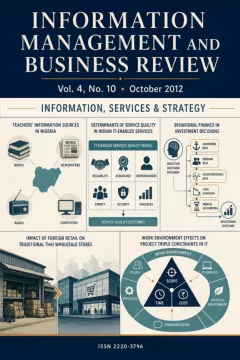
IT enabled Services (ITeS) have charted tremendous growth in India over the last two decades. Over the years, the service domain has evolved to include high-end services as well as traditional services. Along with fresh opportunities, the evolving service landscape brings new challenges for the service providers, with quality being the prime challenge. As the nature of services change, new determinants of service quality emerge. Towards this aim, this research paper presents a fresh perspective of determinants of service quality in high-end ITeS by integrating elements from traditional service quality models and frameworks with issues related to technology and organizational relationship management. The research involves a two-phase study. Findings from the literature survey and a qualitative study are used to identify the determinants of service quality and to create a hypothetical model. Based on data collected from senior executives of Indian service providers, the second phase of the study presents a regression model of the determinants. The combined linear effects of the determinants were found to account for 76.8% of the variation in success of high-end ITeS projects. The regression model highlights the critical and significant role played by Knowledge Management, Technology Management and Service Design and Delivery in service quality. The findings further highlight the potential of mechanisms for capturing and re-using organizational learning in reducing service quality gaps. The strategic implications presented in the paper will provide a starting point for service providers aiming to engage in providing high-end IT-enabled Services.
Keywords
- Service Quality Search this journal for Service Quality (opens in a new tab)
- High-End Services Search this journal for High-End Services (opens in a new tab)
- India Search this journal for India (opens in a new tab)
- Determinants Search this journal for Determinants (opens in a new tab)
- Knowledge Management Search this journal for Knowledge Management (opens in a new tab)
- ITeS Search this journal for ITeS (opens in a new tab)
References
- Alzola, L. C. & Robaina, V. P. (2005). SERVQUAL and its applicability in Electronic Commerce B2C. The Quality Management Journal , 12(4), 46-57.
- Aron, R., Bandyopadhyay, S., Jayanty, S. & Pathak, P. (2008). Monitoring process quality in offshore outsourcing: A model and findings from multi-country survey. Journal of Operations Management , 26(2), 303–321.
- Beaumont, N. & Costa, C. (2002). Information Technology outsourcing in Australia. Information Resources Management Journal , 15(3), 14-31.
- Blanchard, R. F. & Galloway, R. L. (1994). Quality in Retail Banking. International Journal of Service Industry Management , 5(4), 5-23.
- CRISIL Report (2011). http://www.crisil.com/pdf/research/research-industry-information-report-itenabled-services-ites-contents.pdf, accessed on 25 June 2011.
- Devlin, S. J., Dong, H. K. & Brown, M. (2003). Selecting a Scale for Measuring Quality. Marketing Research , 5(3), 13-18.
- Duraivelu, K. & Suryaprakasa Rao, K. (2006). ProducQual- A conceptual model for quality gap analysis across PLC. Journal of Indian Institute of Science, 86(2), 113–124.
- Ganguli, S. & Roy, S. K. (2010). Service quality dimensions of hybrid services. Managing Service Quality , 20(5), 404-424.
- Glynn, W. J., de Burca, S., Brannick T., Fynes, B. & Ennis, S. (2003). Listening Practices and Performance in Service Organizations. International Journal of Service Industry Management , 14(3), 310-330.
- Harmon, E. P., Hensel, S. C. & Lukes, T. E. (2006). Measuring Performance in Services. The McKinsey Quarterly , 14(1), 31-39.
- Hsieh, Y. H., Lin, C. J. & Chen, J. C. (2007). Customer Satisfaction measurement with Neural network. Human Systems Management , 26(1), 47–52. http://www.indiaprline.com/2011/02/17/cii-pwc-report-on-changing-landscape-and-emerging-trendsindian-itites-industry-released-about-the-report/ Accessed on 20.6.2011
- Hyder, E. B., Heston, K. M. & Paulk, M. C. (2004). The eSourcing capability model for service providers, version 2 – model overview, Part 1 and Part 2 (Technical Report No. CMU-ISRI-04-113 and CU-ISRI-04-114). Pittsburgh, PA: Carnegie Mellon University, Institute for Software Research International.
- Jiang, J. J., Klein G. & Carr, C. I. (2002). Measuring Information System Service Quality: SERVQUAL from the other side. MIS Quarterly , 26(2), 145-166.
- Lacity, M. C. & Willcocks, L. P. (1998). An Empirical Investigation of Information Technology Sourcing Practices: Lessons from Experience. MIS Quarterly , 22(3), 363-408.
- Mukherjee, A. & Malhotra, N. (2006). Does Role Clarity explain Employee-perceived Service Quality? A study of Antecedents and Consequences in Call Centres. International Journal of Service Industry Management , 17(5), 444-473.
- NASSCOM and Booze & Co. (2010). Report on Global ER&D, Accelerating Innovation with Indian Engineering, accessed on 5 September 2011, available at http://www.booz.com/media/uploads/NASSCOM_Booz_ESR_Report_2010.pdf
- Parasuraman, A., Zeithaml, V. A. & Berry, L. L. (1985). A Conceptual Model of Service Quality and Its Implications for Future Research. Journal of Marketing , 49(3), 41-50.
- Parasuraman, A. (2005). E-S-QUAL: A Multiple-Item Scale for Assessing Electronic Service Quality. Journal of Service Research , 7(3), 213-233.
- Ramachandran, K. & Voleti, S. (2004). Business process outsourcing (BPO): emerging scenario and strategic options for IT-enabled services. Vikalpa , 29(1), 49-62.
- Ramani, S. (2000). IT Enabled Services: Growing Form of Telework. Economic and Political Weekly , 35(26), 2305-2307.
- Ren, Z. J. & Zhou, Y. P. (2008). Call Center Outsourcing: Coordinating Staffing Level and Service quality. Management Science , 54(2), 369–383.
- Ronnback, A., Witell, L. & Enquist, B. (2009). Quality management systems and Value Creation. International Journal of Quality and Service Sciences , 1(3), 241-254.
- Rottman, J. W. & Lacity, M. C. (2006). Proven Practices for Effectively Off shoring IT Work. MIT Sloan Management Review , 47(3), 56-63.
- Scandura, T. A. & Williams, E. A. (2000). Research Methodology in Management: Current Practices, Trends, and Implications for Future Research. Academy of Management Journal , 43(6), 1248-1264.
- Sohn, C. & Tadisina, S. K. (2008). Development of e-service quality measure for internet-based financial institutions. Total Quality Management , 19(9), 903–918.
- Sureshchandar, G. S., Rajendran, C. & Anantharaman, R. N. (2002). Determinants of customer perceived service quality: A confirmatory factor analysis approach. Journal of Services Marketing , 16(1), 9-34.
- Susarla, A., Barua, A. & Whinston, A. B. (2003). Understanding the Service Component of Application Service Provision: An Empirical Analysis of Satisfaction with ASP Services. MIS Quarterly , 27(1), 91-123.
- Thelen, S. T., Zarb, F. G., Honeycutt-Jr., E. D. & Murphy, T. P. (2010). Services off shoring: Does perceive service quality affects country-of-service origin preference? Managing Service Quality , 20(3), 196-212.
- Tavakol, M. & Dennick, R. (2011). Making sense of Cronbach’s alpha. International Journal of Medical Education , 2, 53-55.
- Willcocks, L., Hindle, J., Feeny, D. & Lacity, M. (2004).IT and Business Process Outsourcing: The Knowledge Potential. Information Management , 21(3), 7-15.
- Yoon, S. & Suh, H. (2004). Ensuring IT Consulting SERVQUAL and User Satisfaction: A Modified Measurement Tool. Information Systems Frontier , 6(4), 341-351.
- Zeithaml, V. A., Parasuraman. A. & Berry, L. L. (1990). Delivering Quality Service – Balancing Customer Perceptions and Expectations, New York: The Free Press, Macmillan Inc.
- Zeithaml, V. A., Parasuraman, A. & Malhotra, A. (2002). Service Quality Delivery through Web Sites: A Critical Review of Extant Knowledge. Journal of the Academy of Marketing Science , 30(4), 362-375.
Downloads
No downloads have been recorded for this article yet. Figures appear here once readers begin downloading the full text.
How to Cite
Share this article
License
Copyright (c) 2012 Vandana Srivastava, Subhash Datta, A. Sharfuddin, Sanjeev Kishore (Author)

This work is licensed under a Creative Commons Attribution 4.0 International License.
Author (s) should affirm that the material has not been published previously. It has not been submitted and it is not under consideration by any other journal. At the same time author (s) need to execute a publication permission agreement to assume the responsibility of the submitted content and any omissions and errors therein. After submission of revised paper in the light of suggestions of the reviewers, the editorial team edits and formats manuscripts to bring uniformity and standardization in published material.
This work will be licensed under Creative Commons Attribution 4.0 International (CC BY 4.0) and under condition of the license, users are free to read, copy, remix, transform, redistribute, download, print, search or link to the full texts of articles and even build upon their work as long as they credit the author for the original work. Moreover, as per journal policy author (s) hold and retain copyrights without any restrictions.
Keywords
- Service Quality Search this journal for Service Quality (opens in a new tab)
- High-End Services Search this journal for High-End Services (opens in a new tab)
- India Search this journal for India (opens in a new tab)
- Determinants Search this journal for Determinants (opens in a new tab)
- Knowledge Management Search this journal for Knowledge Management (opens in a new tab)
- ITeS Search this journal for ITeS (opens in a new tab)
Section
Published
Submissions
Have research to publish? Information Management and Business Review welcomes submissions.
Make a Submission