Abstract
It is a dilemma to professionals that whether they should adopt technology to improve their functional contributions and thereby enhance business performance. Changes in the generations have different approaches to adopt technology application in their work life. As we see the differences in Generation X and Generation Y, in their features and characteristics, it is hypothesized that such differences also expect in professional approach in the adoption of technology for effective functional dissemination. This particular study follows a qualitative research methodology that to explore the relationship between Generation Y professionals in their attitude towards adoption of technology in business operations.
Keywords
References
- Arsenault, P. M. (2004). Validating generational differences: A legitimate diversity and leadership issue. Leadership and Organizational Development Journal , 25(1/2).
- Clark, A. D. (2007). The new reality: Using benefits to attract and retain talent. Employment Relations Today, 4, 47–53.
- Crumpacker, M. & Crumpacker, J. D. (2007). Succession planning and generational stereotypes: Should HR consider age-based values and attitudes a relevant factor or a passing fad? Public Personnel Management, 36(4), 349–69.
- Custer, R. L., Scarcella, J. A. & Stewart, B. R. (1999). The modified Delphi technique: A rotational modification. Journal of Vocational and Technical Education, 15(2), 1-10.
- Dries, N., Pepermans, R. & DeKerpel, E. (2008). Exploring four generations beliefs about career: Is satisfied the new successful? Journal of Management Psychology, 23(8), 907–928.
- Dalkey, N. C. & Helmer, O. (1963). An experimental application of the Delphi method to the use of experts. Management Science, 9(3), 458-467.
- Dalkey, N. C. (1972). The Delphi method: An experimental study of group opinion. In N. C. Dalkey, D. L. Rourke, R. Lewis, & D. Snyder (Eds.). Studies in the quality of life: Delphi and decision-making (pp. 13-54). Lexington, MA: Lexington Books.
- Delbecq, A. L., Van de Ven, A. H. & Gustafson, D. H. (1975). Group techniques for program planning. Glenview, IL: Scott, Foresman, and Co.
- Egri, C. P. & Ralston, D. A. (2004). Generation cohorts and personal values: A comparison of China and the United States. Organization Science, 15(2), 210–220.
- Clark, A. D. (2007). The new reality: Using benefits to attract and retain talent. Employment Relations Today, 2, 47 –53
- Essinger, C. (2006). Managing the millennial generation. Texas Library Journal, 82(3), 104–107.
- Howe, N. & Strauss, B. (2000). Millennials rising: The next greatest generation. New York: Vintage Books.
- Kathryn Y. (2008).Responsibilities & Leadership: Future of the profession : Recruiting and Managing the 'Why?' Generation: Gen Y. The CPA Journal , April.
- King, Z. (2003). New or traditional careers? A study of UK graduates’ preferences. Human Resource Management Journal, 13(1), 5–26.
- Kupperschmidt, B. (2000). Multigeneration employees: Strategies for effective management. The Health Care Manager, 19 , 65–76.
- Loughlin, C. & Barling, J. (2001).Young workers’ values, attitudes, and behaviors. Journal of Occupational and Organizational Psychology, 74(4), 543–558.
- Ludwig, B. G. (1994). Internationalizing Extension: An exploration of the characteristics evident in a state university Extension system that achieves internationalization. Unpublished doctoral dissertation. The Ohio State University, Columbus.
- Ludwig, B. (1997). Predicting the future: Have you considered using the Delphi methodology? Journal of Extension, 35(5), 1-4. Retrieved November 6, 2005 URL: from http://www.joe.org/joe/1997october/tt2.html
- Martin, C. A. (2005). From high maintenance to high productivity: What managers need to know about Generation Y. Industrial and Commercial Training, 37(1), 39–44.
- Pfeiffer, J. (1968). New look at education. Poughkeepsie, NY: Odyssey Press.
- Rowh, M. (2007). Managing younger workers: Like it or not, even in the workplace, things go round and round in the circle game as a new generation moves to the forefront. Office Solutions, 34(1), 29.
- Shaw, S. & Fairhurst, D. (2008). Engaging a new generation of graduates. Education Training, 50(5), 366– 378.
- Shih, W. & Allen, M. (2007). Working with generation-D: Adopting and adapting to cultural learning and change. Library Management, 28(1/2), 89–100.
- Smola, K. W. & Sutton, C. D. (2002). Generational differences: Revisiting generational work values for the new millennium. Journal of Organizational Behavior, 23, 363–382.
- Strauss, W. & Howe, N. (1991). Generations: The history of America’s future, 1584 to 2069. New York: Quill/William/Morrow.
- Turoff, M. & Hiltz, S. R. (1996). Computer based Delphi process. In M. Adler, & E. Ziglio (Eds.).Gazing into the oracle: The Delphi method and its application to social policy and public health (pp. 56-88). London, UK: Jessica Kingsley Publishers.
- Ulschak, F. L. (1983). Human resource development: The theory and practice of need assessment. Reston, VA: Reston Publishing Company, Inc.
- Weingarten, R. M. (2009). Four generations, one workplace: A Gen X-Y staff nurse’s view of team building in the emergency department. Journal of Emergency Nursing, 35 , 27–30.
- Westerman, J. W. & Yamamura, J. H. (2007). Generational preferences for work environment fit: Effects on employee outcomes. Career Development International, 12(2), 150.
- Zemke, R., Raines, C. & Filipczak, B. (2000). Generations at work: Managing the clash of veterans, boomers, Xers and Nexters in your workplace (2nd ed.). New York: AMACOM. Interviews:
- Govind, G. R. HR Head, Continental Tyres (2012). Date of Interview (DOI): May 30th . Hari, A. P. HR Manager, Maxis, (2012). Date of Interview (DOI): June 22nd . Fiaza, A.S.A, Regional HR Manager, Metro Parking (2012). Date of Interview (DOI): August11th .
Downloads
No downloads have been recorded for this article yet. Figures appear here once readers begin downloading the full text.
How to Cite
Share this article
License
Copyright (c) 2013 Normala, S. Govindarajo, Dileep Kumar M. (Author)

This work is licensed under a Creative Commons Attribution 4.0 International License.
Author (s) should affirm that the material has not been published previously. It has not been submitted and it is not under consideration by any other journal. At the same time author (s) need to execute a publication permission agreement to assume the responsibility of the submitted content and any omissions and errors therein. After submission of revised paper in the light of suggestions of the reviewers, the editorial team edits and formats manuscripts to bring uniformity and standardization in published material.
This work will be licensed under Creative Commons Attribution 4.0 International (CC BY 4.0) and under condition of the license, users are free to read, copy, remix, transform, redistribute, download, print, search or link to the full texts of articles and even build upon their work as long as they credit the author for the original work. Moreover, as per journal policy author (s) hold and retain copyrights without any restrictions.
Keywords
Section
Published in
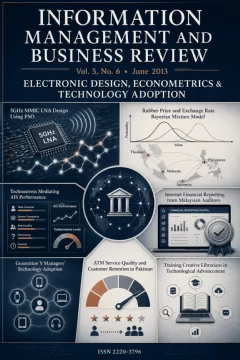 Vol. 5 No. 6 (2013)
Electronic Design, Econometrics & Technology Adoption
View issue contents
Published
Submissions
Have research to publish? Information Management and Business Review welcomes submissions.
Make a Submission