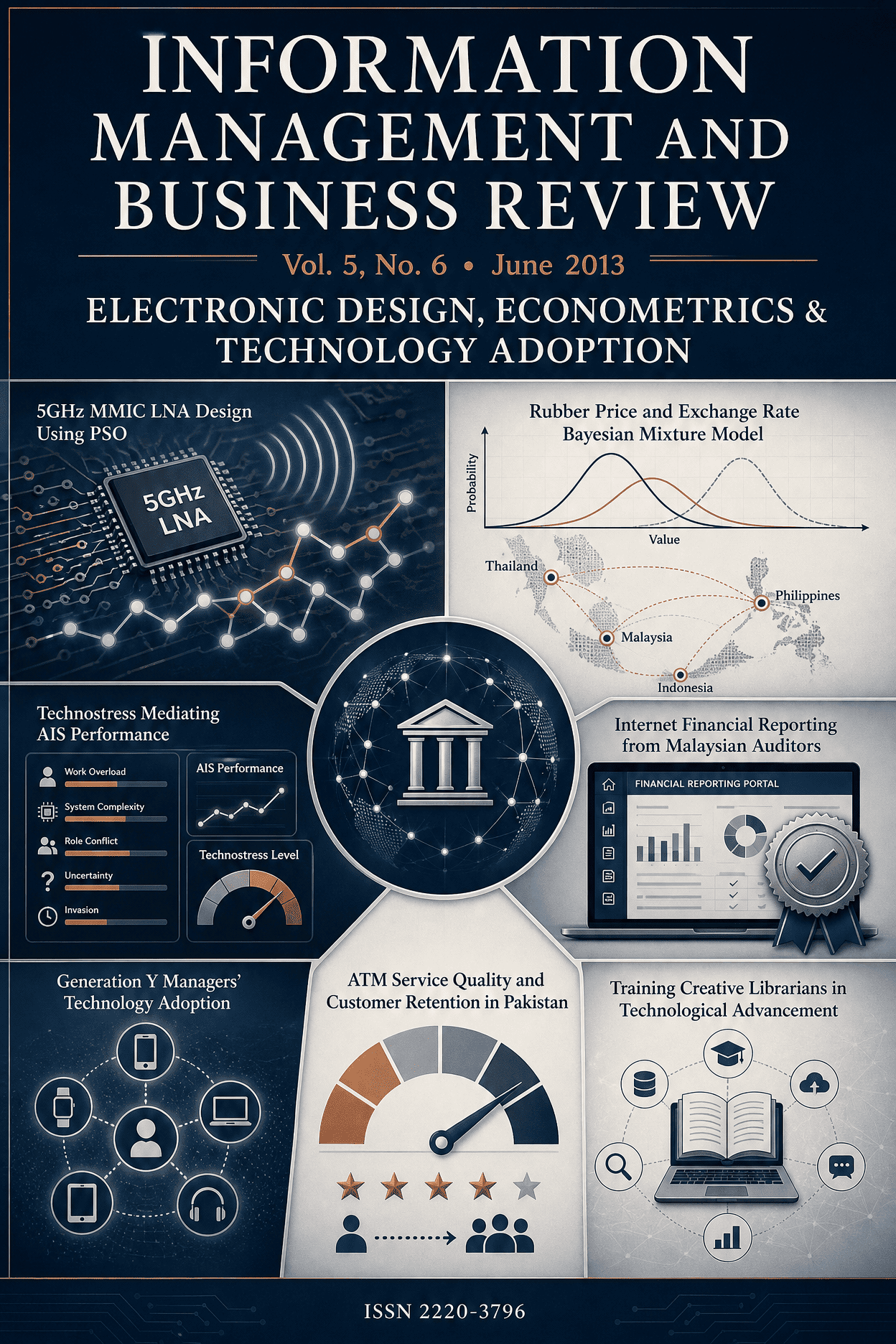
Articles

  • Article 1 in this issue

    5GHz MMIC LNA Design Using Particle Swarm Optimization

    • Author: Low Wen Shin, Neoh Siew Chin, Arjuna Marzuki

    This research presents an optimization study of a 5 GHz Monolithic Microwave Integrated Circuit (MMIC) design using Particle Swarm Optimization (PSO). MMIC Low Noise Amplifier (LNA) is a type of integrated circuit device used to capture signal operating in the microwave frequency. This project consists of two stages: implementation of PSO using MATLAB and simulation of MMIC design using Advanced Design System (ADS). PSO model that mimics the biological swarm behavior is developed to optimize the MMIC design variables in order to achieve the required circuit performance and specifications such as power gain, noise figure, drain current and circuit stability factor. Simulation results show that the proposed MMIC design fulfills the circuit stability factor and achieves a power gain of 19.73dB, a noise figure of 1.15 dB and a current of 0.0467A.

    Pages 257-262

    PDF - 5GHz MMIC LNA Design Using Particle Swarm Optimization (opens in a new tab)
  • Article 2 in this issue

    Rubber Price Effect on Exchange Rate: A Bayesian Mixture Model Approach

    • Author: Seuk Yen Phoong, Mohd Tahir Ismail

    Mixture model is a probabilistic model that denotes the presence of subpopulations within an overall population meanwhile finite mixture model is a mixture model with finite-dimensional. In this paper, finite mixture model is applied and the application of Bayesian method to fit finite mixture model is popular and these application is adopt in the present study in order to explore the relationship between rubber price and exchange rate for Malaysia, Thailand, Philippines and Indonesia. Exchange rate plays leading role for a country because it represents the development for that country. The changes of exchange rate influence the flows of investment either the import or export prices for a nation’s. While another data set that adopt is rubber price. Rubber is an economic commodity that prospers in tropical climate. It is an important raw material because the latex that extracted is the primary source of natural rubber that enables to produce many useful products such as tires, surgical gloves, industrial hoses, rubber sheeting, industrial form parts and others household rubber products. Results found that rubber price effect on the change of exchange rate for Malaysia, Thailand, Philippines and Indonesia.

    Pages 263-269

    PDF - Rubber Price Effect on Exchange Rate: A Bayesian Mixture Model Approach (opens in a new tab)
  • Article 3 in this issue

    Technostress: Mediating Accounting Information System Performance

    • Author: M. U. Saganuwan, W. K. W. Ismail, U. N. U. Ahmad

    In recent times, Accounting Information System (AIS) characteristics were studied to enhance its effectiveness but the impact technology stress, which imposes additional stress in the professionals known as techno stress, is not reflected. Technostress and AIS literatures were reviewed to synthesize the relationship. Technostress adversely affect the professional’s job satisfaction and performance. Therefore, this conceptual paper highlights and synthesizes the issues of techno stress with professionals and the effectiveness of AIS in organizations. However, based on the strength of existing frameworks of AIS, techno stress use to mediate the technological, organizational and cognitive contingency factors under condition of uncertainty to determine AIS effectiveness.

    Pages 270-277

    PDF - Technostress: Mediating Accounting Information System Performance (opens in a new tab)
  • Article 4 in this issue

    A Study of Various Aspects of Internet Financial Reporting: A Case of Malaysian Auditors

    • Author: Mohd Noor Azli bin Ali Khan, Nurul Ain binti Omar

    The objective of this research is to analyse the important items in the disclosure of benefit IFR to company and users, factors companies to engage or not engage IFR and some audit issues that can be used to describe the level of IFR from auditor’s perception. Questionnaires were distributed to 100 auditors. A total of 40 questionnaires were completed and returned, giving a response rate of 40 percent. Based on the literature review of the IFR from the survey towards auditors indicate three items of benefit IFR to user are helps users in the decision-making process, provides accessibility to the users, increase timeliness and efficiency in obtaining financial information. Meanwhile, three items on benefit IFR towards company are attract foreign investors, attract local investors, and promote company wider to the public. On the other hand, three factor influence companies to engage IFR because enhancement of corporate image, stability and improvement in share prices and competitors in the industry. Whilst, three-factor Company not to engage IFR because requires expertise from the company, concerned over disclosure of propriety information and concerned over security information. Finally, the findings of this study also cover audit issues, for example the conversion or transposition processes involved in publishing information on the internet is susceptible to error, information on the internet is exposed to access and modification by unauthorised users both external and internal to the reporting entity and that information on the internet has the potential to be very fluid. Lastly, the limitation of this study was also highlighted and there are suggestions for future research.

    Pages 278-291

    PDF - A Study of Various Aspects of Internet Financial Reporting: A Case of Malaysian Auditors (opens in a new tab)
  • Article 5 in this issue

    Does “Y” Generation Managers Attributes is Associated with Technology Adoption Behavior?

    • Author: Normala, S. Govindarajo, Dileep Kumar M.

    It is a dilemma to professionals that whether they should adopt technology to improve their functional contributions and thereby enhance business performance. Changes in the generations have different approaches to adopt technology application in their work life. As we see the differences in Generation X and Generation Y, in their features and characteristics, it is hypothesized that such differences also expect in professional approach in the adoption of technology for effective functional dissemination. This particular study follows a qualitative research methodology that to explore the relationship between Generation Y professionals in their attitude towards adoption of technology in business operations.

    Pages 292-299

    PDF - Does “Y” Generation Managers Attributes is Associated with Technology Adoption Behavior? (opens in a new tab)
  • Article 6 in this issue

    ATM Service Quality and its Effect on Customer Retention: A Case from Pakistani Banks

    • Author: Ameer Hasan, Usman Asif, Muhammad Irfan Arif, Nimra Khan

    The concept customer retention has received a considerable attention from a few decades in both areas as academic and industry. In the dynamic market environment, customer retention is seen as much important factor to compete in the market. Banks deals very closely to their customers, find, and fulfill their needs. Due to the technological advancement, banks are offering technology based services to the customers, the aim is to have a competitive advantage in satisfying their customer needs and hence to retain their customers. This research attempts to find the technology based ATM service quality, that how the customer are satisfied with it and hence being retained with the bank. The study will find the factor of ATM service quality that are helpful in retaining the customers. Data was collected from different banks of Pakistan and result depicts that the satisfaction of the bank customers with ATM service quality leads to retain the customer with the bank. Hence, the manger should need to focus on the quality ATM service to their customers, to retain their customers with the Banks.

    Pages 300-305

    PDF - ATM Service Quality and its Effect on Customer Retention: A Case from Pakistani Banks (opens in a new tab)
  • Article 7 in this issue

    Training the Creative Librarian in the Age of Technological Advancement

    • Author: Uloma D. Onuoha, Vincent E. Unegbu, Ngozi Ukachi, B.

    This paper examined the changes in librarianship brought about by advancement in technology especially as it relates to new work functions expected of librarians. The major objective of the study was to identify the role of curriculum in the training of creative and innovative librarians. The paper demonstrates that curriculum re-assessment in library schools is necessary for the mastery of knowledge needed for problem solving on which the basis of creativity and innovation lies. As a result, the paper concludes by recommending amongst others, that the curriculum of library schools be reviewed taking into consideration the current job requirements of librarians as this would empower librarians apply knowledge to problem solving, thereby bringing about creativity and innovation in library services. Library administrators should also encourage innovation and creativity by ensuring an enabling environment where staff is free to experiment with technology without fear of reproof.

    Pages 306-312

    PDF - Training the Creative Librarian in the Age of Technological Advancement (opens in a new tab)