Abstract
The concept customer retention has received a considerable attention from a few decades in both areas as academic and industry. In the dynamic market environment, customer retention is seen as much important factor to compete in the market. Banks deals very closely to their customers, find, and fulfill their needs. Due to the technological advancement, banks are offering technology based services to the customers, the aim is to have a competitive advantage in satisfying their customer needs and hence to retain their customers. This research attempts to find the technology based ATM service quality, that how the customer are satisfied with it and hence being retained with the bank. The study will find the factor of ATM service quality that are helpful in retaining the customers. Data was collected from different banks of Pakistan and result depicts that the satisfaction of the bank customers with ATM service quality leads to retain the customer with the bank. Hence, the manger should need to focus on the quality ATM service to their customers, to retain their customers with the Banks.
Keywords
- ATM Search this journal for ATM (opens in a new tab)
- Service Quality Search this journal for Service Quality (opens in a new tab)
- Customer Satisfaction Search this journal for Customer Satisfaction (opens in a new tab)
- Customer Retention Search this journal for Customer Retention (opens in a new tab)
References
- Al-Hawari, M. & Ward, T. (2006).The impact of automated service quality on financial performance and the mediating role of customer retention. Journal of Financial Service Marketing , 10(3), 228-43.
- Allen, F., McAndrews, J. & Strahan, P. (2001). E-finance: An Introduction, Working Paper No. 01-36, Financial Institutions Center, Wharton University, Philadelphia, PA, 7 October,
- Alshurideh, M. & ELSamen, A. A. (2012). The Impact of Internal Marketing on Internal Service Quality: A Case Study in a Jordanian Pharmaceutical Company. International Journal of Business and Management , 7(19).
- Anderson, E. A. & Sullivan, M. W. (1993).The antecedents and consequences of customer satisfaction for firms. Marketing Science , 12, 125-43.
- Bansal, H. & Taylor, S. (1999). The service switching model (SSM): a model of switching behavior in services industries. Journal of Service Research , 2(2), 200–218.
- Bauer, H. H., Hammerschmidt, M. & Falk, T. (2005). Measuring the quality of e-banking portals. International Journal of Bank Marketing , 23(2), 153-175.
- Brady, M., Cronin, J. & Brand, R. (2002). Performance-only measurement of service quality: a replication and extension. Journal of Business Research , 55, 17–31.
- Collier, E. & Bienstock, C. (2006). Measuring service quality in e-retailing. Journal of Service Research , 8(3), 260-75.
- Fassnacht, M. & Koese, I. (2006). Quality of electronic services: conceptualizing and testing a hierarchical model. Journal of Service Research , 9(1), 19-37.
- Fornell, C. (1992). A national customer satisfaction barometer: the. Swedish experience. J. Mark. , 56, 6-21.
- Fullerton, G. & Taylor, S. (2002). Mediating, interactive and non-linear effects in service quality and satisfaction with services research. Canadian Journal of Administrative Sciences , 19(2), 124–136.
- Ibrahim, E. E., Joseph, M. & Ibeh, K. I. N. (2006). Customers’ perception of electronic service delivery in the UK retail banking sector. International Journal of Bank Marketing , 24(7), 475-493.
- Jamal, A. & Naser, K. (2002). Customer satisfaction and retail banking: an Assessment of Some of the Key Antecedents of Customer Satisfaction in Retail Banking. International Journal o Bank Marketing , 20(4), 146-160.
- Joseph, M. & Stone, G. (2003). An empirical evaluation of US bank customer perceptions of the impact of technology on service delivery in the banking sector. International Journal of Retail and Distribution Management , 31(4), 190-202.
- Kandampully, J. (1998). Service Quality to service loyalty: a relationship which goes beyond customer services. Total Quality Management & Business Excellence , 9(6), 431-443.
- Katono, I. W. (2011). Student evaluation of e-service quality criteria in Uganda: the case of automatic teller machines. International Journal of Emerging Markets , 6(3), 200 – 216.
- Khan, A. M. (2010). An Empirical Study of Automated Teller Machine Service Quality and Customer Satisfaction in Pakistani Banks. European Journal of Social Sciences , 13(3).
- Lee, G. G. & Lin, H. F. (2005). Customer perceptions of e-service quality in online shopping. International Journal of Retail and Distribution Management , 33(2), 161-176.
- Levesque, T. & McDougall, G. (1996). Determinants of customer satisfaction in retail banking. International Journal of Bank Marketing , 14(7), 12-20.
- Mittal, V. & Kamakura, W. A. (2001). Satisfaction, Repurchase Intent, and Repurchase Behavior: Investigating the Moderating Effect of Customer Characteristics. Journal of Marketing Research , 38(1), 131-142.
- Mosahab, R., Muhammad, O. & Ramay, T. (2010). Service Quality, Customer Satisfaction and Loyalty: A Test of Mediation. International Business Research , 3(4).
- Mols, N. (2000). The internet and service marketing-the case of Danish retail banking. Internet research. Electronic Networking Applications and Policy , 10(1), 7-18.
- Narteh, B. (2013). Service quality in automated teller machines: an empirical investigation. Managing Service Quality , 23(1), 62-89.
- Pahwa, M. S. & Saxena, K. (2011). Analytical Study of Customer Satisfaction at ICICI Bank with special reference to ATMs, 2011 3rd International Conference on Information and Financial Engineering IPEDR 12 (2011) © (2011) IACSIT Press, Singapore.
- Parasuraman, A. & Zinkhan, G. M. (2002). Marketing to and serving customers through the internet: an overview and research agenda. Journal of the Academy of Marketing Science , 30, 286-295.
- Parasuraman, A., Berry, L. & Zeithaml, V. (1991). Refinement and reassessment of the SERVQUAL scale. Journal of Retailing , 67(4), 420-450.
- Parasuraman, A., Zeithaml, V. & Malhotra, A. (2005). E-S-QUAL: A Multiple-Item Scale for Assessing Electronic Service quality. Journal of Service Research , 7(3), 213-234.
- Parasuraman. A., Zeithaml, V. & Berry, L. (1985). A conceptual model of service quality and its implication for future research. Journal of Marketing , 49, 41-50.
- Parasuraman, A., Zeithaml, V. A. & Berry, L. L. (1988). SERVQUAL, a multiple item scale for measuring consumer perception of service quality. Journal of Retailing , 64(1), 12-40.
- Premalatha, J. R. & Sundaram, N. (2012). Analysis of Customer Satisfaction with reference to ATM Services in Vellore District. IJEMR , 2(2). - Online - ISSN 2249 – 2585 - Print - ISSN 2249 – 8672.
- Roos, I. (1999). Switching processes in customer relationships. Journal of Service Research , 2(1), 68–85.
- Rust, R., Zahorik, A. & Keiningham, T. (1995). Return on quality (ROQ): making service quality financially accountable. Journal of Marketing , 59(2), 58–70.
- Santos, J. (2003). E-service quality: a model of virtual service quality dimensions. Managing Service Quality , 13(3), 233-246.
- Sureshchandar, G., Rajendran, C. & Anantharaman, R. (2002).The relationship between service quality and customer satisfaction – a factor-specific approach. Journal of Services Marketing , 16(4), 363-79.
- Wolfinbarger, M. & Gilly, M. C. (2003). ETailQ: dimensionalizing, measuring and predicting retail quality. Journal of Retailing , 79, 183–198.
- Wu, J. H. & Wang, Y. M. (2007). Measuring ERP success: the key-users’ viewpoint of the ERP to produce a viable IS in the organization. Computers in Human Behavior , 23(3), 1582-96.
- Zeithaml, V., Berry, L. & Parasuraman, A. (1996). The behavioral consequences of service quality. Journal of Marketing , 60(2), 31–46.
Downloads
No downloads have been recorded for this article yet. Figures appear here once readers begin downloading the full text.
How to Cite
Share this article
License
Copyright (c) 2013 Ameer Hasan, Usman Asif, Muhammad Irfan Arif, Nimra Khan (Author)

This work is licensed under a Creative Commons Attribution 4.0 International License.
Author (s) should affirm that the material has not been published previously. It has not been submitted and it is not under consideration by any other journal. At the same time author (s) need to execute a publication permission agreement to assume the responsibility of the submitted content and any omissions and errors therein. After submission of revised paper in the light of suggestions of the reviewers, the editorial team edits and formats manuscripts to bring uniformity and standardization in published material.
This work will be licensed under Creative Commons Attribution 4.0 International (CC BY 4.0) and under condition of the license, users are free to read, copy, remix, transform, redistribute, download, print, search or link to the full texts of articles and even build upon their work as long as they credit the author for the original work. Moreover, as per journal policy author (s) hold and retain copyrights without any restrictions.
Keywords
- ATM Search this journal for ATM (opens in a new tab)
- Service Quality Search this journal for Service Quality (opens in a new tab)
- Customer Satisfaction Search this journal for Customer Satisfaction (opens in a new tab)
- Customer Retention Search this journal for Customer Retention (opens in a new tab)
Section
Published in
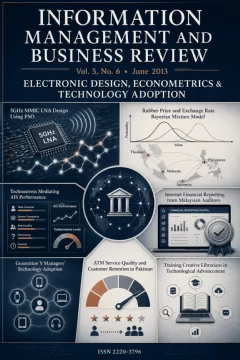 Vol. 5 No. 6 (2013)
Electronic Design, Econometrics & Technology Adoption
View issue contents
Published
Submissions
Have research to publish? Information Management and Business Review welcomes submissions.
Make a Submission