Abstract
This paper examined the changes in librarianship brought about by advancement in technology especially as it relates to new work functions expected of librarians. The major objective of the study was to identify the role of curriculum in the training of creative and innovative librarians. The paper demonstrates that curriculum re-assessment in library schools is necessary for the mastery of knowledge needed for problem solving on which the basis of creativity and innovation lies. As a result, the paper concludes by recommending amongst others, that the curriculum of library schools be reviewed taking into consideration the current job requirements of librarians as this would empower librarians apply knowledge to problem solving, thereby bringing about creativity and innovation in library services. Library administrators should also encourage innovation and creativity by ensuring an enabling environment where staff is free to experiment with technology without fear of reproof.
Keywords
- Creativity Search this journal for Creativity (opens in a new tab)
- Curriculum Search this journal for Curriculum (opens in a new tab)
- ICT Search this journal for ICT (opens in a new tab)
- Innovation Search this journal for Innovation (opens in a new tab)
- Librarianship Search this journal for Librarianship (opens in a new tab)
- Technological Advancement Search this journal for Technological Advancement (opens in a new tab)
- Training Search this journal for Training (opens in a new tab)
References
- Adah, J. E. (2010). Electronic age: What can the college librarian do? Tincity journal of library, archival and information science, 1(2), 70-73.
- Ademodi, D. T. & Adepoju, E. O. (2009). Computer skill among librarians in academic libraries on Ondo and Ekiti States, Nigeria. Library Philosophy & Practice. Retrieved from http://unllib.unl.edu/LPP/ademodi-adepoju.htm
- Adomi, E. E. (2008). Foundations of Reference Services Benin City: Ethiopia Publishing Corporation.
- Adomi, E. E. & Anie, S. O. (2006). An assessment of computer literacy skills of professionals in Nigerian University libraries. Library Hi Tech News , 23(2), 10-14.
- Altrichter, H. (2005). Curriculum implementation – limiting and facilitating factors. In: P. Nentwig & D. Waddington (Eds.): Context based learning of science (pp.35-62). Waxmann: Münster
- Anyira, I. E. (2011) One Among the Twelve: How Library Professionals Constitute a Serious Challenge to the Provision of Library Services in the 21st Century Library Philosophy and Practice. Retrieved from http://www.webpages.uidaho.edu/~mbolin/anyira-twelve.htm
- Bells, S. J. (2008). The Creativity Issue: Putting the spotlight on creative work in urban libraries. Retrieved from http://ulj.lacuny.org/index.php/past-issues/36-151/57-the-creativity-issue-putting-thespotlight-on-creative-work-in-urban-libraries-
- Bronson, P. & Merryman, A. (2010). The creativity crisis. Retrieved from http://www.thedailybeast.com/newsweek/2010/07/10/the-creativity-crisis.html .
- Bruijnzeels, R., Bitter-Rijpkema, M. E. & Verjans, S. (2010). The library school: Empowering the sustainable innovation capacity of new librarians. Retrieved from http://npsig.files.wordpress.com/2010/03/npsig_the-global-librarian_lis-school_paper.pdf .
- Choi, Y. & Rasmussen, E. (2006). What is needed to educate future digital librarians: A study of current practice and staffing patterns in academic and research libraries? Retrieved from http://www.dlib.org/dlib/september06/choi/09choi.html
- Deiss, K. (2004). Innovation and strategy: Risk and choice in shaping user cantered libraries. Library Trends, 53(1), 17-32.
- Diaz, M. G. (2008). Libraries, creativity and innovation. Paper presented at conference to mark the 50th anniversary of the central library of the European Commission Brussels, 2 December 2008. Retrieved from ec.europa.eu/libraries/doc/50ans/Libraries_creativity_and_innovation.ppt
- Edegbo, W. O. (2011). Curriculum Development in Library and Information Science Education in Nigerian Universities: Issues and Prospects. Retrieved from http://www.webpages.uidaho.edu/~mbolin/edegbo.pdf
- Farkas, M. (2013). Encouraging innovation in libraries. Retrieved from http://www.slideshare.net/librarianmer/encouraging-innovation-in-libraries
- Gupta, D. K. (2001). Librarians' changing role in distance education: need for training. Journal of Library Administration, 32(1-2), 225-31.
- Hall, D. (2003). Of babies and bathwater-hiring library staff for the 21st century. In k. Bridges (Ed.), Expectations of librarians in the 21st century (pp. 17-19). Westport, Connecticut: Greenwood press.
- Hashim, L. B. & Mokhtar, W. N. H. W. (n.d). Trends and issues in preparing new era librarians and information professionals. International Journal of Humanities and Social Science, 2(7), 51-156
- Hazeri, A., Sarrafzadeh, M. & Martin, B. (2007). Reflections of information professionals on knowledge management competencies in the LIS curriculum. Journal of Education for Library and Information Science , 48(3), 168-186
- Ifidion, S. E. & Ifidon, E. I. (2007). New directions in African library management. Abuja: Spectrum books limited
- Jain, P. K., Kaur, H. & Babbar, P. (2007). LIS Education in India: Challenges for students and professionals in the digital age. Retrieved from http://eprints.rclis.org/10175/1/D7505896.pdf
- Johnson, J. S. (1991). Computerising information systems in developing countries: Keys to sustainable development. Pakistan Library Bulletin, 22(3), 22-30.
- Kaur, H. & Sharda, P. (2010). Role of technological innovations in improving library services International Journal of Library and Information Science, 2(1), 011-016.
- Koveckienė, E. (2012). We shape our library and then our library shape us. Retrieved from http://www.lbd.lt/wp-content/uploads/2012/02/Eugenija_Koveckiene.pdf
- Lancaster, F. W. (1997). Artificial Intelligence and Expert System Technologies: Prospects. In: D. Raitt (Ed.) Libraries for the New Millennium: Implications for Managers (pp19 – 37). London: Library Association Publishing
- LIAM. (2009). Creativity and innovation in libraries. Retrieved from http://liamofmauritius.wordpress.com/2009/03/21/creativity-and-innovation-in-libraries/
- Mach, M. (2003). Real job titles for libraries and information science professionals. Retrieved from http://www.michellemach.com/jobtitles/realjobs.html
- Madu, E. C. (2008). Technology skills for information handling: New implications for the library profession in Nigeria. The information technologist, 5(1), 171-178
- Malinconico, M. S. (1992). What librarians need to know to survive in an age of technology? Journal of Education for Library and Information Science , 33(3), 226-240 .
- Mäntykangas, A. & Omsted, B. (2012). Implementing innovation management in the librarians’ education. Qualitative and Quantitative Methods in Libraries (QQML), 3, 295–301.
- Martell, C. (2000). The disembodied librarian in the digital age, part 11. College and Research Libraries, 61, 99-113.
- Nofsinger, M. M. (2003). Hiring academic reference librarians in the 21st century. In k. Bridges (Ed.), Expectations of librarians in the 21st century (pp. 41-44). Westport, Connecticut: Greenwood press.
- Ochogwu, M. G. (1990). Alternatives in librarianship: prospects and problems for the Nigerian graduate. Journal of Education for Library & Information Science, 30(4), 181-194.
- Ocholla, D. N. (2000). Review and revision of library and information science curriculum in South Africa University and usage of follow-up study and advancement scanning methods. Retrieved from http://www.slib.ualberta.ca/cais/2000/ocholla.htm
- Oesleby, L. & Birks, J. (2003). Mere mortals need not apply. In k. Bridges (Ed.), Expectations of librarians in the 21st century (pp. 33-36). Westport, Connecticut: Greenwood press.
- Osanyin, F. A., Ige. O. & Adebayo, A. (2006) Introduction to early childhood curriculum development. Retrieved from http://www.nou.edu.ng/noun/NOUN_OCL/pdf/EDUs/ECE%20230.pdf
- Pugh, L. (2005). Managing 21st Century Libraries Toronto: Scarecrow press, Inc
- Pungitore, V. L. (1995). Innovation and the library: The adoption of new ideas in public libraries. West port, Connecticut: Greenwood press.
- Putnam, L. (2005).Making the world safe for questions: why libraries and librarians are needed now more than ever. Public Libraries, 44(2), 86-7.
- Raju, J. (2003). Never the twain shall meet? : Professional and paraprofessional LIS education and training in a changing information environment. Retrieved from: http://ir.dut.ac.za/bitstream/handle/10321/392/Raju_2003.pdf?sequence=1
- Sahlberg, P. (2009). Creativity and innovation through lifelong learning. Lifelong Learning in Europe, 14(1), 53-60.
- Salaam, M. O. & Onifade, F. N. (2009). Academic status and the doctoral degree requirement for promotion of librarians in Nigerian university libraries. Retrieved from http://www.webpages.uidaho.edu/~mbolin/salaam-onifade.htm
- Saleh, A. G, (2011). Educators’ perspective on library education in Nigeria. Retrieved from http://www.webpages.uidaho.edu/~mbolin/gambo.htm.
- Smidt, J. K. (2005). The Cultural Dimension in Library Education. Retrieved from http://archive.ifla.org/IV/ifla71/papers/049e-Smidt.pdf.
- Stenhouse, L. (1975). An introduction to curriculum research and development. London: Heinemann
- Stewart, L. A. (2000) Choosing between print and electronic sources: The selection dilemma. The reference librarians, 71, 79-97.
- Troll, D. A. (2001). How and why libraries are changing. Retrieved from http://www.diglib.org/use/whitepaper.htm .
- Wiles, J. (2005). Curriculum essentials: A resource for educators. Boston: Pearson
- Willgoose, C. E. (1974). The curriculum in physical education. Englewood N. J. I. Prentice Hall Inc.
- Youngok, C. (2006). What is needed to educate future digital librarians? D-Lib Magazine, 12(9), Sept. Retrieved Nov., 17, 2008 from http://www.dlib.org/dlibseptember06/choi.html.
Downloads
No downloads have been recorded for this article yet. Figures appear here once readers begin downloading the full text.
How to Cite
Share this article
License
Copyright (c) 2013 Uloma D. Onuoha, Vincent E. Unegbu, Ngozi Ukachi, B. (Author)

This work is licensed under a Creative Commons Attribution 4.0 International License.
Author (s) should affirm that the material has not been published previously. It has not been submitted and it is not under consideration by any other journal. At the same time author (s) need to execute a publication permission agreement to assume the responsibility of the submitted content and any omissions and errors therein. After submission of revised paper in the light of suggestions of the reviewers, the editorial team edits and formats manuscripts to bring uniformity and standardization in published material.
This work will be licensed under Creative Commons Attribution 4.0 International (CC BY 4.0) and under condition of the license, users are free to read, copy, remix, transform, redistribute, download, print, search or link to the full texts of articles and even build upon their work as long as they credit the author for the original work. Moreover, as per journal policy author (s) hold and retain copyrights without any restrictions.
Keywords
- Creativity Search this journal for Creativity (opens in a new tab)
- Curriculum Search this journal for Curriculum (opens in a new tab)
- ICT Search this journal for ICT (opens in a new tab)
- Innovation Search this journal for Innovation (opens in a new tab)
- Librarianship Search this journal for Librarianship (opens in a new tab)
- Technological Advancement Search this journal for Technological Advancement (opens in a new tab)
- Training Search this journal for Training (opens in a new tab)
Section
Published in
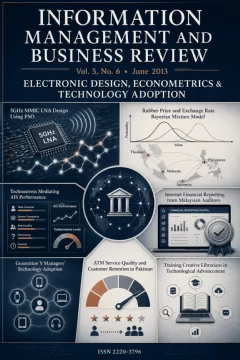 Vol. 5 No. 6 (2013)
Electronic Design, Econometrics & Technology Adoption
View issue contents
Published
Submissions
Have research to publish? Information Management and Business Review welcomes submissions.
Make a Submission