Abstract
Practices of using celebrities as spokespeople for commercialized products are continuously favoured toward the effort of marketing and positioning. The popularity of celebrity advertising is founded upon advertiser’s belief on message credibility by well-known personalities to achieve greater attention, recall and behavioural intention among consumers. The present study assesses the impact of celebrity credibility on the underlying purchase intention of Malaysian consumers toward the footwear industry, by exploring the mediating role of attitude toward advertisement between celebrity credibility and purchase intention. The influence of endorser’s characteristics and cultures on consumer’s behavioural intention is explained through the applications of the Theory of Identification (Kelman, 1961, 2006) and the Meaning Transfer Model (McCracken, 1989) in this study. Descriptive findings collected from 200 potential consumers have suggested attitude toward advertisement as the catalyst of endorser’s identification, for cultivating dimensions of celebrity credibility (trustworthiness, expertise and attractiveness) into transactional intention. The phenomenon of integration approaches of single phenomenon, with two theoretical perspectives (Mayer & Sparrowe, 2013) is demonstrated in this product marketplace.
Keywords
- Celebrity Endorsement Search this journal for Celebrity Endorsement (opens in a new tab)
- Credibility Search this journal for Credibility (opens in a new tab)
- Attitude Toward Advertisement Search this journal for Attitude Toward Advertisement (opens in a new tab)
- Purchase Intention Search this journal for Purchase Intention (opens in a new tab)
- Footwear Search this journal for Footwear (opens in a new tab)
References
- Aaker, D. A., Kumar, V., Day, G. S. & Leone, R. P. (2011). Marketing Research , 10th edition, Asia: John Wiley & Sons.
- Banwari, M. (1990). The Relative Roles of Brand Beliefs and Attitude toward the Ad as Mediator of Brand Attitude: A Second Look. Journal of Marketing Research , 27(2), 209-219.
- Beaulieu, P. (2001). The Effects of Judgments of New Clients’ Integrity upon Risk Judgments, Audit Evidence, and Fees. Auditing: A Journal of Practice and Theory , 20(2), 85-99.
- Bhatt, N., Jayswal, R. M. & Patel, J. D. (2013). Impact of Celebrity Endorser's Source Credibility on Attitude towards Advertisements and Brands. South Asian Journal of Management , 20(4), 74-96.
- Biehal, G., Stephens, D. & Curlo, E. (1992). Attitude toward the Ad and Brand Choice. Journal of Advertising , 21(3), 19-36.
- Chaiken, S. (1979). Communicator Physical Attractiveness and Persuasion. Journal of Personality and Social Psychology , 37(8), 1387-1397.
- Choi, S. M. & Rifon, N. J. (2012). It is a Match: The Impact of Congruence between Celebrity Image and Consumer Ideal Self on Endorsement Effectiveness. Psychology & Marketing , 29(9), 639-650.
- Chong, B., Yang, Z. & Wong, M. (2003). Asymmetrical Impact of Trustworthiness Attributes on Trust, Perceived Value and Purchase Intention: A Conceptual Framework for Cross-cultural Study on Consumer Perception of Online Auction. Electronic commerce: Proceedings of the 5th international conference, 213-219.
- Clark, J. K., Wegener, D. T., Habashi, M. M. & Evans, A. T. (2011). Source Expertise and Persuasion: The Effects of Perceived Opposition or Support on Message Scrutiny. Personality and Social Psychology Bulletin , 38(1), 90-100.
- Comiati, R. & Plăias, I. (2010). The Impact of Endorsers’ Characteristics on Consumers’ Reaction to Ads. Management & Marketing , 8(1), 37.
- Daneshvary, R. & Schwer, R. K. (2000). The Association Endorsement and Consumers’ Intention to Purchase. Journal of Consumer Marketing , 17(3), 203-213.
- Elina, H. K. & Leila, H. (2010). Who Endorses Whom? Meanings Transfer in Celebrity Endorsement. Journal of Product & Brand Management , 19(6), 452-460.
- Erdogan, B. Z., Baker, M. J. & Tagg, S. (2001). Selecting Celebrity Endorsers: The Practitioner’s Perspective. Journal of Advertising Research , 41(3), 39-48.
- Euromonitor International. (2014). Market Sizes (Footwear). Passport . Available from: http://www.portal.euromonitor.com.ezproxy.lancs.ac.uk/Portal/Pages/Statistics/Statistics.aspx [accessed: 22th September 2014].
- Fishbein, M. & Ajzen, I. (1975). Belief, Attitude, Intention, and Behavior: An Introduction to Theory and Research, USA: Wesley Publishing Company.
- Goldsmith, R. E., Lafferty, B. A. & Newell, S. J. (2000). The Impact of Corporate Credibility and Celebrity Credibility on Consumer Reaction to Advertisements and Brands. Journal of Advertising , 29(3), 43-54.
- Gresham, L. G. & Shimp, T. A. (1985). Attitude toward the Advertisement and Brand Attitude: A Classical Conditioning Perspective. Journal of Advertising , 14(1), 10-49.
- Guido, G., Peluso, A. M. & Moffa, V. (2011). Beardedness in Advertising: Effects on Endorsers’ Credibility and Purchase Intention. Journal of Marketing Communications , 17(1), 37-49.
- Hinkin, T. R. (1995). A Review of Scale Development Practices in the Study of Organizations. Journal of Management , 21(5), 967-988.
- Hoyer, W. T. & MacInnis, D. (1997). Consumer Behaviour, Boston, MA: Houghton Mifflin.
- Ilicic, J. & Webster, C. M. (2011). Effects of Multiple Endorsements and Consumer-celebrity Attachment on Attitude and Purchase Intention. Australasian Marketing Journal , 19(4), 230-237.
- Janssens, W. & De Pelsmacker, P. (2005). Advertising for New and Existing Brands: The Impact of Media Context and Type of Advertisement. Journal of Marketing Communications , 11(2), 113-128.
- Joseph, W. B. (1982). The Credibility of Physically Attractive Communicators: A Review. Journal of Advertising , 11(3), 15-24.
- Kelman, H. C. (2006). Interests, Relationships, Identities: Three Central Issues for Individuals and Groups in Negotiating Their Social Environment. Peer Reviewed Journal , 57, 1-26.
- Kelman, H. C. (1961). Processes of Opinion Change. Public Opinion Quarterly , 25, 57-78.
- Khairullah, D. Z. & Khairullah, Z. Y. (1999). Relationships between Acculturation, Attitude toward the Advertisement, and Purchase Intention of Asian-Indian Immigrants. International Journal of Commerce & Management , 9(3/4), 46-65.
- Lafferty, B. A., Goldsmith, R. E. & Flynn, L. R. (2005). Are Innovators Influenced by Endorser Expertise in an Advertisement when Evaluating a High Technology Product? Journal of Marketing Theory and Practice , 13(3), 32-48.
- Lafferty, B. A. & Goldsmith, R. E. (1999). Corporate Credibility’s Role in Consumers’ Attitudes and Purchase Intentions When a High versus a Low Credibility Endorser Is Used in the Ad. Journal of Business Research , 44(2), 109-116.
- Lewisch, P. (2003). A Theory of Identification. International Review of Law and Economics , 23(4), 439-451.
- Liu, M. T., Huang, Y. Y. & Jiang, M. (2007). Relations among Attractiveness of Endorsers, Match-up, and Purchase Intention in Sport Marketing in China. The Journal of Consumer Marketing , 24(6), 358-365.
- MacInnis, D. J., Rao, A. G. & Weiss, A. M. (2002) Assessing when Increased Media Weight of Real World Advertisements Helps Sales. Journal of Marketing Research , 39(11), 391-407.
- Mackenzie, S. B., Lutz, R. J. & Belch, G. E. (1986). The Role of Attitude toward the Ad as a Mediator of Advertising Effectiveness: A Test of Competing Explanations. Journal of Marketing Research , 23(2), 130-143.
- Matthew, T. L., Huang, Y. Y. & Jiang, M. (2007). Relations among Attractiveness of Endorsers, Match-up, and Purchase Intention in Sport Marketing in China. The Journal of Consumer Marketing , 24(6), 358-365.
- Mayer, K. J. & Sparrowe, R. T. (2013). From the Editors: Integrating Theories in AMJ Articles. Academy of Management Journal , 56(4), 917-922.
- McCracken, G. (1989). Who is the Celebrity Endorser? Cultural Foundation of the Endorsement Process. Journal of Consumer Research , 16(3), 310-321.
- McGuire, W. J. (1969). The Nature of Attitudes and Attitude Change. In Lindzey, G. and Aronson, E. (Eds.). Handbook of Social Psychology , 2nd edition (pp.135-214). Cambridge, MA: Addison-Wesley.
- Miller, F. M. & Allen, C. T. (2012). How does Celebrity Meaning Transfer? Investigating the Process of Meaning Transfer with Celebrity Affiliates and Mature Brands. Journal of Consumer Psychology , 22(3), 443-452.
- Mills, J. & Aronson, E. (1965). Opinion Change as the Function of Attractiveness and Desire to Influence. Journal of Personality and Social Psychology , 1(2), 173-177.
- Morin, D. T., Ivory, J. D. & Tubbs, M. (2012). Celebrity and Politics: Effects of Endorser Credibility and Sex on Voter Attitudes, Perceptions and Behaviors. The Social Science Journal , 49(4), 413-420.
- Moser, C. A. (1952). Quota Sampling. Journal of Royal Statistical Society , 115(3), 411-423.
- Muda, M., Musa, R., Mohamed, R. N. & Borhan, H. (2014). Celebrity Entrepreneur Endorsement and Advertising Effectiveness. Procedia – Social and Behavioural Sciences , 130, 11-20.
- Muralidharan, S. & Xue, F. (2014). Influence of TV Endorser Types on Advertising Attitudes and Purchase Intention among Indian Rural Women: An Exploratory Study. Asian Journal of Communication , 25(2), 213-231.
- Nan, X. (2013). Perceived Source Credibility and Advertising Persuasiveness: An Investigation of Moderators and Psychological Processes. Journal of Current Issues & Research in Advertising , 34(2), 195-211.
- Ohanian, R. (1990). Construction and Validation of a Scale to Measure Celebrity Endorsers’ Perceived Expertise, Trustworthiness, and Attractiveness. Journal of Advertising , 19(3), 39-52.
- Ohanian, R. (1991). The Impact of Celebrity Spokespersons' Perceived Image on Consumers' Intention to Purchase. Journal of Advertising Research , 31(1), 46-54.
- Pornpitakpan, C. (2003). Validation of the Celebrity Endorsers’ Credibility Scale: Evidence from Asians. Journal of Marketing Management , 19(1), 179-195.
- Pornpitakpan, C. (2004). The Persuasiveness of Source Credibility: A Critical Review of Five Decades' Evidence. Journal of Applied Social Psychology , 34(2), 243-281.
- Rossiter, J. R. & Smidts, A. (2012). Print Advertising: Celebrity Presenters. Journal of Business Research , 65(6), 874-879.
- Sallam, M. A. A. (2011). The Impact of Source Credibility on Saudi Consumer's Attitude toward Print Advertisement: The Moderating Role of Brand Familiarity. International Journal of Marketing Studies , 3(4), 63-77.
- Sallam, M. A. A. & Wahid, N. A. (2012). Endorser Credibility Effects on Yemeni Male Consumer's Attitudes towards Advertising, Brand Attitude and Purchase Intention: The Mediating Role of Attitude toward Brand. International Business Research , 5(4), 55-66.
- Schouten, B. C. (2008). Compliance Behavior and the Role of Ethnic Background, Source Expertise, Selfconstruals and Values. International Journal of Intercultural Relations , 32(6), 515-523.
- Shrimp, T. A. (1981). Attitude toward the Ad as a Mediator of Consumer Brand Choice. Journal of Advertising , 10(2), 9-48.
- Stemthal, B., Dholakia, R. R. & Leavitt, C. (1978). The Persuasive Effect of Source Credibility: Tests of Cognitive Response. Journal of Consumer Research , 4(4), 252-260.
- Subhadip, R., Varsha, J. & Pragati, R. (2013). The Moderating Role of Consumer Personality and Source Credibility in Celebrity Endorsements. Asia-Pacific Journal of Business Administrations , 5(1), 72-88.
- Tormala, Z. L. & Clarkson, J. J. (2008). Source Trustworthiness and Information Processing in Multiple Message Situations: A Contextual Analysis. Social Cognition , 26(3), 357-367.
- Tran, G. N. (2013). The Role of Celebrity Endorsers. Society for Marketing Advances Proceedings , 25, 156-159.
- Tsai, M. T., Chin, C. W. & Chen, C. C. (2010). The Effect of Trust Belief and Salesperson’ Expertise on Consumer’s Intention to Purchase Nutraceuticals: Applying the Theory of Reasoned Action. Social Behavior & Personality: An International Journal , 38(2), 273-288.
- Van der Waldt, D. L. R., de Beer, N. & du Plessis, N. (2007). Attitudes towards Attractive and Credible Celebrities in Advertisements: A Survey amongst Students. Communicare , 26(1), 44-58.
- Wang, A. & Lin, C. (2011). Effects of Content Class with Endorsement and Information Relevancy on Purchase Intention. Management Research Review , 34(4), 417-435.
- Wang, J. S., Cheng, Y. F. & Chu, Y. L. (2012). Effect of Celebrity Endorsements on Consumer Purchase Intentions: Advertising Effect and Advertising Appeal as Mediators. Human Factors and Ergonomics in Manufacturing & Service Industries , 23(5), 357-363.
- Wu, W. Y., Linn, C. T., Fu, C. S. & Sukoco, B. M. (2012). The Role of Endorsers, Framing, and Rewards on the Effectiveness of Dietary Supplement Advertisements. Journal of Health Communication , 17, 54-75.
- Yan, R. N., Ogle, J. P. & Hyllegard, K. H. (2010). The Impact of Message Appeal and Message Source on Gen Y Consumers’ Attitudes and Purchase Intentions toward American Apparel. Journal of Marketing Communications , 16(4), 203-224.
- Yoon, K., Kim, C. H. & Kim, M. S. (1998). A Cross-cultural Comparison of the Effects of Source Credibility on Attitudes and Behavioral Intentions. Mass Communication & Society , 1(3/4), 153-173.
Downloads
No downloads have been recorded for this article yet. Figures appear here once readers begin downloading the full text.
How to Cite
Share this article
License
Copyright (c) 2015 Zu Qian ONG, Derek Lai Teik ONG (Author)

This work is licensed under a Creative Commons Attribution 4.0 International License.
Author (s) should affirm that the material has not been published previously. It has not been submitted and it is not under consideration by any other journal. At the same time author (s) need to execute a publication permission agreement to assume the responsibility of the submitted content and any omissions and errors therein. After submission of revised paper in the light of suggestions of the reviewers, the editorial team edits and formats manuscripts to bring uniformity and standardization in published material.
This work will be licensed under Creative Commons Attribution 4.0 International (CC BY 4.0) and under condition of the license, users are free to read, copy, remix, transform, redistribute, download, print, search or link to the full texts of articles and even build upon their work as long as they credit the author for the original work. Moreover, as per journal policy author (s) hold and retain copyrights without any restrictions.
Keywords
- Celebrity Endorsement Search this journal for Celebrity Endorsement (opens in a new tab)
- Credibility Search this journal for Credibility (opens in a new tab)
- Attitude Toward Advertisement Search this journal for Attitude Toward Advertisement (opens in a new tab)
- Purchase Intention Search this journal for Purchase Intention (opens in a new tab)
- Footwear Search this journal for Footwear (opens in a new tab)
Section
Published in
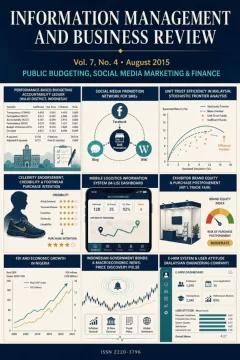 Vol. 7 No. 4 (2015)
Public Budgeting, Social Media Marketing & Finance
View issue contents
Published
Submissions
Have research to publish? Information Management and Business Review welcomes submissions.
Make a Submission