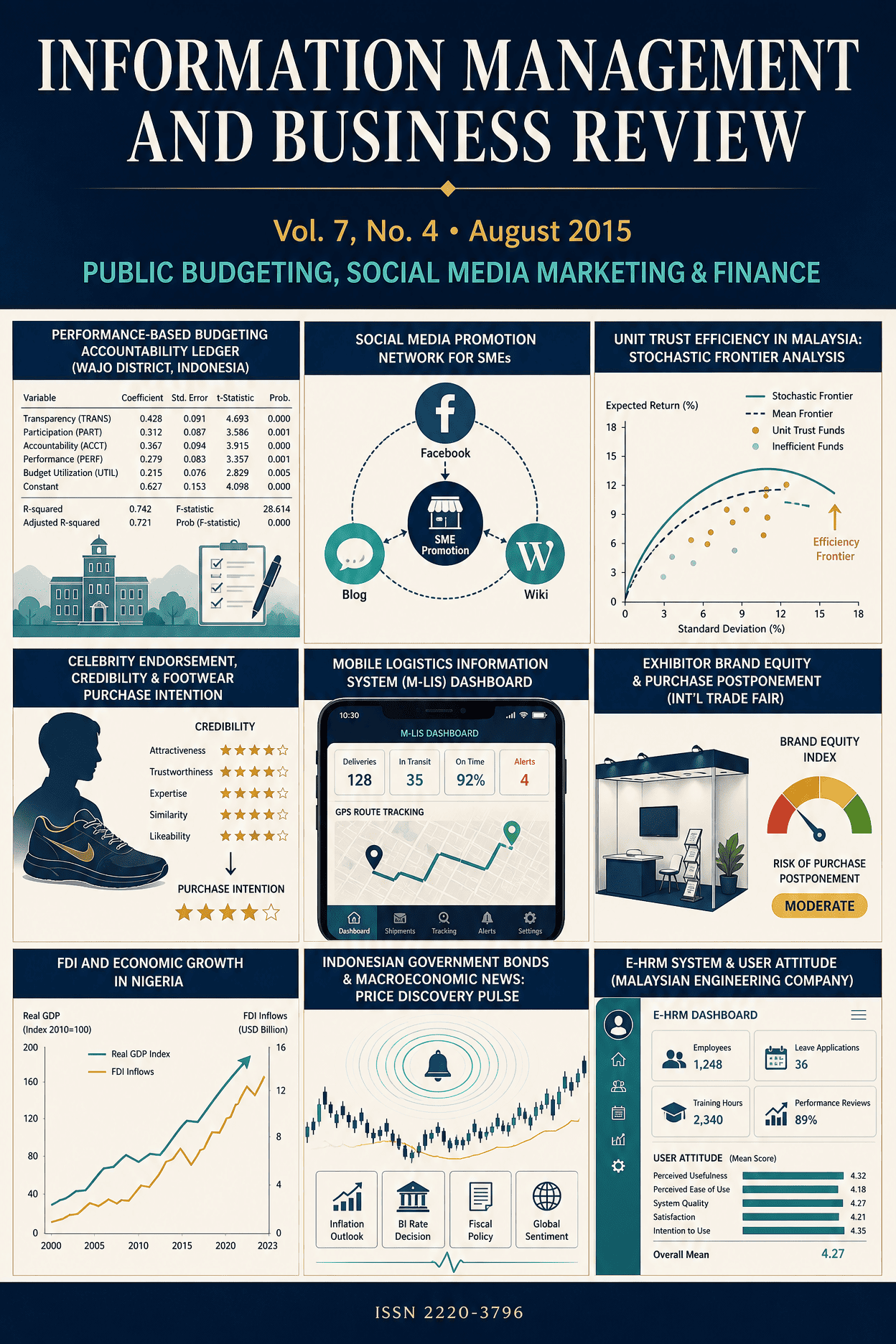
Articles 1–10 of 12

  • Article 1 in this issue

    The Effect of Performance-Based Budgeting Implementation towards the Institution Performance Accountability (Case Study: Wajo)

    • Author: Seri Suriani

    This study aimed at finding out empirical evidences whether the application of performance-based budgeting affected the performance accountability of Wajo government, seeing the effects of the application of performance-based budgeting to performance accountability of government agencies using four variables, namely, the budget planning (X1), the implementation of the budget (X2), the budget reporting/accountability (X3), and the performance evaluation (X4). In this study, the samples were 100 people. They are from 33 regional work units (SKPD) which consists of a team of Local Government Budget (TAPD) who involved in formatting the government budgets of Wajo regency. Data were collected through direct observation and survey obtained by distribution of questionnaires to the respondents. This study used multiple linear regression models with software SPSS. The study results showed that the budget planning and the budget reporting / accountability gave positive and significant impacts on performance accountability of government agencies, the implementation of the budget and the performance evaluation. It is shown from the results of multiple linear regression test which showed Y = 7.904 + 0.223 X1 + 0.222 X2 + 1.433 + 0.227 X3 X4. In conclusion, the application of performance-based budgeting gave positive effects on performance accountability of government agencies.

    Pages 6-22

    PDF - The Effect of Performance-Based Budgeting Implementation towards the Institution Performance Accountability (Case Study: Wajo) (opens in a new tab)
  • Article 2 in this issue

    Relationship between Brand Perceptions and Satisfaction: Empirical Study on Skin Products in Malaysia

    • Author: Tiyu Swed Xue, Har Wai Mun, Ooi Bee Chen, Tan Ee Fang, Lee Kuan Chen, Goh Jih Yi

    In the highly competitive marketplace, marketers for the skin care product are facing challenges with identifying the consumer’s brand perception and brand satisfaction. Brand satisfaction is perceived as an important issue on skin care industry. Obviously, customers are the important stakeholders in organizations and their satisfaction is a priority to the company. This study aims to investigate the relationship between brand perceptions and brand satisfaction on skin care products with four independent variables (quality, promotion, image and preference). This study employed the statistic software of SPSS version 19.0 to evaluate 200 sets of questionnaires which collected from students, undergraduates, working adults and other respondents. The findings in this study shows that the brand perceptions on quality, image and preference have positive and significant relationship with brand satisfaction on skin care products. However, the relationship between brand perception on promotion and brand satisfaction is being rejected. Thus, the marketers can focus on perception on quality, image and preference to increase customers’ brand satisfaction to capture and retain them.

    Pages 23-32

    PDF - Relationship between Brand Perceptions and Satisfaction: Empirical Study on Skin Products in Malaysia (opens in a new tab)
  • Article 3 in this issue

    Use of Social Media as a Media Promotion for Small and Medium Enterprises

    • Author: Isma Azis Riu

    Era of information technology extremely dynamic, fast growing as it is now, allows us to communicate with anyone, anytime, anywhere cheaply and quickly crossed the line geography. Especially with social media or social media, which increasingly plays an important role in communicating and socialize? Social media is not just used by the individual. In fact there are many large companies, small and medium enterprises (SMEs), even the candidates, presidential candidates, even use it as a medium of communication and media promotion. Social Media is an online media, the users can easily participate, share and create contents include blogs, social networks, wikis, forums and virtual worlds. Blogs, social networking and wikis are forms of social media are most commonly used by people around the world. Conclusions that can be drawn is very important to use social media as a promotional medium for Small and Medium Enterprises (SMEs) in a systematic and structured, because in addition to not require huge capital, and does not require an office, could be anywhere, anytime due to real time. Range is not limited to the Internet reaches all regions and even countries. With so many current Social Media, Small and Medium Enterprise Social Media can choose which one is suitable for their products. Utilization of Social Media, can be establish communication with customers, build emotional bounding. And in this era of social media gave birth to a new customer segment called customer social (social customer), thus giving birth to new ways or practices of a business, product or service in the interaction with the market.

    Pages 33-41

    PDF - Use of Social Media as a Media Promotion for Small and Medium Enterprises (opens in a new tab)
  • Article 4 in this issue

    Marketing Communication Model in Social Network Facebook

    • Author: Herman Winarto

    The limited funds made small and medium enterprise attempt to do marketing communication activities by finding ways of marketing communication that does not require substantial funds.The emergence of social networking media, such as Facebook is an opportunity for small and medium enterprises (SMEs) as a cheap marketing communication media, but not many SMEs are successfully doing marketing communications with social networking media, such failure due to a lack of knowledge in utilizing the social networking media. Indonesia have many small and medium enterprises, and most of them found difficulties in marketing communication, this study was held with purpose to examine the marketing communication activity in social networking media facebook. The study used a qualitative approach, that used interview ,observation and documentation, to assess the activity of SMEs marketing communications in facebook page, the setting of the research was the SMEs who success performed marketing communication in social networking media facebook. The results of this study resulted in a model of marketing communication through social networking media facebook page, which is useful as a guide for SMEs who will do the marketing communications.

    Pages 42-45

    PDF - Marketing Communication Model in Social Network Facebook (opens in a new tab)
  • Article 5 in this issue

    The Performance of Unit Trust Industry in Malaysia

    • Author: Aminah Shari, Zahariah Sahudin

    This study measured the efficiency of fixed income unit trust funds and equity unit trust funds for the period of January 2004 to December 2014. A total of 36 fixed income funds and 109 equity funds were evaluated using stochastic frontier analysis (SFA) technique with three inputs (expense ratio, portfolio turnover ratio, and fund management stated fee) and one output variable (return). The econometric technique was used to measure the portfolio efficiency score as well as to compare the efficiency of fixed income funds and equity funds. The results indicated that the average efficiency score for equity unit trust funds was higher than fixed income unit trust funds. Nevertheless, when the samples were categorized into panel data, the average efficiency score for fixed income funds increased throughout ten years. Meanwhile the average score for equity funds was consistent over the years. It shows that time is invariant for equity funds. However, this means that the performance efficiency for both types of funds was considered excellent and efficient. The results indicate that the mean efficiency achieved in unit trust industry is almost 100% of its potential output.

    Pages 46-54

    PDF - The Performance of Unit Trust Industry in Malaysia (opens in a new tab)
  • Article 6 in this issue

    The Impact of Celebrity Credibility on Consumer’s Purchase Intention toward the Footwear Industry in Malaysia: The Mediating Effect of Attitude toward Advertisement

    • Author: Zu Qian ONG, Derek Lai Teik ONG

    Practices of using celebrities as spokespeople for commercialized products are continuously favoured toward the effort of marketing and positioning. The popularity of celebrity advertising is founded upon advertiser’s belief on message credibility by well-known personalities to achieve greater attention, recall and behavioural intention among consumers. The present study assesses the impact of celebrity credibility on the underlying purchase intention of Malaysian consumers toward the footwear industry, by exploring the mediating role of attitude toward advertisement between celebrity credibility and purchase intention. The influence of endorser’s characteristics and cultures on consumer’s behavioural intention is explained through the applications of the Theory of Identification (Kelman, 1961, 2006) and the Meaning Transfer Model (McCracken, 1989) in this study. Descriptive findings collected from 200 potential consumers have suggested attitude toward advertisement as the catalyst of endorser’s identification, for cultivating dimensions of celebrity credibility (trustworthiness, expertise and attractiveness) into transactional intention. The phenomenon of integration approaches of single phenomenon, with two theoretical perspectives (Mayer & Sparrowe, 2013) is demonstrated in this product marketplace.

    Pages 55-63

    PDF - The Impact of Celebrity Credibility on Consumer’s Purchase Intention toward the Footwear Industry in Malaysia: The Mediating Effect of Attitude toward Advertisement (opens in a new tab)
  • Article 7 in this issue

    Logistics Information Systems (LIS) on the Go-Mobile Apps and Social Media

    • Author: Hermann Gruenwald

    Logistics has evolved over the past few decades from transportation and warehousing to global Supply Chain Management (SCM). This requires the coordination of the flow of material, money and information. The velocity of doing business has increased and manual operations have been automated. Modern Logistic Information Systems (LIS) with all its logistics related sub systems are replacing muscle power with brain power and pencil and paper with smart phones and social media. The virtual aspect of logistics has become equally important to the physical realm of transportation and warehousing. Supply Chain Management (SCM) deals with getting the right stuff to the right people at the right time in the right amount. To accomplish this task there are a number of more or less integrated logistics software application. Demand forecasting models based on historical data from data marts and data warehouses with built in seasonality and pricing models. Load planning software to appropriately palletize, containerize and load trucks, trains and vessels. Route planning software with real time traffic and weather updates combined with Global Positioning Systems (GPS) to reduce transportation time and fuel costs. Warehouse Management Systems (WMS) to receive, put-away, store, receive and marshal the shipment. Electronic documents accompany the shipment from purchase order, letter of credit to customs clearing and back-haul charges. While these applications in the past have been mostly desktop applications used in the office at the management level, the move is to mobile applications. The footprint of LIS is getting smaller and is moving from the desktop to the Smartphone. At the core of any logistic information systems (LIS) is electronic communication. With the advent of the internet and social media personal communication has taken on other forms. With smart phones and tablets like the I-Phone and I-Pad e-commerce advanced to m-commerce. While technology enables the global supply chain, how do future logistics professionals feel about applying this cutting edge communication technology in their personal and professional lives? This quantitative study compares the aptitude of Thai logistics management students towards the use of social media and modern mobile telecommunication technology in their personal lives and in the context of professional use in connection with logistics information systems (LIS).

    Pages 64-73

    PDF - Logistics Information Systems (LIS) on the Go-Mobile Apps and Social Media (opens in a new tab)
  • Article 8 in this issue

    The Relationships among Buyers’ Perceived Risk, Exhibitors’ Brand Equity, Purchase Postponement and Switching Intention-From the Perspectives of Perceived Risk Theory and Expectancy Theory

    • Author: Chao-Chih Hung, Wen-Long Zhuang, Che-Huei Lin

    This study explores the effects of buyers’ perceived risk on their purchase postponement and switching intention in an international industrial fair, as well as examines the moderating effect of exhibitors’ brand equity on the above relationships. This study uses the purposive sampling method to survey buyers of the famous International Woodworking Machine Fair in Hanover, Germany. Of the 200 surveys distributed, 105 valid questionnaires were returned, representing a response rate of 52.50%. Analytical results show that higher buyers’ perceived risk is associated with buyers’ higher purchase postponement, and stronger switching intention. Furthermore, when facing high-brand equity exhibitors’ products, if buyers perceive low risk of use, they are unlikely to delay purchase and switch suppliers; in contrast, if they perceive high risk of use, they are more likely to delay purchase and switch suppliers. Finally, when buyers face low-brand equity exhibitors’ products, if they perceive low risk of use, they will delay purchase and switch suppliers; in contrast, if they perceive high risk of use, they will tend not to delay purchase and switch suppliers.

    Pages 74-89

    PDF - The Relationships among Buyers’ Perceived Risk, Exhibitors’ Brand Equity, Purchase Postponement and Switching Intention-From the Perspectives of Perceived Risk Theory and Expectancy Theory (opens in a new tab)
  • Article 9 in this issue

    The Impact of Foreign Direct Investment on Economic Growth in Nigeria

    • Author: Sani Ali Ibrahim, Hussin Abdullah

    The economic development performance can be used to measure the economic growth of a given country. In economic analysis, a country can attain economic growth through the growth in national income measurement. However, there were rigorous discussions on the role of foreign direct investment (FDI) on economic growth and continued to be a topic of discussion on the contemporary economy. This paper serves as an extension to the previous empirical studies on the issue by providing some evidence from time series data for the period 1971 to 2013 of Nigeria. The primary aim of this study is to analyze the impact of FDI on economic growth of Nigeria taking trade openness, Gross Fixed Capital Formation and human capital as control variables. To investigate the long run equilibrium relationship, Johansen and Juselius co-integration approach is analyzed, while the speed of adjustment in the short run is analyzed through the use of VECM method. In Nigeria, FDI, GFCF and HK have long run relationship with economic growth. However, the coefficient of ECM in Nigeria is statistically significant at 1% level of significance. Thus, 10.8% of the adjustment is achieved due to the correction of the adjustment speed in a year.

    Pages 90-97

    PDF - The Impact of Foreign Direct Investment on Economic Growth in Nigeria (opens in a new tab)
  • Article 10 in this issue

    Macroeconomic News and Price Discovery in Indonesian Government Bond Market

    • Author: Dahlia Ervina

    The study of macroeconomic news impact on government bond gets little attention, especially in emerging markets. Andritzky et al. (2007) and Nowak et al. (2011) study this impact for some emerging countries, but little attention given to Asian countries. The question about whether macroeconomic news have impacts on government bond is important, considering the large amount of government bonds outstanding in Indonesia and the importance of regulation to maintain the stabilization of bond price. This research use daily returns of Indonesian government bond benchmark series over five-year period to investigate the impact of domestic and global macroeconomic news announcements. We study the relationship using event study approach. Following common literature we use surprise component of macroeconomic news announcements, which will be defined as the difference between market expectation and the actual release of the macroeconomic news. We use economic forecast survey conducted by Bloomberg as the proxy of market expectations needed to calculate domestic (Indonesia) and global (US) macroeconomic news announcements surprises. We find that, for bond returns, surprises of global macroeconomic news announcements is more important than domestic ones, especially for recent years, while both surprises of global and domestic macroeconomic news announcements affect bond returns volatility.

    Pages 98-107

    PDF - Macroeconomic News and Price Discovery in Indonesian Government Bond Market (opens in a new tab)