Abstract
Logistics has evolved over the past few decades from transportation and warehousing to global Supply Chain Management (SCM). This requires the coordination of the flow of material, money and information. The velocity of doing business has increased and manual operations have been automated. Modern Logistic Information Systems (LIS) with all its logistics related sub systems are replacing muscle power with brain power and pencil and paper with smart phones and social media. The virtual aspect of logistics has become equally important to the physical realm of transportation and warehousing. Supply Chain Management (SCM) deals with getting the right stuff to the right people at the right time in the right amount. To accomplish this task there are a number of more or less integrated logistics software application. Demand forecasting models based on historical data from data marts and data warehouses with built in seasonality and pricing models. Load planning software to appropriately palletize, containerize and load trucks, trains and vessels. Route planning software with real time traffic and weather updates combined with Global Positioning Systems (GPS) to reduce transportation time and fuel costs. Warehouse Management Systems (WMS) to receive, put-away, store, receive and marshal the shipment. Electronic documents accompany the shipment from purchase order, letter of credit to customs clearing and back-haul charges. While these applications in the past have been mostly desktop applications used in the office at the management level, the move is to mobile applications. The footprint of LIS is getting smaller and is moving from the desktop to the Smartphone. At the core of any logistic information systems (LIS) is electronic communication. With the advent of the internet and social media personal communication has taken on other forms. With smart phones and tablets like the I-Phone and I-Pad e-commerce advanced to m-commerce. While technology enables the global supply chain, how do future logistics professionals feel about applying this cutting edge communication technology in their personal and professional lives? This quantitative study compares the aptitude of Thai logistics management students towards the use of social media and modern mobile telecommunication technology in their personal lives and in the context of professional use in connection with logistics information systems (LIS).
Keywords
References
- Ahn, J. (2011). Digital divides and social network sites: Which students participate in social media? Journal of Educational Computing Research , 45(2), 147-163.
- Alavi, M. & Carlson, P. (1992). A review of MIS research and disciplinary development. Journal of Management Information Systems , 8(4), 45-62
- Anderson, D. (2003). Selling Supply Chain Software: Strategies for the New Millennium. ASCET 2003. 5.
- Arnold, D. (2008). Handbook of Logistics. Springer Verlag, Heidelberg. (In German)
- Baumgarten, H. (2001). Logistics in the e-period, FAZ Verlag –Bereich Buch, Frankfurt am Main. (In German)
- Boyd, D. & Ellison, N. (2007). Social network sites: Definition, history, and scholarship. Journal of ComputerMediated Communication , 13(1), 210-230.
- Gammelgaard, B. & Larson, P. D. (2001). Logistics skills and competences for supply chain management. International Journal of Physical Distribution & Logistics Management , 22(2), 344-357.
- Hargittai, E. (2007). Whose space? Differences among users and non-users of social network sites. Journal of Computer-Mediated Communication , 13(1), 276-297.
- Lenhart, A., Purcell, K., Smith, A. & Zickuhr, K. (2010). Social media & mobile internet use among teens and young adults. Pew Internet & American Life Project, 1-37.
- Markus, M. L. & Robey, D. (1988). Information Technology and Organizational Change: Causal Structure in Theory and Research. Management Science , 34(5), 583-598.
Downloads
No downloads have been recorded for this article yet. Figures appear here once readers begin downloading the full text.
How to Cite
Share this article
License
Copyright (c) 2015 Hermann Gruenwald (Author)

This work is licensed under a Creative Commons Attribution 4.0 International License.
Author (s) should affirm that the material has not been published previously. It has not been submitted and it is not under consideration by any other journal. At the same time author (s) need to execute a publication permission agreement to assume the responsibility of the submitted content and any omissions and errors therein. After submission of revised paper in the light of suggestions of the reviewers, the editorial team edits and formats manuscripts to bring uniformity and standardization in published material.
This work will be licensed under Creative Commons Attribution 4.0 International (CC BY 4.0) and under condition of the license, users are free to read, copy, remix, transform, redistribute, download, print, search or link to the full texts of articles and even build upon their work as long as they credit the author for the original work. Moreover, as per journal policy author (s) hold and retain copyrights without any restrictions.
Keywords
Section
Published in
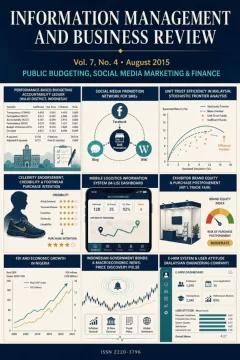 Vol. 7 No. 4 (2015)
Public Budgeting, Social Media Marketing & Finance
View issue contents
Published
Submissions
Have research to publish? Information Management and Business Review welcomes submissions.
Make a Submission