Abstract
The economic development performance can be used to measure the economic growth of a given country. In economic analysis, a country can attain economic growth through the growth in national income measurement. However, there were rigorous discussions on the role of foreign direct investment (FDI) on economic growth and continued to be a topic of discussion on the contemporary economy. This paper serves as an extension to the previous empirical studies on the issue by providing some evidence from time series data for the period 1971 to 2013 of Nigeria. The primary aim of this study is to analyze the impact of FDI on economic growth of Nigeria taking trade openness, Gross Fixed Capital Formation and human capital as control variables. To investigate the long run equilibrium relationship, Johansen and Juselius co-integration approach is analyzed, while the speed of adjustment in the short run is analyzed through the use of VECM method. In Nigeria, FDI, GFCF and HK have long run relationship with economic growth. However, the coefficient of ECM in Nigeria is statistically significant at 1% level of significance. Thus, 10.8% of the adjustment is achieved due to the correction of the adjustment speed in a year.
Keywords
- FDI Search this journal for FDI (opens in a new tab)
- Trade Openness Search this journal for Trade Openness (opens in a new tab)
- Gross Fixed Capital Formation Search this journal for Gross Fixed Capital Formation (opens in a new tab)
- Human Capital Search this journal for Human Capital (opens in a new tab)
- VECM Search this journal for VECM (opens in a new tab)
References
- Adams, S. (2009). Can Foreign Direct Investment (FDI) Help to Promote Growth in Africa? African Journal of Business Management , 3(5), 178–183.
- Agrawal, G. & Khan, M. A. (2011). Impact of FDI on GDP: A Comparative study of China and India. International Journal of Business and Management , 6(10), 71–79.
- Akinlo, A. E. (2004). Foreign Direct Investment and Growth in Nigeria: An Empirical Investigation. Journal of Policy Modeling , 26, 627–639.
- Baharumshah, A. Z. & Law, S. H. (2010). Foreign Direct Investment, Economic Freedom and Economic Growth: International Evidence. Economic Modelling , 27(5), 1079–1089.
- Barro, R. J. & Sala-i-Martin, X. (2004). Economic Growth, (2nd ed), London, The MIIT Press Cambridge.
- Bashir, T., Mansha, A., Zulfiqar, R. & Riaz, R. (2014). Impact of FDI on Economic Growth: A Comparison of South Asian States & China. European Scientific Journal , 10(1), 446–469.
- Hassen, S. & Anis, O. (2012). Foreign Direct Investment (FDI) and Economic Growth: An Approach in terms of Cointegration for the Case of Tunisia. Journal of Applied Finance & Banking , 2(4), 193–207.
- Hooi, L. H. & Wah, T. B. (2010). Linkages between Foreign Direct Investment. Domestic Investment and Economic Growth in Malaysia , 2, 48–57.
- Ismail, M., Saadiah, M., Ridzuan, A. R. & Ahmed, E. M. (2014). The Export Led-Growth and FDI Led-Growth Nexus in Malaysia: Evidence from ARDL Analysis. Advances in Research , 2(5), 240–249.
- Jadhav, P. (2012). Determinants of Foreign Direct Investment in BRICS Economies: Analysis of Economic, Institutional and Political Factor. Procedia - Social and Behavioral Sciences , 37, 5–14.
- Johansen, S. & Juselius, K. (1990). Maximum Likelihood Estimation and Inference on Cointegration - with Applications to the Demand for Money. Oxford Bulletin of Economics and Statistics , 52(2), 169–210.
- Macaulay, E. D. (2003). Foreign Direct Investment and the Performance of the Nigerian Economy.In 1st International Technology, Education and Environment Conference (ASSR)
- Nabi, M. H. & Malarvizhi, C. (2014). Impact of GDP and Exchange Rate on Foreign Direct Investment in Malaysia. Australian Journal of Basic and Applied Sciences , 8(1), 473–478.
- OECD. (2008). Benchmark Definition of Foreign Direct Investment, Report, (4th ed), OECD .
- Ojo, A. S. (2012). Foreign Direct Investment (FDI) Trends in Developing Nations: Nigeria Experience in a Globalization Era. International Business and Management , 4(1), 146–156.
- Parviz, A. (2011). Economic Growth Determinants and Foreign Direct Investment: Causality in Canada. International Journal of Business and Social Science , 2(11), 1–9.
- Saqib, N., Masnoon, M. & Rafique, N. (2013). Impact of Foreign Direct Investment on Economic Growth of Pakistan. Advances in Management & Applied Economics , 3(1), 35–45.
- UNCTAD. (2014). Investing in the SDGs: An Action Plan, Report, New York and Geneva .
- Zaheer, K. K. & Bashir, A. K. (2011). Impact of FDI and Trade Openness on Economic Growth: A Comparative Study of Pakistan and Malaysia. Theoretical and Applied Economics , 17(11), 53–58.
- Zakari, A. Y., Mohammed, A. H. & Adamu, Y. M. (2012). Does FDI Cause Economic Growth? Evidence from Selected Countries in Africa and Asia. African Journal of Social Sciences , 2(4), 114–124.
Downloads
No downloads have been recorded for this article yet. Figures appear here once readers begin downloading the full text.
How to Cite
Share this article
License
Copyright (c) 2015 Sani Ali Ibrahim, Hussin Abdullah (Author)

This work is licensed under a Creative Commons Attribution 4.0 International License.
Author (s) should affirm that the material has not been published previously. It has not been submitted and it is not under consideration by any other journal. At the same time author (s) need to execute a publication permission agreement to assume the responsibility of the submitted content and any omissions and errors therein. After submission of revised paper in the light of suggestions of the reviewers, the editorial team edits and formats manuscripts to bring uniformity and standardization in published material.
This work will be licensed under Creative Commons Attribution 4.0 International (CC BY 4.0) and under condition of the license, users are free to read, copy, remix, transform, redistribute, download, print, search or link to the full texts of articles and even build upon their work as long as they credit the author for the original work. Moreover, as per journal policy author (s) hold and retain copyrights without any restrictions.
Keywords
- FDI Search this journal for FDI (opens in a new tab)
- Trade Openness Search this journal for Trade Openness (opens in a new tab)
- Gross Fixed Capital Formation Search this journal for Gross Fixed Capital Formation (opens in a new tab)
- Human Capital Search this journal for Human Capital (opens in a new tab)
- VECM Search this journal for VECM (opens in a new tab)
Section
Published in
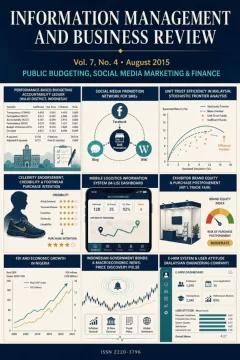 Vol. 7 No. 4 (2015)
Public Budgeting, Social Media Marketing & Finance
View issue contents
Published
Submissions
Have research to publish? Information Management and Business Review welcomes submissions.
Make a Submission