Abstract
Electronic Human Resource Management (e-HRM) is “…the application of information technology for both networking and supporting at least at least two individual or collective actors in their shared performing of HR activities” (Strohmeir, 2007). Using a survey method, this study reports the determinant of employee attitude towards e-HRM in an engineering company in Malaysia. There are basically two major independent variables i.e. perceived usefulness and perceived ease of use. The overall results show that the employees had significantly positive attitude towards e-HRM as they perceived that the system is useful and easy to use. Data shows that they intend to use e-HRM and predict that they would use e-HRM in future. The findings of this research provide valuable insights for the management to create a positive attitude towards technological interventions especially in assisting human resource management. Hence, a company should enhance the employees’ understanding of the system through a proper and thorough training so that they will perceive the system as useful and easy to use.
Keywords
- e-HRM Search this journal for e-HRM (opens in a new tab)
- Electronic Human Resource Management Search this journal for Electronic Human Resource Management (opens in a new tab)
- Perceived Usefulness Search this journal for Perceived Usefulness (opens in a new tab)
- Perceived Ease of Use Search this journal for Perceived Ease of Use (opens in a new tab)
- Engineering Company Search this journal for Engineering Company (opens in a new tab)
References
- Boundarouk, T. & Looise, J. K. (2005). HR contribution to IT innovation implementation: results of three case studies. Creativity and Innovation Management, 14(2), 160-168.
- Bueno, S. & Salmeron, J. L. (2008). TAM-based success modeling in ERP. Interact. Comp, 20(6), 515-523.
- Davis, F. D. (1989). Perceived usefulness, perceived ease of use, and user acceptance of information technology. MIS quarterly , 3, 319-340.
- Erdoğmuş, N. & Esen, M. (2011). An Investigation of the Effects of Technology Readiness on Technology Acceptance in e-HRM. Procedia-Social and Behavioral Sciences , 24, 487-495.
- Lee, M. C. (2010). Explaining and predicting users’ continuance intention toward e-learning: an extension of the expectation confirmation model. Comp. Edu., 54, 506-516.
- Lepak, D. P. & Snell, S. A. (1998). Virtual HR: Strategic human resource management in the 21st century. Human resource management review , 8(3), 215-234.
- Olivas-Lujan, M. R., Ramirez, J. & Zapata-Cantu, L. (2007). E-HRM in Mexico: Adapting innovations for global competitiveness. International Journal of Manpower, 28(5), 418-434.
- Ruel, H. J., Bondarouk, T. V. & Van der Velde, M. (2007). The contribution of e-HRM to HRM effectiveness: Results from a quantitative study in a Dutch Ministry. Employee Relations , 29(3), 280-291.
- Strohmeier, S. (2007). Research in e-HRM: Review and implications. Human Resource Management Review , 17(1), 19-37.
- Venkatesh, V., Morris, M. G., Davis, G. B. & Davis, F.D. (2003). User acceptance of information technology: toward a unified view. MIS Quarterly , 27(3), 425-478.
- Voermans, M. & Veldhoven, M. V. (2007). Attitudes towards E-HRM: An empirical study at Philips. Personnel Review, 36(6), 887-902.
- Yusoff, Y. M., Ramayah, T. & Ibrahim, H. (2010). E-HRM: A proposed model based on technology acceptance model. Afr. J. Bus. Manage , 4(13), 3039-3045.
- Yusoff, Y. M. & Ramayah, T. (2012). Electronic human resource management (e–HRM) and human resource (HR) competencies: some evidence from an emerging market. International Journal of Information and Communication Technology , 4(1), 27-39.
Downloads
No downloads have been recorded for this article yet. Figures appear here once readers begin downloading the full text.
How to Cite
Share this article
License
Copyright (c) 2015 Muhamad Khalil Omar, Siti Norizzati Khairul Fauzi, Azzarina Zakaria, Badrul Azmier Mohamed (Author)

This work is licensed under a Creative Commons Attribution 4.0 International License.
Author (s) should affirm that the material has not been published previously. It has not been submitted and it is not under consideration by any other journal. At the same time author (s) need to execute a publication permission agreement to assume the responsibility of the submitted content and any omissions and errors therein. After submission of revised paper in the light of suggestions of the reviewers, the editorial team edits and formats manuscripts to bring uniformity and standardization in published material.
This work will be licensed under Creative Commons Attribution 4.0 International (CC BY 4.0) and under condition of the license, users are free to read, copy, remix, transform, redistribute, download, print, search or link to the full texts of articles and even build upon their work as long as they credit the author for the original work. Moreover, as per journal policy author (s) hold and retain copyrights without any restrictions.
Keywords
- e-HRM Search this journal for e-HRM (opens in a new tab)
- Electronic Human Resource Management Search this journal for Electronic Human Resource Management (opens in a new tab)
- Perceived Usefulness Search this journal for Perceived Usefulness (opens in a new tab)
- Perceived Ease of Use Search this journal for Perceived Ease of Use (opens in a new tab)
- Engineering Company Search this journal for Engineering Company (opens in a new tab)
Section
Published in
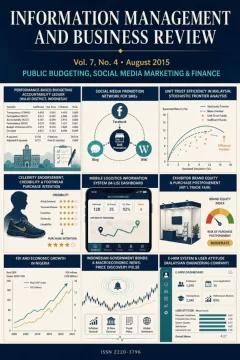 Vol. 7 No. 4 (2015)
Public Budgeting, Social Media Marketing & Finance
View issue contents
Published
Submissions
Have research to publish? Information Management and Business Review welcomes submissions.
Make a Submission