Abstract
This study aims to examine and analyze the effect of transactional leadership to organizational commitment and Islamic performance of Sharia Bank in South Sulawesi. Leader is one of the most important elements that will never disappear from human social life. It arises because of the differences in people's lives are heterogeneous, which then need to put together diselerasikan and directed to the differences that do not result in conflict. There are several types of leadership among transactional leadership. This study was conducted in South Sulawesi with focus on: 1) Sharia BTN, 2) Sharia Mandiri, 3) Sharia BNI, 4) Sharia Muamalah; 5) Sharia BRI, 6) Sharia Niaga; 7) Sharia Mega; 8) Sharia Bukopin; 9) Sharia Sulselbar and 11) Sharia Permata. The main tool in this study is a questionnaire submitted to the Islamic Bank employees in the province of South Sulawesi were selected as sample. It is necessary for item analysis with Structural Equation Modeling (SEM). The results showed that the transactional leadership is significantly influence the Islamic performance. Next, the transactional leadership has no significant effect on the Islamic performance through the organizational commitment.
Keywords
- Islamic Performance Search this journal for Islamic Performance (opens in a new tab)
- Leadership Style Search this journal for Leadership Style (opens in a new tab)
- Transactional Leadership Styles Search this journal for Transactional Leadership Styles (opens in a new tab)
- Organizational Commitment Search this journal for Organizational Commitment (opens in a new tab)
- Sharia Bank Search this journal for Sharia Bank (opens in a new tab)
References
- Darmawan, C. (2006). Kiat sukses Manajemen Rosulullah:Manajemen Sumber daya Insani berbasis nilai-nilai Ilahiah, Jakarta : Khasanah Intelektual.
- Davis, K. (2000). Perilaku Dalam Organisasi, Jilid I, Edisi Ketujuh, Erlangga, Jakarta
- Dessler, G. (1996). Manajemen Sumber Daya Manusia, Edisi 7, Alih Bahasa : Benyamin Molan, Jakarta : Prenhanlindo
- Fineman, S., Sims, D. & Gabriel, Y. (2005). Organizing and Organizations 3rd Ed. British: Sage Publication, Ltd.
- Mc. Clelland, D. C. (1961). The Achieving Society. New York: D. Van Nostrand Company, Inc.
- Nawawi, H. (1993). Manajemen Sumber Daya Manusia untuk Bisnis Yang Kompetitif, Yogyakarta : Penerbit Gadjah Mada University Press.
- Nawawi, H. (2001). Metode Penelitian Bidang Sosial. Gajah Mada University. Press.Yogyakarta
- Rashid, M. Z. A., Sambasivan, M. & Rahman, A. A. (2003). The Influence of Organizational Culture on Attitudes toward Organizational Change. Leadership and Organizational Development Journal, 1(2).
- Robbins, S. (1996). Perilaku Organisasi. Jakarta: PT Raja Grafindo
- Robbins, S. (2000). Perilaku Organisasi, Jilid 1, Alih bahasa: Hadyana Pujaatmaja, Jakarta : Prenhallindo.
- Schein, E. H. (1999). Organizational Culture and Leadership, 2nd Ed. San Fransisco, Jossey – Bass Publishers
- Singarimbun, M. (1995). Metode Penelititan Survei. LP3S, Jakarta
- Sugiyono. (2001). Metode Penelitian Administrasi, Penerbit Alfabeta Bandung
- Tasmara, T. (1995). Etos Kerja Pribadi Muslim, Jakarta : Penerbit PT. Dana bhakti Wakaf.
- Zadjuli, S. I. (1999a). Prinsip-Prinsip Ekonomi Islam, Surabaya: Fakultas Ekonomi Universitas Airlangga.
Downloads
No downloads have been recorded for this article yet. Figures appear here once readers begin downloading the full text.
How to Cite
Share this article
License
Copyright (c) 2016 Muchran BL (Author)

This work is licensed under a Creative Commons Attribution 4.0 International License.
Author (s) should affirm that the material has not been published previously. It has not been submitted and it is not under consideration by any other journal. At the same time author (s) need to execute a publication permission agreement to assume the responsibility of the submitted content and any omissions and errors therein. After submission of revised paper in the light of suggestions of the reviewers, the editorial team edits and formats manuscripts to bring uniformity and standardization in published material.
This work will be licensed under Creative Commons Attribution 4.0 International (CC BY 4.0) and under condition of the license, users are free to read, copy, remix, transform, redistribute, download, print, search or link to the full texts of articles and even build upon their work as long as they credit the author for the original work. Moreover, as per journal policy author (s) hold and retain copyrights without any restrictions.
Keywords
- Islamic Performance Search this journal for Islamic Performance (opens in a new tab)
- Leadership Style Search this journal for Leadership Style (opens in a new tab)
- Transactional Leadership Styles Search this journal for Transactional Leadership Styles (opens in a new tab)
- Organizational Commitment Search this journal for Organizational Commitment (opens in a new tab)
- Sharia Bank Search this journal for Sharia Bank (opens in a new tab)
Section
Published in
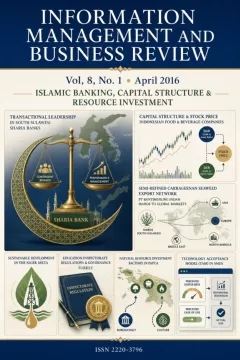 Vol. 8 No. 1 (2016)
Islamic Banking, Capital Structure & Resource Investment
View issue contents
Published
Submissions
Have research to publish? Information Management and Business Review welcomes submissions.
Make a Submission