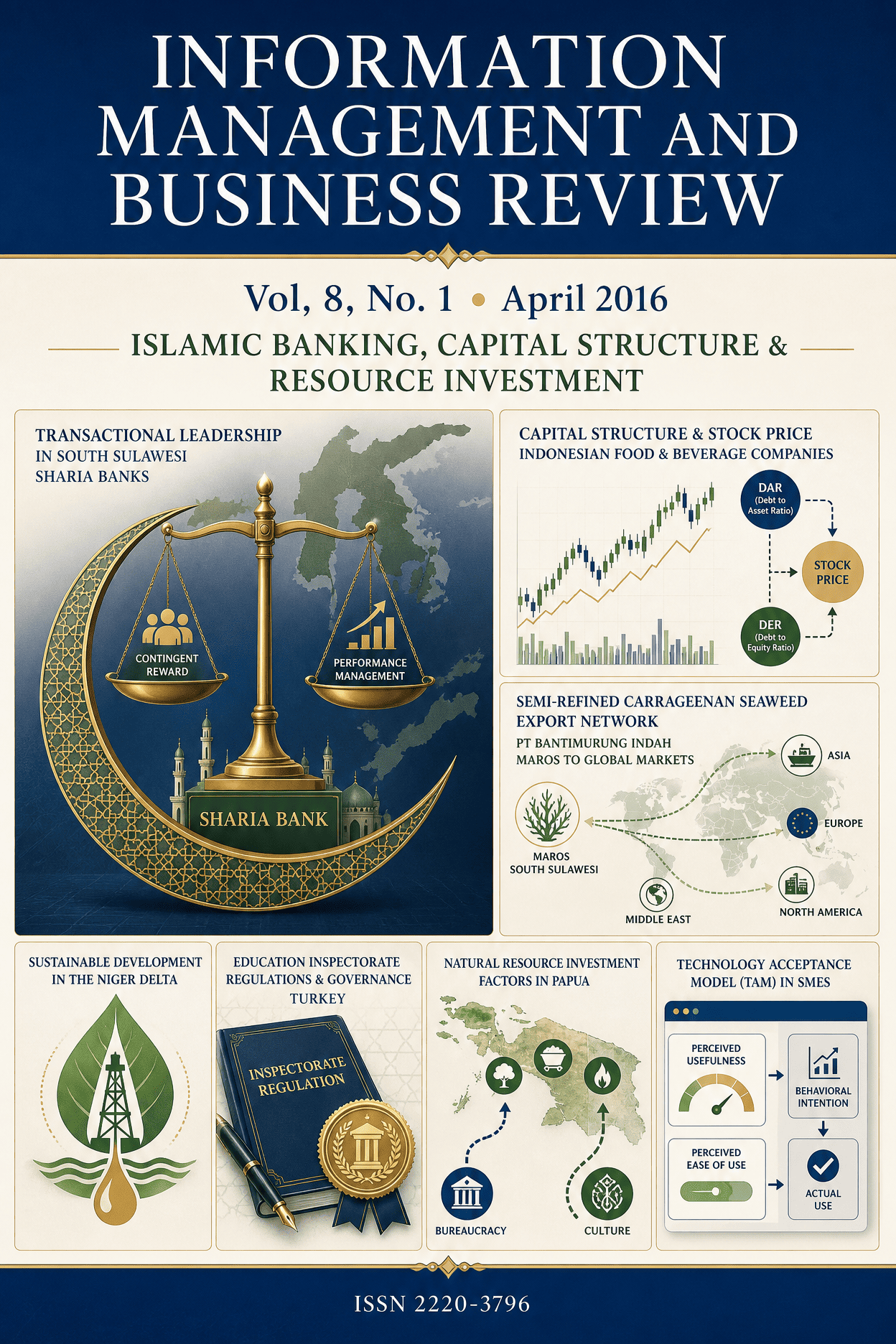
Articles

  • Article 1 in this issue

    The Transactional Leadership Styles to Organizational Commitment and Islamic Performance of Sharia Bank in South Sulawesi

    • Author: Muchran BL

    This study aims to examine and analyze the effect of transactional leadership to organizational commitment and Islamic performance of Sharia Bank in South Sulawesi. Leader is one of the most important elements that will never disappear from human social life. It arises because of the differences in people's lives are heterogeneous, which then need to put together diselerasikan and directed to the differences that do not result in conflict. There are several types of leadership among transactional leadership. This study was conducted in South Sulawesi with focus on: 1) Sharia BTN, 2) Sharia Mandiri, 3) Sharia BNI, 4) Sharia Muamalah; 5) Sharia BRI, 6) Sharia Niaga; 7) Sharia Mega; 8) Sharia Bukopin; 9) Sharia Sulselbar and 11) Sharia Permata. The main tool in this study is a questionnaire submitted to the Islamic Bank employees in the province of South Sulawesi were selected as sample. It is necessary for item analysis with Structural Equation Modeling (SEM). The results showed that the transactional leadership is significantly influence the Islamic performance. Next, the transactional leadership has no significant effect on the Islamic performance through the organizational commitment.

    Pages 6-12

    PDF - The Transactional Leadership Styles to Organizational Commitment and Islamic Performance of Sharia Bank in South Sulawesi (opens in a new tab)
  • Article 2 in this issue

    Assessment of Leadership of a Superior in Polish Enterprises

    • Author: Monika Sipa, Anna Lemańska-Majdzik

    Changes taking place in today's globalised world force enterprises to focus more attention on the quality of leadership resulting mainly from actions and decisions taken by superiors, heads or managers of organisations. Striving to strengthen their market position and achieve success, enterprises concentrate on looking for solutions that will allow them to stimulate employees to make changes and develop in order to increase the quality of the functioning of human capital, and thus implement the strategy of the organisation. Effectiveness and quality of leadership depend to a large extent on competences of employees in an organisation, in particular the competences of the managerial staff. The paper presents results of a survey conducted in January 2015 on a group of employees of Polish enterprises. The aim of the paper is to indicate the main characteristics of a superior and their leadership skills in the area of managing employees. It also points out relationships between selected characteristics and the scale and profile of a company's activity, how long it has been functioning on the market and the period of employment of those surveyed.

    Pages 13-22

    PDF - Assessment of Leadership of a Superior in Polish Enterprises (opens in a new tab)
  • Article 3 in this issue

    Effect of Capital Structure, Company Size and Profitability on the Stock Price of Food and Beverage Companies Listed on the Indonesia Stock Exchange

    • Author: Sitti Murniati

    The purpose of this study was to analyze the effect of capital structure proxy for debt to asset ratio (DAR) and the debt to equity ratio (DER), company size and profitability are proxied by return on assets (ROA), return on equity (ROE) and net profit margin (NPM) to the stock price on the company's Food and Beverage listed on the Indonesia Stock Exchange. This study uses Associative approach. The population in this study is the Food and Beverage companies listed in Indonesia Stock Exchange year period 2011 to 2014. Sampling method used is purposive sampling and the amount of samples obtained is 11 companies with 44 observations. Hypotheses were tested using multiple regression analysis. Results of the study were 1) capital structure proxy for debt to asset ratio (DAR) significant negative effect on stock prices, this means that if a decline in the value of DAR, the stock price will rise, 2) capital structure proxy for debt to equity ratio (DER) significant positive effect on stock prices, it means that the higher the value of DER then be followed by a decrease in stock prices, 3) The company size significant positive effect on stock prices, this suggests that the relationship between the SIZE with stock prices in the same direction, if SIZE increases, the stock price will increase, 4) profitability is proxied by return on assets (ROA) significant positive effect on stock prices, this means that the assets of the company to make a profit can affect stock prices, 5) profitability proxied with a return on equity (ROE) significant negative effect, this means that if a decline in ROE it will be followed by a decrease in stock prices, and 6) Profitability which is proxied by net profit margin (NPM) significant negative effect on stock prices, this means that while the net profit increased, the total sales will rise this is due to the high costs incurred by the company so that NPM has no effect on stock prices.

    Pages 23-29

    PDF - Effect of Capital Structure, Company Size and Profitability on the Stock Price of Food and Beverage Companies Listed on the Indonesia Stock Exchange (opens in a new tab)
  • Article 4 in this issue

    The Development of Seaweed at DI PT. Bantimurung Indah Maros Regency

    • Author: Yuliana

    This study aims to know the marketing systems, market shares, sales projection for next 5 years, and marketing prospects of processed seaweed (Semi Refine Carrageenan) at PT. Bantimurung Indah Maros. This study was conducted at PT. Bantimurung Indah Maros located at Dr. Sam Ratulangi Street, Maros Regency, South Sulawesi. This company was one of the branches of Bosowa Group producing processed seaweed. Data collected were processed seaweed production, export realization of processed seaweed, realization of processed seaweed according to types/specification (2003-2007), and industry companies/export-destination countries of processed seaweed at PT. Bantimurung Indah Maros. According to marketing mix analysis of marketing systems of processed seaweed (Semi Refine Carrageenan) of PT. Bantimurung Indah Maros, it was shown that the marketing systems was sales of processed seaweed products (Semi Refine Carrageenan) to industrial companies in the international scale with “Systems Sales” method started by conducting business negotiation with buyer candidates in which it was included the application of all marketing mix variables such as product (sample shipping), price (price offerings), distribution (goods delivery/delivery time) and promotion (local, national and international exhibitions, international seminars and conferences, and internet). According to market shares analysis it was shown that when processed seaweed products (Semi Refine Carrageenan) were converted to dry seaweed (raw material) with sucrose content of 25 %, PT. Bantimurung Indah Maros controlled average market shares of 12, 79% for the last 5 years (2003-2007), and for SRC (TG) products it controlled market shares of 100% in South Sulawesi. According to prediction analysis of processed seaweed exports (Semi Refine Carrageenan) bulk volume (ton) and value (US$) by using Least Squares method it was shown that sales volume averaged - 305.41 ton/year with value of US$ -159.548, 8 per year for next 5 years (2008-2012). According to External and Internal Environment analysis (SWOT Analysis it was shown that PT. Bantimurung Indah Maros has much strength, especially in marketing section (company reputation, quality reputation and so on), has many weaknesses (limitations in technology, production facility, and so on), and has many opportunities (prospects of seaweed use, geographical location, and so on).

    Pages 30-37

    PDF - The Development of Seaweed at DI PT. Bantimurung Indah Maros Regency (opens in a new tab)
  • Article 5 in this issue

    Human Capability and Entrepreneurial Development in the Niger Delta Region of Nigeria

    • Author: Paul Oghenero Okumagba, Otega Okinono

    The paper sets out to explore the link existing between the entrepreneurial interventions and human capital development in Niger Delta Region of Nigeria. In order to address the major problem of the Niger Delta region of Nigeria, many successive governments in Nigeria have embarked on one entrepreneurship developmental program or the other. Unfortunately, all these government efforts have failed to yield a fruitful sustainable entrepreneurial development particularly among the Niger Delta region that are mainly the target of the programs. Past studies have attributed such failure to a range of factors such as infrastructure decay and deficiency leading to poor human development, lack of proper implementation of the master plan, lack of funds, inadequacy of the master plan etc. Although, the efforts of the past studies as well as that of the developmental agencies are commendable, however, they have failed to address one important issue which is the human capability aspect of the developmental program. Therefore, this paper explores the role of human capability approach on the effectiveness of the entrepreneurship development programs within the Niger Delta region context and the political influence with a view to proposing a framework to examine the relationship between human capability and effective entrepreneurship development programs.

    Pages 38-46

    PDF - Human Capability and Entrepreneurial Development in the Niger Delta Region of Nigeria (opens in a new tab)
  • Article 6 in this issue

    Analysis of the Perceptions of Administrators on the Educations Regulations

    • Author: Saduman Kapusuzoglu, Zubeyde Copur

    The main purpose of the Ministry of National Education Guidance and Inspection Directorate and Education Inspectors Directorates Regulation consists of defining the organizations and duties of these directorates. In this respect, the regulation deals with the power and responsibilities of education inspectors to be appointed in the directorates separately and regulates issues such as their appointment, employment, training and replacement; in short all working style and principles. In this study, it is aimed at analyzing and evaluating the Ministry of National Education Guidance and Supervision Directorate and Education Inspectors Directorates Regulation taking the views of inspectors in the dimensions of structure, process and understanding. In line with this purpose, the views of education inspectors (N=86) have been obtained by Baskan and Kapusuzoğlu (2013) through a survey of 25 items developed in line with the regulations. The obtained data has been analyzed through averages, the T- test, Anova and Tukey-B tests. As a result of the study, it has been concluded that the inspectors do not find the application terms related to the competition examination and the changes made in terms of the examination board, regulations made in terms of the reclamation period and the oral examination process “appropriate” and that they find the regulations related to the written examination subjects and score weight, their training and appointment “partially appropriate.” In addition, the views of the inspectors do not display differences based on personal characteristics with the exception of terms of service.

    Pages 47-56

    PDF - Analysis of the Perceptions of Administrators on the Educations Regulations (opens in a new tab)
  • Article 7 in this issue

    Smartphone Use of Effectiveness in Supporting Young Entrepreneurs Business Activity in the Palopo Using Technology Acceptance Model (TAM)

    • Author: Muhammad Ikbal, Rahmat Solling Hamid

    The development effort involving young entrepreneurs by age relative in Palopo City is now starting to grow and develop. One of the factors that affect the increasingly rapid development of information and communication technology. The development of information and communication technology enables anyone to conduct business without having to incur substantial costs for investment only places and other infrastructure. This study aims to determine the effectiveness of the use of information and communication technology in this case is a smart phone to support the business activities of young entrepreneurs in Palopo. Total sample of 150 respondents. Data analysis was performed using the Partial Least Square (PLS) with 4.0 WarpPLS program. The results of the study results showed that of the five hypotheses which are built in this research there are four hypotheses that can be accepted: (1) Perceived Ease of Use significant effect on Perceived Usefulness; (2) Perceived Ease of Use significant positive effect on User Satisfaction; (3) Perceived Usefulness significant positive effect on Behavioral intention; (4) User Satisfaction significant positive effect on Behavioral Intention. While the hypothesis is not accepted, namely (1) Perceived Ease of Use positive effect was not significant to the User Satisfaction, which in this hypothetical direct influence that has no significant effect. This study also provides empirical support for the theory of TAM in the context of the Smartphone use by young entrepreneurs in the city of Palopo in support of business activities. The benefits and user satisfaction is an important determinant that explains the interest behaves using Smartphone. In addition Smartphone has a user friendly design that allows users to operate the various service features / applications provided on each brand Smartphone. The results of this research study also found information that would have a positive impact on young entrepreneurs perkembagan with age categories were taken from 20 years has begun to grow. This indicates that the motivation, innovation and creativity among young entrepreneurs to continue to try to create jobs independently.

    Pages 57-65

    PDF - Smartphone Use of Effectiveness in Supporting Young Entrepreneurs Business Activity in the Palopo Using Technology Acceptance Model (TAM) (opens in a new tab)
  • Article 8 in this issue

    Factor Analysis - Dominant Factors Affecting the Investment of Natural Resources in Papua Province

    • Author: Zainal Arifin Wasaraka

    The aims of this research are to determine and to analyze about the effect of infrastructure, bureaucracy and regulation, and culture social environment toward natural resources in Papua Provincial. The research methods are survey and path way analyses. Results from the research showed that are: 1) bureaucracy and regulation factor have direct effect to invest, it is also indirect effect with culture intervening variables, 2)The Direct effect of culture social environment to invest natural resources is 21,3%.

    Pages 66-71

    PDF - Factor Analysis - Dominant Factors Affecting the Investment of Natural Resources in Papua Province (opens in a new tab)