Abstract
The progress of this study is to offer and test models that include models of leadership of customer behavior and willingness to deliberately purchase luxury fashion items. The impact of many social, psychological and social emergencies has been identified and recognized. To narrow this gap, the study was conducted to identify key milestones in the readiness to buy counterfeit products in Pakistan. The survey was conducted by 257 people from three major markets in Pakistan, such as Lahore, Faisalabad and Islamabad. In addition, the SEM technique is used to test the hypothesis. The study ends with some contributions and findings. Economic benefits, past experience and materialism of counterfeiting play an important role in the pursuit of counterfeit products. While the hedonic benefits were not as important as hypothetical. The study identifies the leading determinants of lying and willingness to buy fake products by testing a wide range of literature and theories on consumer behavior and marketing. From the point of view of managers, stylish fashion makers will gain insight into the factors that play a key role in counterfeiting. However, a little of this study was revised on the basis of the regional context. From a theoretical point of view the theoretical theory is encouraged to enter into the literary literature relating to purchasing decisions.
Keywords
- Counterfeit Goods Search this journal for Counterfeit Goods (opens in a new tab)
- Economic Benefits Search this journal for Economic Benefits (opens in a new tab)
- Hedonic Benefits Search this journal for Hedonic Benefits (opens in a new tab)
- Materialism Search this journal for Materialism (opens in a new tab)
- Willingness to Buy Counterfeits Search this journal for Willingness to Buy Counterfeits (opens in a new tab)
- Attitude Towards Counterfeits Search this journal for Attitude Towards Counterfeits (opens in a new tab)
References
- Bai, B., Law, R. & Wen, I. (2008). The impact of website quality on customer satisfaction and purchase intentions: Evidence from Chinese online visitors. International journal of hospitality management, 27(3), 391-402.
- Belfanti, C. M. (2017). Branding before the brand: Marks, imitations and counterfeits in pre-modern Europe. Business History, 1-20.
- Belk, R. W. (2003). Shoes and self. ACR North American Advances.
- Blumberg, C., Cooper, D. & Schindler, S. (2008). Research methods. Boston: Irwin, 2, 130-139.
- Chernev, A., Hamilton, R. & Gal, D. (2011). Competing for consumer identity: Limits to self-expression and the perils of lifestyle branding. Journal of Marketing, 75(3), 66-82.
- El Din, D. G. & El Sahn, F. (2013). Measuring the factors affecting Egyptian consumers' intentions to purchase global luxury fashion brands. The Business & Management Review, 3(4), 44.
- Furnham, A. & Valgeirsson, H. (2007). The effect of life values and materialism on buying counterfeit products. The Journal of Socio-Economics, 36(5), 677-685.
- Gabriel Taquini, R. (2016). The consumer-to-consumer persuasion: application of rhetorical appeals in consumer’s reviews. University of Twente.
- Gentry, J. W., Putrevu, S. & Shultz, C. J. (2006). The effects of counterfeiting on consumer search. Journal of consumer behaviour, 5(3), 245-256.
- Grossman, G. M. & Shapiro, C. (1988). Foreign counterfeiting of status goods. The Quarterly Journal of Economics, 103(1), 79-100.
- Huang, J. H., Lee, B. C. & Hsun Ho, S. (2004). Consumer attitude toward gray market goods. International Marketing Review, 21(6), 598-614.
- Khan, A. S., Shabbir, R. & Majeed, S. (2017). Ascertaining The Leading Antecedents Of Willingness To Buy Counterfeit Luxury Fashion Products: An Evaluation And Extension.
- Mathieson, K., Peacock, E. & Chin, W. W. (2001). Extending the technology acceptance model: the influence of perceived user resources. ACM SigMIS Database, 32(3), 86-112.
- Min, S. & Mentzer, J. T. (2004). Developing and measuring supply chain management concepts. Journal of business logistics, 25(1), 63-99.
- Nia, A. & Lynne Zaichkowsky, J. (2000). Do counterfeits devalue the ownership of luxury brands? Journal of product & brand management, 9(7), 485-497.
- Prendergast, G., Hing Chuen, L. & Phau, I. (2002). Understanding consumer demand for non-deceptive pirated brands. Marketing intelligence & planning, 20(7), 405-416.
- Ramayah, T., Lee, J. W. C. & Mohamad, O. (2010). Green product purchase intention: Some insights from a developing country. Resources, Conservation and Recycling, 54(12), 1419-1427.
- Richins, M. L. & Dawson, S. (1992). A consumer values orientation for materialism and its measurement: Scale development and validation. Journal of Consumer Research, 19(3), 303-316.
- Sheppard, B. H., Hartwick, J. & Warshaw, P. R. (1988). The theory of reasoned action: A meta-analysis of past research with recommendations for modifications and future research. Journal of Consumer Research, 15(3), 325-343.
- Tifferet, S. & Herstein, R. (2012). Gender differences in brand commitment, impulse buying, and hedonic consumption. Journal of product & brand management, 21(3), 176-182.
- Tynan, C., McKechnie, S. & Chhuon, C. (2010). Co-creating value for luxury brands. Journal of Business research, 63(11), 1156-1163.
- Van der Heijden, H. (2004). User acceptance of hedonic information systems. MIS quarterly, 695-704.
- Veloutsou, C. & Bian, X. (2008). A cross‐national examination of consumer perceived risk in the context of non‐deceptive counterfeit brands. Journal of consumer behaviour, 7(1), 3-20.
- Yoo, B. & Lee, S. H. (2009). Buy genuine luxury fashion products or counterfeits? ACR North American Advances.
Downloads
No downloads have been recorded for this article yet. Figures appear here once readers begin downloading the full text.
How to Cite
Share this article
License
Copyright (c) 2018 Khalid Jamil, Muhammad Asghar Ali, Naeem Akram (Author)

This work is licensed under a Creative Commons Attribution 4.0 International License.
Author (s) should affirm that the material has not been published previously. It has not been submitted and it is not under consideration by any other journal. At the same time author (s) need to execute a publication permission agreement to assume the responsibility of the submitted content and any omissions and errors therein. After submission of revised paper in the light of suggestions of the reviewers, the editorial team edits and formats manuscripts to bring uniformity and standardization in published material.
This work will be licensed under Creative Commons Attribution 4.0 International (CC BY 4.0) and under condition of the license, users are free to read, copy, remix, transform, redistribute, download, print, search or link to the full texts of articles and even build upon their work as long as they credit the author for the original work. Moreover, as per journal policy author (s) hold and retain copyrights without any restrictions.
Keywords
- Counterfeit Goods Search this journal for Counterfeit Goods (opens in a new tab)
- Economic Benefits Search this journal for Economic Benefits (opens in a new tab)
- Hedonic Benefits Search this journal for Hedonic Benefits (opens in a new tab)
- Materialism Search this journal for Materialism (opens in a new tab)
- Willingness to Buy Counterfeits Search this journal for Willingness to Buy Counterfeits (opens in a new tab)
- Attitude Towards Counterfeits Search this journal for Attitude Towards Counterfeits (opens in a new tab)
Section
Published in
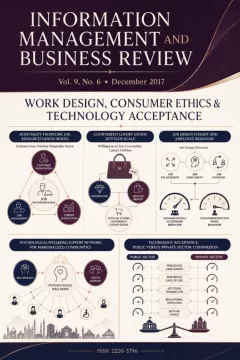 Vol. 9 No. 6 (2017)
Work Design, Consumer Ethics & Technology Acceptance
View issue contents
Published
Submissions
Have research to publish? Information Management and Business Review welcomes submissions.
Make a Submission