Articles

  • Article 1 in this issue

    Job Resourcefulness, Customer Orientation and Employees Outcomes: A Study of Hotel Employees in Pakistan

    • Author: Afsheen Fatima, Sarah Salah Uddin, Saba Mehmood, Ashfeen Bibi

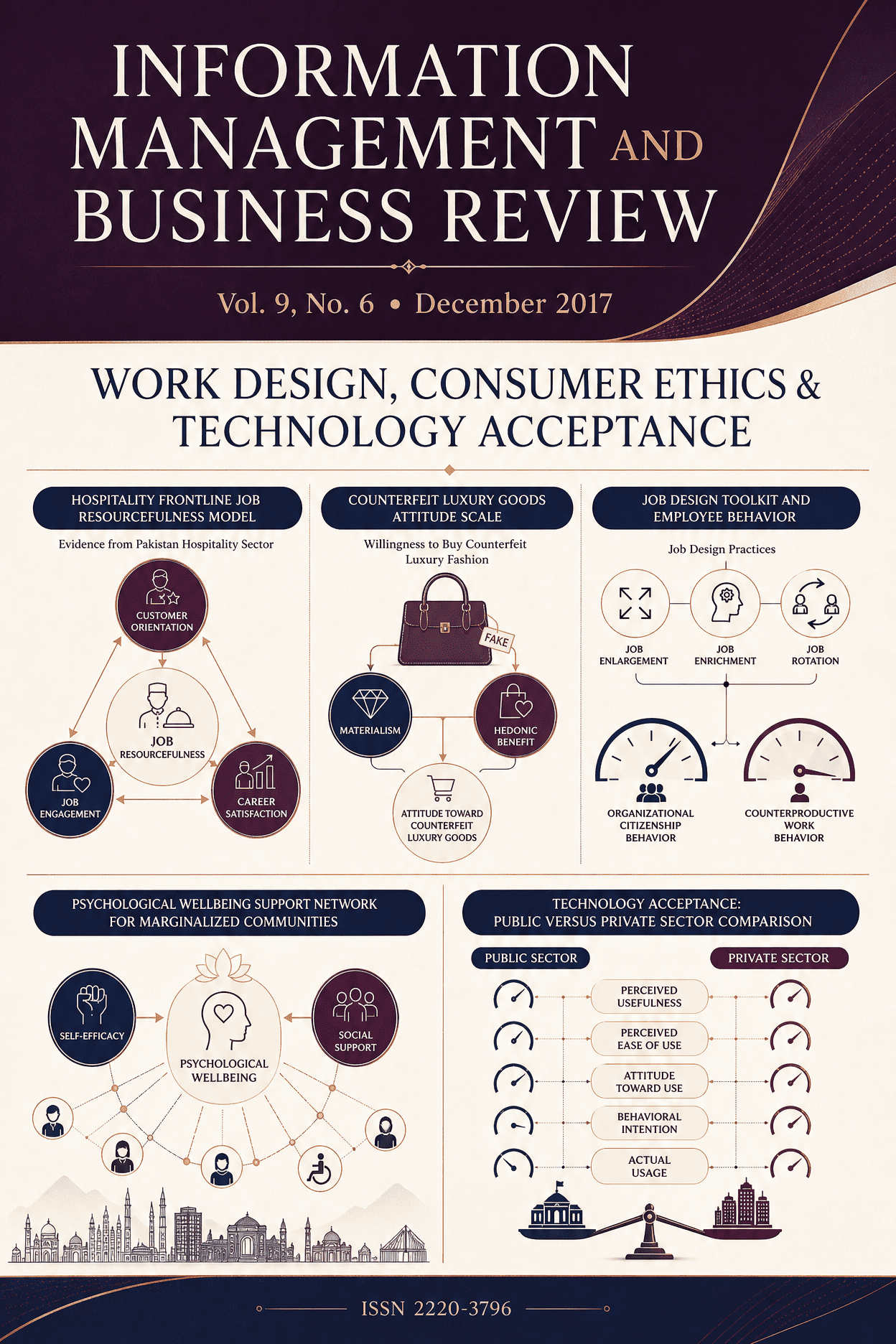
    Increased competition and a rapidly changing environment present a huge challenge to organizations in implementing effective human capital and development strategies to boost their efficiency and overall performance. An organization’s human resource is definitively its most significant asset. The provisions of important job resources help workforce perform their job in an efficient way. These resources are very important for employee satisfaction and performance of the organization. This study was carried out to examine the impact of job resourcefulness (JR) on two employee outcomes i.e., job engagement and career satisfaction directly as well as indirectly through customer orientation. A convenient sample of 257 employees was taken from hospitality industry within twin cities of Pakistan (Rawalpindi and Islamabad). Questionnaires were used to collect data using a five point Likert type scale. Job resourcefulness was operationalized using four items from Harris et al. (2006) whereas customer orientation was measured using four items from Licata et al. (2003). Five items were selected from career satisfaction scale developed by Greenhaus et al. (1990). Finally, nine items scale of job engagement developed by (Schaufeli, Bakker et al. 2006) was also used. The results exhibit that all the variables are positively and significantly related. Moreover, the findings are indicative of customer orientation’s role as a mediator between job resourcefulness and employee outcomes. Recommendations for future research and research implications are also discussed at the end of the paper.

    Pages 6-17

    PDF - Job Resourcefulness, Customer Orientation and Employees Outcomes: A Study of Hotel Employees in Pakistan (opens in a new tab)
  • Article 2 in this issue

    A Study of Factors Affecting Consumer’s Willingness to buy Counterfeit Products

    • Author: Khalid Jamil, Muhammad Asghar Ali, Naeem Akram

    The progress of this study is to offer and test models that include models of leadership of customer behavior and willingness to deliberately purchase luxury fashion items. The impact of many social, psychological and social emergencies has been identified and recognized. To narrow this gap, the study was conducted to identify key milestones in the readiness to buy counterfeit products in Pakistan. The survey was conducted by 257 people from three major markets in Pakistan, such as Lahore, Faisalabad and Islamabad. In addition, the SEM technique is used to test the hypothesis. The study ends with some contributions and findings. Economic benefits, past experience and materialism of counterfeiting play an important role in the pursuit of counterfeit products. While the hedonic benefits were not as important as hypothetical. The study identifies the leading determinants of lying and willingness to buy fake products by testing a wide range of literature and theories on consumer behavior and marketing. From the point of view of managers, stylish fashion makers will gain insight into the factors that play a key role in counterfeiting. However, a little of this study was revised on the basis of the regional context. From a theoretical point of view the theoretical theory is encouraged to enter into the literary literature relating to purchasing decisions.

    Pages 18-25

    PDF - A Study of Factors Affecting Consumer’s Willingness to buy Counterfeit Products (opens in a new tab)
  • Article 3 in this issue

    A Study of Casual Relationship of Job Design and Employee’s Behavior

    • Author: Saqib Muneer, Khalid Jamil, Muhammad Idrees

    Some factors other than higher salaries, compensation benefits and conducive workplace seem to have strong impact on employee’s performance i.e. organization citizenship behavior and counterproductive work behavior. Purpose of this study is to examine the impact of job design elements i.e. job enlargement, job enrichment and job rotation on employee’s organizational citizenship behavior and counterproductive work behavior in the banking sector of Faisalabad and extent to which this relationship is mediated by motivation. Data was collected from 170 frontline managers of banks. After analysis of data, it was found that that there is a positive and significant relationship between job enlargements, job enrichment on OCB while negative and significant relationship between job rotation and OCB. Negative and significant relationship between job enlargement and CWB, negative but insignificant relationship between job enrichment and CWB while positive and significant relationship was found between the job rotation and CWB. Motivation was partially mediating the relationship between job enlargement, enrichment, rotation and organizational citizenship behavior, while motivation was partially mediating the relationship between job rotation and counterproductive work behavior. This study enhances the existing literature of job design and contributes to research by finding how job design influences the OCB & CWB.

    Pages 26-35

    PDF - A Study of Casual Relationship of Job Design and Employee’s Behavior (opens in a new tab)
  • Article 4 in this issue

    The Impact of Social Support on Psychological Distress among Khawajasira Community: The Mediated Effect of Self-Efficacy

    • Author: Hafiz Muhammad Ahmad Abbas, Virdah Iram Gull, Khalid Ghaffar

    Khawajasira is a general terminology used typically in Pakistan that refers to the people who are transgender, hermaphrodite, inter-sexed, eunuch, transvestites, homosexual or bisexual (Brettell & Sagen, 1997). The current study examines the impact of Social Support and Self-efficacy in producing Psychological distress among Khawajasiras. A sample of total two hundred Khawajasiras (N=200) was drawn from the KhawajaSira community living in Southern Punjab. Urdu versions of Psychological Distress Scale K10 by Kessler (2010), General Self-Efficacy Scale (2003) and a 3 item self-created questionnaire were used to measure Psychological distress, Self-efficacy and Social support respectively. To measure reliability of all three scales, reliability analysis was performed. Analysis of data through SPSS suggested significant positive association among Self-efficacy and Social support; Social support and Self-efficacy significantly negatively associated with Psychological distress. Moreover, Social support significantly predicted the Psychological distress in Khawajasiras even after controlling the demographic variables. In KhawajaSira community, association between Social support and Psychological Distress was mediated by Self-efficacy. Suggestions for future research and implications of the study were also discussed.

    Pages 36-40

    PDF - The Impact of Social Support on Psychological Distress among Khawajasira Community: The Mediated Effect of Self-Efficacy (opens in a new tab)
  • Article 5 in this issue

    Differences in Information Technology Systems in Public and Private Sector

    • Author: Marwah Yusuf, Paulus Tangke, Grace T. Pontoh

    This study aims to examine differences in information technology acceptance in the public sector and private sector in Indonesia. This study explores previous research on the subject, especially with regard to the Technology Acceptance Model (TAM). Acceptance of technology according to theory can be influenced by several aspects, such as: behavior, satisfaction, benefits, convenience, social as well as security and privacy. Of the various aspects of this most influential generally considered to differences in acceptance of the technology on "every individual" in the public sector and the private sector there are two namely: aspects of behavior and benefits.

    Pages 41-44

    PDF - Differences in Information Technology Systems in Public and Private Sector (opens in a new tab)