Abstract
The purpose of this study is to measure the level of financial literacy of working women, to describe assets allocation, as well as the time and profit in investment. This research paper is a qualitative study using the descriptive method. Noting the purpose, it is suitable if the qualitative approach was implemented. The respondents are working women with most of them have been married, 16-22 years old on average, have a bachelor degree, and work in the government sector with the majority of the income is more than 4.000.000 rupiahs. Those respondents’ characteristics will influence their choice in doing investment because it is associated with the tolerance of risks. The first form of behavior and preference of investment done by working women is that majority of them have thought about investment plan and most of the respondents think that everyone can get profitable investment if they do financial planning and saving/investment. The second form of behavior is that the majority of respondents are more interested in property investment. The third form of behavior motivating working women in doing investment is themselves, like retirement planning and family security reason. Based on the study, it shows that working women have high financial literacy which is indicated by their discipline in doing the investment of their excess money, thus they have control over their finances and believe to get investment profit they should do financial planning.
Keywords
- Financial Behavior Search this journal for Financial Behavior (opens in a new tab)
- Working Women Search this journal for Working Women (opens in a new tab)
- Investment Decision-Making Search this journal for Investment Decision-Making (opens in a new tab)
- Financial Literacy Search this journal for Financial Literacy (opens in a new tab)
- Assets Allocation Search this journal for Assets Allocation (opens in a new tab)
References
- Ajzen, I. (1985). From Intentions to Action: Theory of Planned Behavior. New York: Springer.
- Ajzen, I. (1991). Theory of planned behavior. Journal Organizational Behavior and Human Decision Processes, 50, 179–211.
- Ajzen, I. & Fishbein, M. (1977). Attitude-Behavior Relations: A Theoretical Analysis and Review of Empirical Research. Psychological Bulletin, 84(5), 888–918.
- Ajzen, I. & Fishbein, M. (2000). Attitudes and the Attitude-Behavior Relation: Reasoned and Automatic Processes. European Review of Social Psychology, 11(1), 1–33.
- Allport, G. W. (1954). The Nature of Prejudice. Oxford: Addison-Wesley.
- Azwar, S. (2000). Sikap Manusia, Teori, dan Pengukurannya. Jogjakarta: Pustaka Pelajar Jogja Offset.
- Bahl, S. (2012). Investment Behaviour of Working Women of Punjab. A Journal of Economics and Management, 1(6).
- Bajtelsmit, V. L. & VanDerhei, J. L. (1997). Risk Aversion and Pension Investment Choices. Positioning Pensions for the Twenty-First Century (Vol. 35). Philadelphia: University of Pennsylvania Press.
- Baker, H. K. & Nofsinger, J. R. (2010). Behavioral Finance: Investors, Corporations, and Markets. New Jersey: John Wiley & Sons.
- Bernasek, A. & Shwiff, S. A. (2001). Gender, Risk, and Retirement. Journal of Economic Issues, 35(2), 345–356.
- Butler, K. C. & Domian, D. L. (1991). Risk, Diversification, and the Investment Horizon. The Journal of Portofolio Management, 17(3), 41–48.
- Byrnes, J. P., Miller, D. C. & Schafer, W. D. (1999). Gender Differences in Risk Taking: A Meta-Analysis. Psychological Bulletin, 125(3), 367–383.
- Chang, R. Y. (1998). Langkah-langkah Pemecahan Masalah. Jakarta: PT Pustaka Binaman Pressindo.
- Chen, H. & Volpe, R. P. (1998). An Analysis of Personal Financial Literacy Among College Students. Financial Services Review, 7(2), 107–128.
- Christanti, N. & Mahastanti, L. A. (2011). Faktor-faktor yang Dipertimbangkan Investor dalam Melakukan Investasi. Jurnal Manajemen Teori Dan Terapan, 4(3), 37–51.
- Dharmmesta, B. S. (1998). Theory Of Planned Behavior dalam Penelitian Sikap, Niat dan Perilaku Konsumen. Kelola, 8(7), 85–163.
- Eckel, C. C. & Grossman, P. J. (2002). Differences in the Economic Decisions of Men and Women: Experimental Evidence. North-Holland, Amsterdam, The Netherlands: Elsevier Science B. V.
- Gneezy, U., Leonard, K. L. & List, J. A. (2009). Gender Differences in Competition: Evidence from a Matrilineal and a Patriarchal Society. Econometrica, 77(5), 1637–1664.
- Hartono, J. (2003). Teori Portofolio dan Analisis Investasi. Yogyakarta: BPFE-Yogyakarta.
- Hibbert, A. M., Lawrence, E. & Prakash, A. (2008). Are Woman More Risk-Averse Than Men?, 1–56.
- Hidayat, R. (2010). Keputusan Investasi Dan Financial Constraints: Studi Empiris Pada Bursa Efek Indonesia. Buletin Ekonomi Moneter Dan Perbankan, 12(4), 457–479.
- Hinz, R. P., McCarthy, D. D. & Turner, J. A. (1997). Are WOmen Conservative Investors? Gender Differences in Participants-Directed Pension Investments. Philadelphia: University of Pennsylvania Press.
- Indonesia, S. (2017). East Java Province in Figures.
- Indrawan, H. (2014). Variabel Demografi Wanita Bekerja di Surabaya dalam Pemilihan Jenis Investasi Keluarga. FINESTA, 2(1), 71–75.
- Jahanzeb, A., Muneer, S. & Ur-Rehman, S. (2012). Implication of Behavioral Finance in Investment Decisionmaking Process. Information Management and Business Review, 4(10), 532–536.
- Jain, R. (2014). An Analysis of Income and Investment Pattern of Working Women in the City of Ahmedabad. International Journal of Research in Management & TechnologyInternational Journal of Research in Management & Technology, 4(46), 139–146.
- Jisha, V. G. & GoMathi, V. (2017). A Study on the Perception of Investment Pattern among Urban Working Women with Reference to Coimbatore City. International Journal of Engineering Science and Computing, 7(2), 4303–4307.
- Kreitner, R. & Kinicki, A. (2001). Organizational Behavior. Irwin McGraw-Hill.
- Mincer, J. & Polachek, S. (1974). Family Investments in Human Capital: Earnings of Women Family Investments in Human Capital: Earnings of Women. Journal Pf Political Economy, 82(2), 76–108.
- Mittal, M. (2010). Study of Differences in Behavioral Biases in Investment Decision Making. The IUP Journal of Behavioral Finance, 7(4), 20–34.
- Mowen. (1995). Perilaku Konsumen dan Komunikasi Pemasaran. Jakarta: Karangan Sutisna.
- Notoatmodjo, S. (1997). Pengembangan Sumber Data Manusia. Jakarta: Penerbit PT Rineka Cipta.
- Olsen, R. A. & Cox, C. M. (2001). The Influence of Gender on the Perception and Response to Investment Risk: The Case of Professional Investors. Journal of Psychology and Financial Markets, 2(1), 29–36.
- Peteros, R. & Maleyeff, J. (2013). Application of Behavioral Finance Concept to Investment Decision Making: Suggestion for Improving Investment Education Courses. International Journal of Management, 30(1), 249–261.
- Purwanto, H. (1998). Pengantar Perilaku Manusia untuk Keperawatan. Jakarta: EGC.
- Rahadjeng, E. R. (2011). Analisis Perilaku Investor Perspektif Gender dalam Pengambilan Keputusan Investasi di Pasar Modal. E-Journal Universitas Muhammadiyah Malang, 6, 90–97.
- Rajarajan, V. (2000). Predictors of Expected Rate of Return by Individual Investors. The Indian Journal of Commerce, 53(4), 65–70.
- Retno, R. N. H. (2014). Analisis Keputusan Investasi oleh Tenaga Kerja Indonesia. Jurnal Ilmiah Mahasiswa FEB Universitas Brawijaya, 2, 2.
- Selvi, T. T. (2012). A Study on Investment Behaviour of Women Entrepreneurs in Coimbatore District. Unpublished Dissertation, Mother Teresa Women’s University India.
- Shefrin, H. (2000). Beyond Greed and Fear: Understanding Behavioral Finance and Psychology of Investing. Boston: Harvard Business School Press.
- Sunariyah. (2003). Pengantar Pengetahuan Pasar Modal. Yogyakarta: (UPP) AMP YKPN.
- Sunden, A. E. & Surette, B. J. (1998). Gender Differences in the Allocation of Assets in retirement Savings Plans. American Economic Review, 88(2), 207–211.
- Sung, J. (1997). A Structural Analysis of Retirement Funds in a Family Context: Participation and Investment in Stocks. Unpunlished Dissertations, the Ohio State University , Columbus, OH.
- Tandelilin, E. (2010). Portofolio dan Investasi: Teori dan Aplikasi. Yogyakarta: Kanisius.
- Warren, W. E., Stevens, R. E. & McConkey, C. W. (1990). Using Demography and Lifestyle Analysis to Segment Individual Indualestors: A Segmentation Approach. Journal of Behavioral Finance, 5(3), 170–179.
- Yuh, Y. & Hanna, S. D. (1997). The Demand for Risky Assets in Retirement Portfolios. Proceedings of the Academy Financial Services, (July), 1–10.
Downloads
No downloads have been recorded for this article yet. Figures appear here once readers begin downloading the full text.
How to Cite
Share this article
License
Copyright (c) 2019 Nadia Asandimitra, Tony Seno Aji, Achmad Kautsar (Author)

This work is licensed under a Creative Commons Attribution 4.0 International License.
Author (s) should affirm that the material has not been published previously. It has not been submitted and it is not under consideration by any other journal. At the same time author (s) need to execute a publication permission agreement to assume the responsibility of the submitted content and any omissions and errors therein. After submission of revised paper in the light of suggestions of the reviewers, the editorial team edits and formats manuscripts to bring uniformity and standardization in published material.
This work will be licensed under Creative Commons Attribution 4.0 International (CC BY 4.0) and under condition of the license, users are free to read, copy, remix, transform, redistribute, download, print, search or link to the full texts of articles and even build upon their work as long as they credit the author for the original work. Moreover, as per journal policy author (s) hold and retain copyrights without any restrictions.
Keywords
- Financial Behavior Search this journal for Financial Behavior (opens in a new tab)
- Working Women Search this journal for Working Women (opens in a new tab)
- Investment Decision-Making Search this journal for Investment Decision-Making (opens in a new tab)
- Financial Literacy Search this journal for Financial Literacy (opens in a new tab)
- Assets Allocation Search this journal for Assets Allocation (opens in a new tab)
Section
Published in
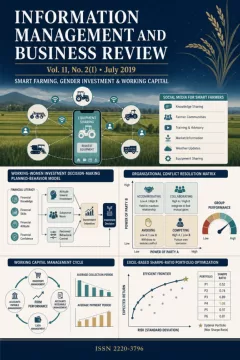 Vol. 11 No. 2(I) (2019)
Smart Farming, Gender Investment & Working Capital
View issue contents
Published
Submissions
Have research to publish? Information Management and Business Review welcomes submissions.
Make a Submission