Articles

  • Article 1 in this issue

    Social Media for Smart Farmer-Shared Farming Equipment Model

    • Author: Wuttipong Pongsuwan, Hongladda Pongsuwan

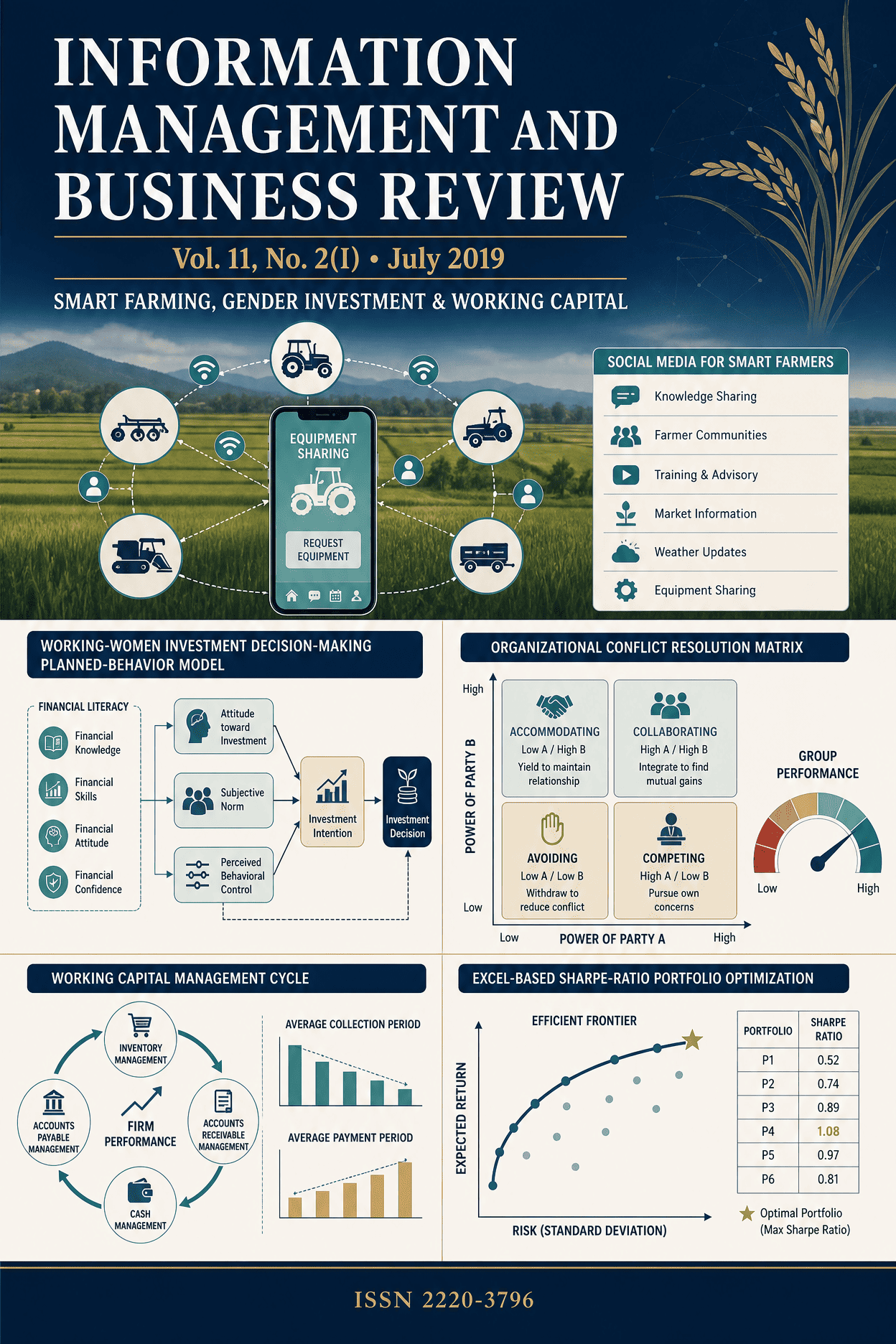
    This research offers a roadmap for creating a concept for building a collaborative and connected mobility model to share the agricultural machine. The study aims to adopt those models to create a collaborative and connected mobility model as a Shared Agricultural Machine Network for Smart Farmer. The fact that Thai farmers are facing the aging crisis, like all other industries and farming machinery has become a need for manpower replacement to keep their earning for livings. Unfortunately, these machines are often expensive, so they can own only a few, and when it comes to reaping the harvest season, and they often require different tools for specific purposes. Our survey has shown that farmers have different ways of cultivating different crops at the same time this implies that in harvesting season there are unused agricultural pieces of equipment available to share among them. The model of shared farm equipment could lead to new farmers’ way of life and it’s time to become smart-farmers. This paper will discuss important considerations, including the need for challenges, trends, and opportunities for farmers to have machinery when needed and to share what idle with others via a peer-to-peer network using mobile application platform.

    Pages 1-9

    PDF - Social Media for Smart Farmer-Shared Farming Equipment Model (opens in a new tab)
  • Article 2 in this issue

    Financial Behavior of Working Women in Investment Decision-Making

    • Author: Nadia Asandimitra, Tony Seno Aji, Achmad Kautsar

    The purpose of this study is to measure the level of financial literacy of working women, to describe assets allocation, as well as the time and profit in investment. This research paper is a qualitative study using the descriptive method. Noting the purpose, it is suitable if the qualitative approach was implemented. The respondents are working women with most of them have been married, 16-22 years old on average, have a bachelor degree, and work in the government sector with the majority of the income is more than 4.000.000 rupiahs. Those respondents’ characteristics will influence their choice in doing investment because it is associated with the tolerance of risks. The first form of behavior and preference of investment done by working women is that majority of them have thought about investment plan and most of the respondents think that everyone can get profitable investment if they do financial planning and saving/investment. The second form of behavior is that the majority of respondents are more interested in property investment. The third form of behavior motivating working women in doing investment is themselves, like retirement planning and family security reason. Based on the study, it shows that working women have high financial literacy which is indicated by their discipline in doing the investment of their excess money, thus they have control over their finances and believe to get investment profit they should do financial planning.

    Pages 10-20

    PDF - Financial Behavior of Working Women in Investment Decision-Making (opens in a new tab)
  • Article 3 in this issue

    Power, IntraTeam Conflicts, Conflict Contagion and its Impact on Performance

    • Author: Amina Malik, Haroon Aziz, Shahab Ud Din, Tanveer Ahmed

    The objective of this study is to examine the importance of power, intrateam conflict, conflict contagion and its impact on organizational performance. This study has used past literature to extend work on power, intrateam conflict, conflict contagion and its impact on performance by providing prepositions. The study demonstrates the importance of power and its impact on intrateam conflicts, which form the shape of conflict contagion and ultimately affect performance. Study found that power leads to more conflicts and its process of spreading hastens because of its contagious nature negatively influences the team’s performance. The paper has highlighted the untapped element of power and creates a bridge between power, conflict and its impact on organizational performance. Many researchers have focused separately on power, teamwork and conflict. However, still, there is a need to assess whether individual power interests also takes the form of conflict contagion, which might affect performance of the organization.

    Pages 21-26

    PDF - Power, IntraTeam Conflicts, Conflict Contagion and its Impact on Performance (opens in a new tab)
  • Article 4 in this issue

    Assessing Working Capital Management and Performance of Listed Manufacturing Firms: Nigeria Evidence

    • Author: Akinleye G. T., ADEBOBOYE Roseline

    This study assessed working capital management and performance of listed manufacturing firms in Nigeria 20 firms were sampled, over 10 years. The study employed static data analyses and panel Granger causality test. Result showed that average collection period exerts insignificant negative effect on return on capital employed of the sampled firms, while average collection period also exerts insignificant negative effect on earnings per share of the sampled firms. The result further showed that, average payment period exerts insignificant positive effect on return on capital employed of the sampled firms, but average payment period exerts insignificant negative effect on earnings per share of the sampled firms. The study concluded that, average collection period and average payment exert insignificant effect on return on capital employed of listed manufacturing firms in Nigeria, also; average collection period and average payment period exert insignificant effect on earnings per share of listed manufacturing firms in Nigeria. Hence manufacturing firms in Nigeria should objectively manage average collection period and also maintain a consistent improvement in return on capital employed and earnings per share of listed manufacturing firms in Nigeria.

    Pages 27-34

    PDF - Assessing Working Capital Management and Performance of Listed Manufacturing Firms: Nigeria Evidence (opens in a new tab)
  • Article 5 in this issue

    Excel Based Financial Modeling for Making Portfolio Management Decisions

    • Author: Sree Rama Murthy Y

    The Excel based financial model proposed in this paper provides a very simple but powerful method for portfolio selection. Apart from a simple and powerful tool for making portfolio management decisions, the paper also proposes an easy to use technique for calculating portfolio standard deviation without using correlation coefficients. The model uses “Excel Solver Add-In” to create an optimum portfolio by maximizing the Sharpe ratio. Benefits of Sharpe style optimization are demonstrated using data on monthly returns from 1999 to 2010 covering 30 stocks.

    Pages 35-41

    PDF - Excel Based Financial Modeling for Making Portfolio Management Decisions (opens in a new tab)