Abstract
The primary objective of this study was to assess the impact of electronic banking on profitability in the Nigeria banking industry. An inferential survey research design was adopted. Primary data were collected through questionnaires from both staff and customers of the surveyed bank. It was complemented with secondary data sourced from the company’s audited financial statements for the period 2010 to 2017. Data collected were analyzed using both descriptive and inferential statistics while testing of the hypotheses was done using multiple regression analysis. The study revealed that cards play a significant role more than other channels and immediately followed by ATM. Also, it was observed that E-Banking channels contributed to Bank's profitability, that E-banking services (EBS) had an influence on the retention and loyalty of bank's customers and that the quality of service, security, reliability and efficiency have a definite impact on the usage of the services of e-banking. It was recommended that the Nigerian banking industry should invest more in card products, followed by ATM amongst other electronic channels; as they generate more revenues for the bank. The study also recommended further development of other channels (Mobile, Corporate Payments, POS and internet banking) to further enhance their contribution to the bank's profitability. Nigerian banks should also create a business strategy that is customer-centric by being continuously innovative in identifying the needs of their customers and improving on their products offering while developing new ones, to retain and keep the loyalty of their existing customers while attracting new ones.
Keywords
- Electronic Banking Search this journal for Electronic Banking (opens in a new tab)
- Profitability Search this journal for Profitability (opens in a new tab)
- Banking Industry Search this journal for Banking Industry (opens in a new tab)
- Regression Analysis Search this journal for Regression Analysis (opens in a new tab)
- Nigeria Search this journal for Nigeria (opens in a new tab)
References
- Abaenewe, Z. C., Ogbulu, O. M. & Ndugbu, M. O. (2013). Electronic Banking and Bank Performance in Nigeria. West African Journal of Industrial and Academic Research, 6(1), 171-187.
- Ajzen, I. (1991). The theory of planned behavior. Organizational Behavior and Human Decision Processes, 50(2), 179–211.
- Angelakopoulos, G. & Mihiotis, A. (2011). E-banking: challenges and opportunities in the Greek banking sector. Electronic Commerce Research, 11(3), 297-319.
- Ashtiani, P. G. & Iranmanesh, A. (2012). New approach to the study of factors affecting the adoption of electronic banking services with an emphasis on the role of positive word of mouth. African Journal of Business Management, 6(11), 4328-4335.
- Awolusi, O. D. (2012). Effectiveness of total quality management on business performance in Nigerian manufacturing firms: an empirical analysis, International Journal of Enterprise Network Management, 5(3), 254-271.
- Awolusi, O. D. & Onigbinde, I. O. (2013). Enterprise Resource Planning and organizational performance in Nigerian manufacturing firms: an empirical analysis. Global Journal of Commerce and Management Perspective, 2(4), 12-23.
- Awolusi, O. D. & Akinruwa, T. E. (2014). Cultural Combination and International Acquisition Performance of Multinational Corporations in Nigeria. Global Journal of Commerce and Management Perspective, 3(1), 1-14.
- Basel Committee on Banking Supervision. (1998). Risk Management for Electronic Banking and Electronic Money Activities. Journal of Small Business Management, 4(2), 51-840.
- Basel Committee on Banking Supervision. (2003). Risk Management Principles for Electronic Banking. Bank for International Settlement. Journal of Business, 18(5), 93-147.
- Berenson, M. (2006). Basic business statistics: concepts and applications (12th Ed.) London: Pearson.
- Blazi, C. & Awolusi, O. D. (2020). Employee Engagement in Multinational Diverse Organization in Difficult Terrain: A Study of Non-Family Station Organization, Information Management and Business Review, 12(1), 45-62.
- Blumberg, B., Cooper, D. R. & Schindler, P. S. (2005). Business Research Methods. Berkshire: McGraw-Hill Education.
- Chakrabartty, S. N. (2013). Best Split-Half and Maximum Reliability. IOSR Journal of Research & Method in Education, 3(1), 1-8.
- Cheng, T. C., Lam, Y. C. & Yeung, C. L. (2006). Adoption of internet banking: An empirical study in Hong Kong. Decision Support Systems, 42(3), 1558-1572.
- Cohen, L., Manion, L. & Morrison, K. (2007). Research methods in education (6th Ed.) New York, USA: Routledge.
- Collins, J. (2001). Level 5 leadership: The Triumph of Humility and Fierce Resolve. Harvard Business Review, 83(7-8), 136-146.
- Cook, D. A. & Beckman, T. J. (2006). Current Concepts in Validity and Reliability for Psychometric Instruments: Theory and Application. The American Journal of Medicine, 119(1), 166.e7-166.e16.
- Coombs, C. H. (1987). The structure of conflict. American Psychologist, 42(4), 355-363.
- Cooper, D. R. & Schindler, P. S. (2011). Business Research Methods (9th Ed.) McGraw Hill.
- Creswell, R. (2014). Research Design: Qualitative, Quantitative, and Mixed Methods Approaches. USA: SAGE Publications.
- Crotty, M. (1998). The foundations of social research. London: Sage.
- Davis, F. D., Bogozzi, R. P., & Warshaw, P. R. (1989). User acceptance of computer technology: A comparison of two theoretical models. Management of Science, 35(1), 982-1003.
- Davis, F. D. (1989). Perceived usefulness, perceived ease of use, and user acceptance of information technology. MIS Quarterly, 13(3), 319-340.
- Devi, J. T., Pudaruth, S. & Ramdin, P. (2012). Factors influencing the adoption of internet banking: a case study of commercial banks in Mauritius. World Journal of Science, Technology and Sustainable Development. 9(3), 204-234.
- Downing, S. M. (2004). Reliability: On the Reproducibility of Assessment Data. Med Education, 38(1), 1006-12.
- Easterby-Smith, M., Thorpe, R. & Jackson, P. (2012). Management Research (4th Ed.). London: SAGE Publications.
- Eccles, R. G. & Serafeim, G. (2013). The Performance Frontier: Innovating for a Sustainable Strategy. Harvard Business Review, 1-10.
- Farris, P. W., Bendle, N. T., Pfeifer, P. E. & Reibstein, D. J. (2010). Marketing Metrics: The Definitive Guide to Measuring Marketing Performance (2nd ed.), Pearson Education, Upper Saddle River, New Jersey.
- Fishbein, M. & 0Ajzen, I. (1975). Belief, attitude, intention, and behavior: An introduction to theory and research. Reading, Mass; Don Mills, Ontario: Addison-Wesley Pub. Co.
- Grix, J. (2004). The Foundations of Research. London: Palgrave Macmillan.
- Harihara, S. R. & Pavithra, V. (2012). A Study on Customer Perception and Awareness in the Usage of Internet Banking. International Conference on Strategic trends on Innovations and Creativity on Management Practices. Available at: http://papers.ssrn.com/sol3/papers.cfm?abstract_id=2187245 (Accessed: 07/04/18).
- Hernando, I. & Nieto, M. (2006). Is the Internet Delivery Channel Changing Banks' Performance? The Case of Spanish Banks. Banco de Espana Research Paper No. WP-0624.
- Hong, S. J., Thong, J. Y. L. & Tam, K. Y. (2006). Understanding Continued Information Technology Usage Behavior: A Comparison of Three Models in the Context of Mobile Internet. Decision Support Systems, 42(3), 1819-1834.
- Jayawardhena, C. & Foley, P. (2000). Changes in the banking sector -The case of Internet banking in the UK. Internet Research, 10(1), 19-30.
- Johnson, S. (2014). Advantages and Disadvantages of Positivism. Available at: http://www.ehow.com/info_12088541_advantages-disadvantages-positivism.html (Accessed: 07/05/18).
- Kadzo, S. & Wafula, M. K. (2015). Effects of Internet banking on the Financial Performance of Commercial Banks in Kenya (A Case of Kenya Commercial Bank). International Journal of Scientific and Research Publications, 5(5), 9-20.
- Kaur, R. (2013). The Impact of Electronic Banking on Banking Transactions: A Cost-Benefit Analysis. IUP Journal of Bank Management, 12(2), 62-71.
- Kimberlin, C. L. & Winterstein, A. G. (2008). Validity and Reliability of Measurement Instruments Used in Research. American Journal of Health-System Pharmacists, 65(1), 2276- 2284.
- Kricks, T. (2009). CARTA & Caribbean Group of Banking Supervisors. It Workshop for Regional Bank Examiners. International Journal of Small Business Management, 4(10), 51-84.
- Kolodinsky, J. M. & Hogarth, J. M. (2004). The adoption of electronic banking technologies by US consumers. The International Journal of Bank Marketing, 22(4), 238-259.
- Lai, P. C. (2016). Design and Security impact on consumers’ intention to use single platform E-payment. Interdisciplinary Information Sciences, 22(1), 111-122.
- LeBeouf, M. (1987). How to Win Customers and Keep them for Life. Berkley Publishing Group: New York, USA.
- Lee, G. & Lin, H. (2005). Customer’s perception of e-service quality in online shopping. International Journal of Retail and Distribution Management, 33(2), 316-322.
- Liu, Y., Li, H. & Carlsson, C. (2010). Factors driving the adoption of m. learning: An empirical study. Computers and Education, 55(3), 1211 – 1219.
- Ma, Z. (2012). Factors affecting the customer satisfaction of internet banking: An Empirical study in China. Journal of Convergence Information Technology, 7(3), 101-109.
- Madan, C. R. & Kensinger, E. A. (2017). Test-Retest Reliability of Brain Morphology Estimates. Brain Informatics, 4(1), 107–121.
- Matira, K. M. & Awolusi, O. D. (2020). Leaders and Managers Styles towards Employee Centricity: A Study of Hospitality Industry in the United Arab Emirates, Information Management and Business Review, 12(1), 1-21.
- Mawutor, J. K. M. (2014). Impact of E-Banking on the Profitability of Banks in Ghana. Research Journal of Finance and Accounting, 5(22), 53-63.
- Morris, E. & Burkett, K. (2011). Mixed Methodologies: A New Research Paradigm or Enhanced Quantitative Paradigm. Online Journal of Cultural Competence in Nursing and Healthcare, 1(1), 27-36.
- Mukonga, L. M. & Awolusi, O. D. (2019). Strategic Leadership in the Post-Conflict States: A Study of the Democratic Republic of Congo (DRC), Journal of Social and Development Sciences, 10(4), 36-51.
- Ngai, L. W. T., Poon, J. K. L. & Chan, Y. H. C. (2007). Empirical examination of the adoption of WebCT using TAM. Computers and Education, 48(2), 250 – 267.
- Njogu, J. N. (2014). The effect of Electronic Banking on Profitability of Commercials in Kenya. A Research Project Submitted in Partial Fulfillment of The Requirements for The Award of The Degree of Master of Science in Finance, School of Business, University of Nairobi. Available at: (Accessed: 05/05/18).
- Olatunji, O. O. & Awolusi, O. D. (2019). Performance Evaluation and Improvement among Salesmen in the Nigerian Fast Moving Consumer Goods Sector, Journal of Social and Development Sciences, 10(4), 12-29.
- Oliver, V. (2010). 301 Smart Answers to Tough Business Etiquette Questions. Skyhorse Publishing: New York, USA.
- Onikoyi, I. A., Babafemi, E. A. & Awolusi, O. D. (2013). Biblical and Societal appraisal of divorce amongst Christians. Babcock Journal of Management and Social Sciences, 2(1), 72-90.
- Ovidiu, S. & Alina, S. (2015). The impact of internet banking on the performance of Romanian banks: DEA and PCA approach.
- Pitt, M. & Koufopoulos, D. N. (2012). Essentials of Strategic Management. London: Sage
- Rad, H. S., Rasoulian, A., Mirzaei, M. & Sharifipour, A. (2017). Electronic Banking; a New Strategy to Create Customers’ Loyalty to Investment and Its Impact on Economic Initiatives. International Journal of Management, Accounting and Economics, 4(4), 431-442.
- Rauf, H. (2014). Trends in China’s E-commerce Market. Available at: http://www.chinabriefing.com/news/2014/06/04/trends-chinas-e-commerce-market.html (Accessed: 23/09/18).
- Reeves, M., Love, C. & Tillmanns, P. (2012). Your Strategy Needs a Strategy. Harvard Business Review, 23(2), 234-245.
- Robson, C. (2011). Real World Research: A Resource for Users of Social Research Methods in Applied Settings, (2nd Ed.). Sussex, A. John Wiley and Sons Ltd.
- Salawu, R. O. & Salawu, M. K. (2007). The Emergence of Internet Banking in Nigeria: An Appraisal. Information Technology Journal, 6(4), 490-496.
- Salehi, M. & Alipour, M. (2010). E-banking in an emerging economy: Empirical evidence of Iran. International Journal of Economics and Finance, 2(1), 201-209.
- Saunders, M., Lewis, P. & Thornhill, A. (2009). Research Methods for Business Students, (5th Ed.). Harlow, Pearson Education.
- Shekharan, U. & Bougie, R. (2010). Research Methods for Business: A Skill Building Approach (5th Ed.). New Delhi: John Wiley.
- Simpson, J. (2002). The Impact of the Internet in Banking: Observations and Evidence from Developed and Emerging Markets. International Journal of Telematics and Informatics, 19(1), 315-330.
- Singh, A. S. (2014). Conducting Case Study Research in Non-Profit Organizations. Qualitative Market Research: An International Journal, 17(1), 77–84.
- Singh, J. & Kour, G. (2011). Customer satisfaction and universal banks: An empirical study. International Journal of Commerce and Management, 21(4), 327-348.
- Shih, Y. Y. & Fang, K. (2004). The use of a Decomposed Theory of Planned Behavior to study Internet banking in Taiwan. Internet Research, 14(3), 213-223.
- Sumra, S. H., Manzoor, M. K., Sumra, H. H. & Abbas, M. (2011). The Impact of E-Banking on the profitability of Banks: A Study of Pakistani Banks. Journal of Public Administration and Governance, 23(2), 23-34.
- Thatcher, R. (2010) Validity and Reliability of Quantitative Electroencephalography. Journal of Neurotherapy, 14(1), 122-152.
- Twycross, A. & Shields, L. (2004). Validity and Reliability-What are it All About? Part 2: Reliability in Quantitative Studies. Pediatric Nursing, 16(10), 23-36.
- Wang, D. H., Claire, L., Kenneth, B. Y. & Randell, B. (2009). To trust or not to trust: The consumer's dilemma with e-banking. Journal of Internet Business, 6(2), 1-27.
- Worku, G., Tilahun, A. I. & Tafa, M. A. (2016). The Impact of Electronic Banking on Customers' Satisfaction in Ethiopian Banking Industry (The Case of Customers of Dashen and Wogagen Banks in Gondar City). Journal of Business & Financial Affairs, 5(2), 1-18.
- Yang, J., Cheng, L. & Luo, X. (2009). A comparative study on e-banking services between China and USA. International Journal of Electronic Finance, 3(3), 235-252.
- Yang, S., Li, Z., Ma, Y. & Chen, X. (2018). Does Electronic Banking Really Improve Bank Performance? Evidence in China. International Journal of Economics and Finance, 10(2), 82-94.
Downloads
No downloads have been recorded for this article yet. Figures appear here once readers begin downloading the full text.
How to Cite
Share this article
License
Copyright (c) 2020 Uchenna Aduaka, Olawumi D. Awolusi (Author)

This work is licensed under a Creative Commons Attribution 4.0 International License.
Author (s) should affirm that the material has not been published previously. It has not been submitted and it is not under consideration by any other journal. At the same time author (s) need to execute a publication permission agreement to assume the responsibility of the submitted content and any omissions and errors therein. After submission of revised paper in the light of suggestions of the reviewers, the editorial team edits and formats manuscripts to bring uniformity and standardization in published material.
This work will be licensed under Creative Commons Attribution 4.0 International (CC BY 4.0) and under condition of the license, users are free to read, copy, remix, transform, redistribute, download, print, search or link to the full texts of articles and even build upon their work as long as they credit the author for the original work. Moreover, as per journal policy author (s) hold and retain copyrights without any restrictions.
Keywords
- Electronic Banking Search this journal for Electronic Banking (opens in a new tab)
- Profitability Search this journal for Profitability (opens in a new tab)
- Banking Industry Search this journal for Banking Industry (opens in a new tab)
- Regression Analysis Search this journal for Regression Analysis (opens in a new tab)
- Nigeria Search this journal for Nigeria (opens in a new tab)
Section
Published in
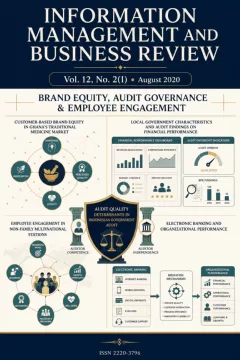 Vol. 12 No. 2(I) (2020)
Brand Equity, Audit Governance & Employee Engagement
View issue contents
Published
Submissions
Have research to publish? Information Management and Business Review welcomes submissions.
Make a Submission