Articles

  • Article 1 in this issue

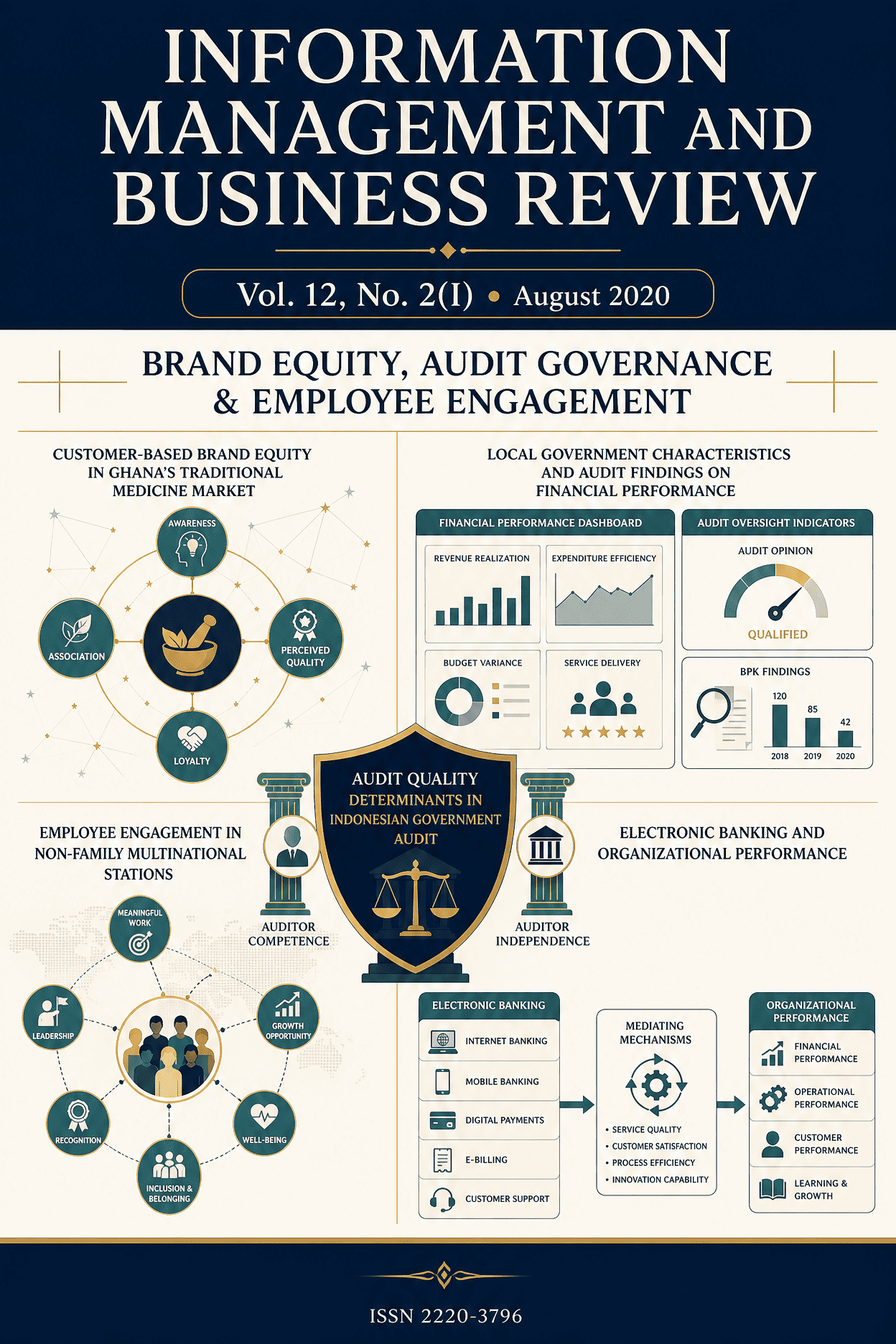
    Influence of Brand Awareness and Perceive Quality on Loyalty: The Mediating Role of Association in Traditional Medicine Market in Kumasi, Ghana

    • Author: Peter Kwasi Oppong, Solomon Tawiah Yeboah, Adelaide Gyawu

    Enhancing brand quality, association and awareness can generate greater loyalty which may lead to a sustainable edge in a competitive market. And yet, there is a relative paucity of studies on the influence of awareness and quality on loyalty via the mediating impact of association, particularly in the traditional health market. Hence, this study sought to investigate the influence of awareness and quality on loyalty via the intervening role of the association in the traditional health market. Based on Aaker`s customer-based brand equity framework, eight hypotheses were stated and examined through structural equation modelling. Data were gathered from a sample of 348 customers through systematic sampling. The research found that association perfectly mediates the path between awareness and loyalty, but plays a partial role in the path between perceived quality and loyalty. The study, therefore, contributes to advancing the limited branding literature in the traditional medicine industry. First, the study establishes the starring role of awareness, association, and quality as antecedents of loyalty in the context of brand management in the traditional medicine industry. Not only this but also the research confirms that association acts as a mediator in the relationships among awareness, association, quality and loyalty in the context of brand management in the traditional medicine industry.

    Pages 1-11

    PDF - Influence of Brand Awareness and Perceive Quality on Loyalty: The Mediating Role of Association in Traditional Medicine Market in Kumasi, Ghana (opens in a new tab)
  • Article 2 in this issue

    The Effect of Local Expenditure, Local Wealth Level, Audit Opinion, and Audit Findings on the Performance of Indonesian Local Governments

    • Author: Luna Nur Amalina, Mahendro Sumardjo

    This study aims to determine the effect of local expenditure, local wealth level, audit opinion, and audit findings on the performance of local governments. This study uses the quantitative method, the hypothesis testing with multiple linear regression analysis was used, using SPSS version 23. The population is the local governments of Districts/Cities in Indonesia. The sample is 489 data samples were collected. Results obtained from testing showed that local expenditure, local wealth level, and audit opinion significantly affect the performance of local governments. Meanwhile, audit findings do not have a significant effect towards the Performance of Local Governments. Future studies are expected to be able to add more variables that have not been used in this study, such as government size, local standing, and intergovernmental standing.

    Pages 12-19

    PDF - The Effect of Local Expenditure, Local Wealth Level, Audit Opinion, and Audit Findings on the Performance of Indonesian Local Governments (opens in a new tab)
  • Article 3 in this issue

    Electronic Banking and Profitability in the Nigerian Banking Industry

    • Author: Uchenna Aduaka, Olawumi D. Awolusi

    The primary objective of this study was to assess the impact of electronic banking on profitability in the Nigeria banking industry. An inferential survey research design was adopted. Primary data were collected through questionnaires from both staff and customers of the surveyed bank. It was complemented with secondary data sourced from the company’s audited financial statements for the period 2010 to 2017. Data collected were analyzed using both descriptive and inferential statistics while testing of the hypotheses was done using multiple regression analysis. The study revealed that cards play a significant role more than other channels and immediately followed by ATM. Also, it was observed that E-Banking channels contributed to Bank's profitability, that E-banking services (EBS) had an influence on the retention and loyalty of bank's customers and that the quality of service, security, reliability and efficiency have a definite impact on the usage of the services of e-banking. It was recommended that the Nigerian banking industry should invest more in card products, followed by ATM amongst other electronic channels; as they generate more revenues for the bank. The study also recommended further development of other channels (Mobile, Corporate Payments, POS and internet banking) to further enhance their contribution to the bank's profitability. Nigerian banks should also create a business strategy that is customer-centric by being continuously innovative in identifying the needs of their customers and improving on their products offering while developing new ones, to retain and keep the loyalty of their existing customers while attracting new ones.

    Pages 20-37

    PDF - Electronic Banking and Profitability in the Nigerian Banking Industry (opens in a new tab)
  • Article 4 in this issue

    Determinants of Audit Quality in Indonesia Supreme Audit Institution: A Conceptual Study

    • Author: Fahmi Givari Akbar, Khoirul Aswar, Noegrahini Lastiningsih

    This research is based on the problem of poor audit practices by the Big Four audit firms and the mid-tier audit firms in UK in 2018/2019 cycle, which is indicated as audit failure. This resulted in sanctions and fines that increased significantly from the previous year. Problems related to audit quality are also experienced by government internal auditors in Indonesia. This is due to several factors such as the quality of government internal auditor resources that are still below the lowest service standards as a public institution, lack of available apparatus and low competency, and limited budget. The purposes of this study are to determine the extent of audit quality produced by government internal auditors at the Principal Inspectorate of Indonesia’s Supreme Audit Institution. Based on attribution theory, this study has several objectives, namely to determine the effect of competence, independence, and motivation on audit quality. Therefore, the contribution of this research can be the object of consideration and evaluation for Indonesia’s Supreme Audit Institution auditors regarding the audit process and audit results in the public or government sector, an information for Principal Inspectorate of Indonesia’s Supreme Audit Institution as an effort to maintain and improve the quality of government internal audits, and an information for the public in overseeing the audit quality of the management and responsibility of state finances.

    Pages 38-41

    PDF - Determinants of Audit Quality in Indonesia Supreme Audit Institution: A Conceptual Study (opens in a new tab)
  • Article 5 in this issue

    Factors Affecting the Performance of Public Sector Practitioners in the Republic of Congo

    • Author: Gildas Moukouyou-Kouaka, Olawumi D. Awolusi

    In most of the structures of the public sector in the Republic of Congo, the quality of services provided to the general public has never been of good quality as perceived by the population. Consequently, the purpose of this study is to understand the root cause of inefficiency in the public sector of the Republic of Congo. A descriptive survey was designed for this purpose. Gill et al. (2008) argument on the most preferred use of interviews questionnaires in qualitative research was utilized to gather data from the sampled respondents. The data obtained from the individual's interviews were analysed using SPSS software. The traditional approaches of employee's performance management were analysed and plotted. The results of the study revealed that many employees were not adequately trained to perform their duties; in the meantime, most of these employees have not received any training in the last 10-15 years. Furthermore, it was also revealed that the top management doesn't undertake performance management appraisal and also the latter doesn't promote career development. Therefore, the employees suggested capacity building training. Revision of the salary scale and improvement of working conditions as the things that needs to be changed to improve their performance. Finally, the researcher concluded that among others actions that can be taken there is need to initiate a restructuration of the public sector in the Republic of Congo e.g. by re-introducing an entrance to the public sector examination, introduce performance appraisal management system and establish a career development systems for all categories of employment, to promote the culture of excellence in its structures and improve employee's performance. The novelty of the present study is the fact that the effectiveness of most of the services rendered to the general public in the Republic of Congo has never been investigated using scientific approaches. This study has therefore established the relation between the decisions taken by the top management and their impacts on employee’s performance. In the meantime, the study has provided also the evidence on the correlation between the organization’s culture and the decisions taken by the top management.

    Pages 42-61

    PDF - Factors Affecting the Performance of Public Sector Practitioners in the Republic of Congo (opens in a new tab)