Abstract
The purpose of this study is to investigate the relationship among Balanced Scorecard, consultative management style, participative management style and organization size with organizational performance. All the variables are highly correlated with each other. This is an empirical study and data is collected from 100 respondents of service sector from Azad Kashmir. We used five likert scales to collect data from the respondents and data analyzed through SPSS. The result showed that there is a significant positive correlation among variables. This study also indicates that effective management style is necessary for improving the performance of organization. The result indicates that Balanced Scorecard has significant impact on performance of organization. Organization use BSC to handle the complexity and challenges that management faces during their operations. The collection of data is from small area due to time constraint. In the future comparative study can be done with other organizations for better analysis of results.
Keywords
- Balanced Scorecard Search this journal for Balanced Scorecard (opens in a new tab)
- Participative Management Search this journal for Participative Management (opens in a new tab)
- Consultative Management Search this journal for Consultative Management (opens in a new tab)
- Organization Size Search this journal for Organization Size (opens in a new tab)
- Organization Performance Search this journal for Organization Performance (opens in a new tab)
References
- Barringer, B. R. & Bluedorn, A. C. (1999). The relationship between corporate entrepreneurship and strategic management. Strategic Management Journal , 20(5), 421-444.
- Belardo, S. & Belardo, A. W. (2002). Innovation Throug Learning:What Leaders Need to Know in The 21ist Century. Whitston Publishing Company, Albany, NY.
- Brown, M. G. (2000). Winning Score: How to Design and Implement Organizational Scorecards. Productivity Press, Cambridge, MA.
- Bryson, J. M. & Bromiley, P. (1993). Critical factors affecting the planning and implementation of major products. Strategic Management Journal , 14, 319-337.
- Cappelli, P. (2000). Managing without Commitment. Organizational Dynamics , 28(4), 11-24.
- Chorengel, S. & Teare, R. (1994). Developing a responsive global network of Hyatt Hotels & Resorts. In R. Teare & M. D. Olsen (Eds.), International hospitality management: Corporate strategy in practice, 339-345.
- Cloudhury, V. & Sampler, J. L. (1997). Information specificity and environmental scanning: An economic perspective. Management Information Systems Quarterly , 21(1), 25-53.
- Davis, T. R. V. (2001). Integrating internal marketing with participative management. Management Decision , 39(2), 121-130.
- Dev, C. S. & Olsen, M. D. (1989). Environmental uncertainty, business strategy and financial performance: an empirical study of the US lodging industry. Journal of Hospitality and Tourism Research , 13(3), 171186.
- Dooley, R. S. & Fryxell, G. E. (1999). Attaining decision quality and commitment from dissent: The moderating effects of loyalty and competence in strategic decision-making teams. Academy of Management Journal , 42(4), 389-402.
- Forbes, D. P. & Milliken, F. J. (1999). Cognition and corporate governance: Understanding boards of directors as strategic decision-making groups. Academy of Management Review , 24(3), 489-505.
- Garvin, D. A. (2000). Learning in Action: A Guide to Putting the Learning Organization to Work. Harvard Business School Press, Boston, MA.
- Ghobadian, A. & Gallear, D. (1997). TQM and organization size. International Journal of Operations & Production Mangement , 17(2), 121-163.
- Gmur, B. Bartlet, A. & Kissling, R. (2010). Organization from a systematic Perspective: Application of the viable system model to the Swiss Youth Hostel Association. Kybernetes , 39(9/10), 1627-1644.
- Haapasalo, H. Ingalsuo, K. & Lenkkeri, T. (2006). Linking strategy into operational management: a survey of BSC implementation in Finnish energy sector. Benchmarking: An International Journal , 13(6), 701717.
- Harrington, R. J. (2004). The environment, involvement, and performance: Implications for the strategic process of food service firms. International Journal of Hospitality Management , 23(4), 317-341.
- Harrington, R. J. & Ottenbacher, M. C. (2009). Decision-making tactics and contextual features: Strategic, tactical and operational implications. International Journal of Hospitality and Tourism Administration , 10(1), 25-43.
- Joiner, T. A. (2007). Total quality management and performance. International Journal of Quality and Reliability Management , 24(6), 617- 627.
- Kolsaker, A. & Lee-Kelley, L. (2008). Citizens’ attitudes towards e-government and e-governance: a UK study. International Journal of Public Sector Management , 21(7), 723- 738.
- Lawrie, G. & Cobbold, I. (2004). Development of the 3rd generation Balanced Scorecard. 2GC Active Management, Maidenhead, available at: www.2gc.co.uk/pdf/2GC-W0412.pdf. Learnmangement2.com http://www.learnmarketing.net/
- Maisela, T. (1995). Participative management facilitates a productive workplace. Human Resource Management , 11(5), 20-28.
- Martell, R. F. Lane, D. M. & Emrich, C. G. (1996). Male- Female difference: A computer simulation. American Psychologist , 51, 157-158.
- Make coaching count (2006). Development and Learning in Organization, 20(5), 24-27.
- Malmi, T. (2001). Balanced Scorecards in Finnish companies: a research note. Management Accounting Research , 12(2), 207-220.
- Marsick, V. E. & Watkins, K. E. (2003). Demonstrating the value of an organization’s learning culture: the dimensions of the learning organization questionnaire. Advances in Developing Human Resources , 5(2), 132-151.
- Mintzberg, H. (1973). Strategy-making in three modes. California Management Review , 16(2), 44-53.
- Nafukho, F. M., Graham, C. M. & Muyia, M. H. (2009). Determining the relationship among organizational learning dimensions of a small-size business enterprise. Journal of European Industrial Training , 33(1), 32-51.
- Niven, P. R. (2005). Driving focus and alignment with the Balanced Scorecard. The Journal for Quality and Participation , Winter, 21-25.
- Northouse, P. G. (2004). Leadership theory and practice (3rd ed.). Thousand Oaks , CA: Sage Publications.
- Ogbeide, G. A. Groves, J. & Cho, S. (2008). Leadership Styles of Foodservice Managers and Subordinates Perceptions. Journal of Quality Assurance in Hospitality and Tourism , 9(4), 317-336.
- Okumus, F. (2003). A framework to implement strategies in organizations. Management Decision , 41(9), 871882.
- Oosthuizen, G. J. & Du Toit, A. S. A. (1999). Participative management in academic library services. Library Management , 20(4), 213-219.
- Ottenbacher, M. & Harrington, R. J. (2008). German culinary innovation processes: Differences in involvement and other factors. Journal of Foodservice Business Research , 11(4), 412-438.
- Reddick, C. G. (2011). Citizen Interaction and e-government, Transforming Government: People. Process and Policy , 5(2), 167-184.
- Schmelzer, C. D. & Olsen, M. D. (1994). A data based strategy implementation framework for companies in the restaurant industry. International Journal of Hospitality Management , 13(4), 347-359.
- Simons, T. Pelled, L. H. & Smith, K. A. (1999). Making use of difference: Diversity, debate, and decision comprehensiveness in top management teams. Academy of Management Journal , 42, 662-673.
- Smylie, M. A. Lazarus, V. & Brownlee-Conyers, J. (1996). Instrumental outcomes of school based participative decision making. Educational Evaluation and Policy Analysis , 18, 181-191
- Snyder, W. M. & Cummings, T. G. (1998). Organizational learning disorders: conceptual model and intervention hypotheses. Human Relations , 51(7), 873-895.
- Sorensen, P. F. & Minahan, M. (2011). McGregor’s Legacy: the evolution and current application of Theory Y management. Journal of Management History, 17(2), 178-192.
- Teare, R. E. Costa, J. & Eccles, G. (1998). Relating strategy, structure and performance. International Journal of Contemporary Hospitality Management , 10(2), 58-77.
- The European Observatory for SMEs (1995). Third Annual Report, EIM Small Business and Research Consultancy, The Netherlands.
- Valmohammadi, C. & Servati, A. (2011). Performance measurement system implementation using Balanced Scorecard and statistical methods. International Journal of Productivity and performance Management , 60(5), 493-511.
- Young, E. D. Coutts, D. W. & Kapitan, D. (1998). UV laser ablation and irm-GCMs microanalysis. Geochimica et Cosmochimica Acta , 62(18), 3161-3168.
Downloads
No downloads have been recorded for this article yet. Figures appear here once readers begin downloading the full text.
How to Cite
Share this article
License
Copyright (c) 2011 Muhammad Yameen, Syed Kamran Ali Shah, Jam Javed Iqbal, Adeel Razaq, M. Suleman Sabir, Adil Sohail, Zafar Ullah (Author)

This work is licensed under a Creative Commons Attribution 4.0 International License.
Author (s) should affirm that the material has not been published previously. It has not been submitted and it is not under consideration by any other journal. At the same time author (s) need to execute a publication permission agreement to assume the responsibility of the submitted content and any omissions and errors therein. After submission of revised paper in the light of suggestions of the reviewers, the editorial team edits and formats manuscripts to bring uniformity and standardization in published material.
This work will be licensed under Creative Commons Attribution 4.0 International (CC BY 4.0) and under condition of the license, users are free to read, copy, remix, transform, redistribute, download, print, search or link to the full texts of articles and even build upon their work as long as they credit the author for the original work. Moreover, as per journal policy author (s) hold and retain copyrights without any restrictions.
Keywords
- Balanced Scorecard Search this journal for Balanced Scorecard (opens in a new tab)
- Participative Management Search this journal for Participative Management (opens in a new tab)
- Consultative Management Search this journal for Consultative Management (opens in a new tab)
- Organization Size Search this journal for Organization Size (opens in a new tab)
- Organization Performance Search this journal for Organization Performance (opens in a new tab)
Section
Published in
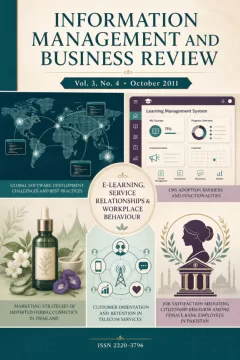 Vol. 3 No. 4 (2011)
E-Learning, Service Relationships & Workplace Behaviour
View issue contents
Published
Submissions
Have research to publish? Information Management and Business Review welcomes submissions.
Make a Submission