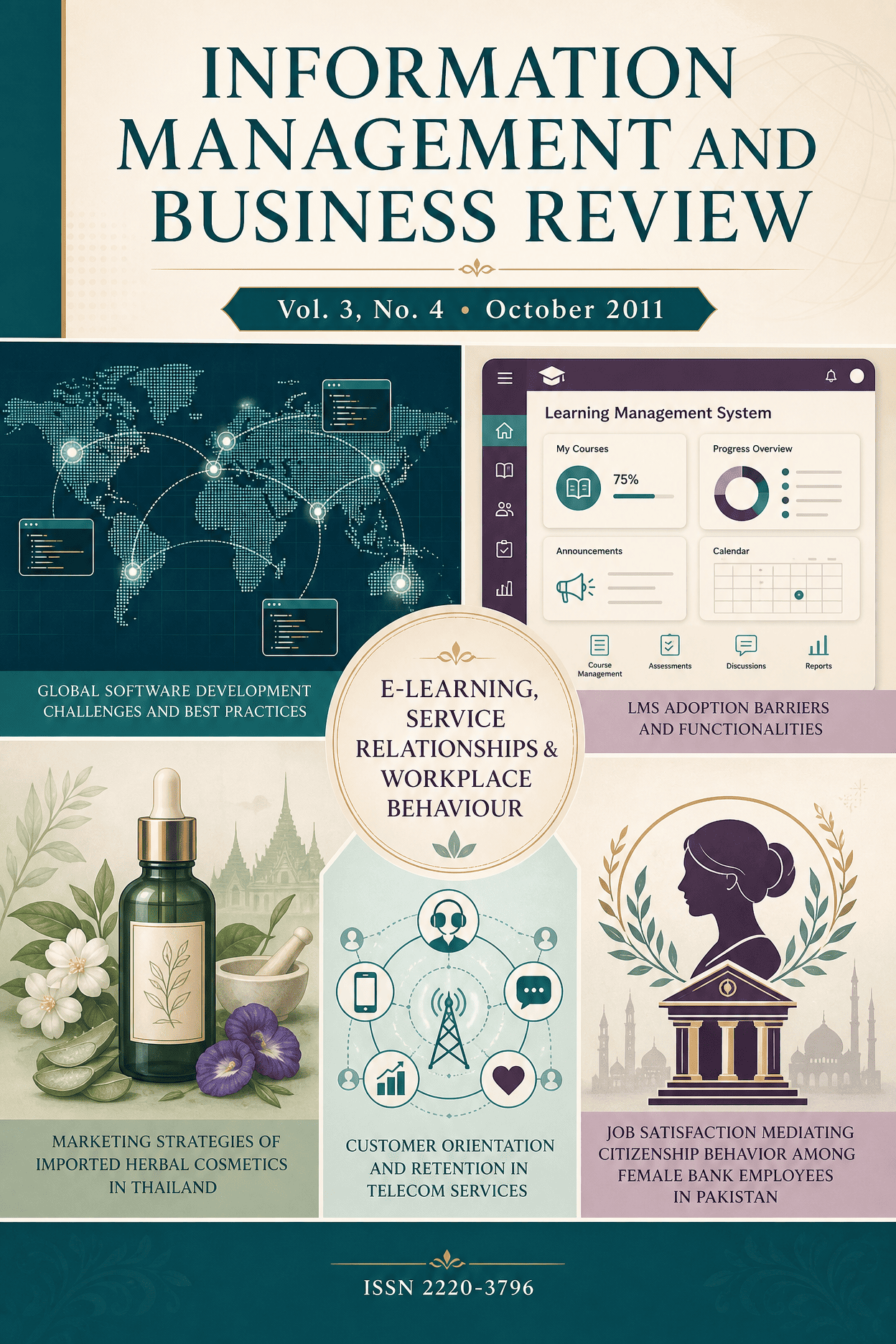
Articles

  • Article 1 in this issue

    The Context of Global Software Development: Challenges, Best Practices and Benefits

    • Author: Sami Ul Haq, M. Naeem Ahmed Khan, Muhammad Tariq

    Global Software Development (GSD) environment is based on a contractual relationship between client and vendor organizations in which a client outsources all or some part of its software development activities to a vendor. The vendor in return provides the agreed services in lieu of certain amount of remuneration. The main reasons to select the GSD technique include reduced cost, faster development and access to skilled manpower available across the world. Though GSD is emerging as an effective technique, but it suffers from many challenges like poor communication, lack of trust and coordination. These challenges pose serious risk to the smooth execution of the GSD projects. In the past decade, GSD has become an area of active research and a number of the researchers have worked on different aspects of it. In this paper, we present a critical review of the research studies conducted on GSD to highlight the challenges, best practices and benefits of GSD. Our findings reveal that much of the research in this area has been focused on addressing issues faced by client organizations, however, vendor side in the GSD relationship is much ignored due to which this field of study is still immature; hence, further research work is required to be undertaken to address the issues faced by the vendor organizations.

    Pages 193-197

    PDF - The Context of Global Software Development: Challenges, Best Practices and Benefits (opens in a new tab)
  • Article 2 in this issue

    Organization Performance Influenced by the BSD and Consultative Management Style

    • Author: Muhammad Yameen, Syed Kamran Ali Shah, Jam Javed Iqbal, Adeel Razaq, M. Suleman Sabir, Adil Sohail, Zafar Ullah

    The purpose of this study is to investigate the relationship among Balanced Scorecard, consultative management style, participative management style and organization size with organizational performance. All the variables are highly correlated with each other. This is an empirical study and data is collected from 100 respondents of service sector from Azad Kashmir. We used five likert scales to collect data from the respondents and data analyzed through SPSS. The result showed that there is a significant positive correlation among variables. This study also indicates that effective management style is necessary for improving the performance of organization. The result indicates that Balanced Scorecard has significant impact on performance of organization. Organization use BSC to handle the complexity and challenges that management faces during their operations. The collection of data is from small area due to time constraint. In the future comparative study can be done with other organizations for better analysis of results.

    Pages 198-205

    PDF - Organization Performance Influenced by the BSD and Consultative Management Style (opens in a new tab)
  • Article 3 in this issue

    Learning Management Systems (LMS): Inside Matters

    • Author: Shakeel Iqbal, Ijaz A. Qureshi

    By the end of last millennium, many universities and colleges started using internet to meet their distance learning needs. Different course management systems (CMS) were developed to meet the needs of online and hybrid courses. These CMS later on transformed into Learning Management Systems (LMS). Many educational institutions have already started using LMS and there are still many who are considering adopting one. The big question before the late adopters of this online learning technology is which LMS they should opt for? This study will be useful for those who are in the process of selecting an LMS as well as those who are in the business of designing one. A survey was conducted to get feedback from the faculty of higher education institutions to find out the major barriers in adoption of e-learning and to find out what kind of functionalities and teaching methodologies should be supported by LMSs. Results indicate lack of training, lack of incentives to use e-learning, lack of technical support and lack of time to develop e-courses are the major barriers in adoption of e-learning by the faculty members. As far as the desired functionalities in an LMS are concerned ability to create student groups for group activities, availability of discussion board, announcement board and online quizzes, file sharing/transfer functionality were the most sought functionalities. The most desired method of teaching that need to be supported by LMS had been group problem solving, discussion based strategies, problem based learning and simulation. The results of survey will be helpful for the adopter as well as designers of LMS.

    Pages 206-216

    PDF - Learning Management Systems (LMS): Inside Matters (opens in a new tab)
  • Article 4 in this issue

    Marketing Strategies of Imported Herbal Cosmetic Products in Thailand

    • Author: Rojanadilok Thanisorn, Bunchapattanasakda

    This research investigated the factors that influence marketing strategies of imported herbal cosmetic products in Thailand. The study is qualitative research using in - depth interview to collect primary data and use content analysis to analyze the obtained data. The facial herbal cosmetics products using in this study were moisturizer, whitening lotions, creams, powder, toner, make up cleansing, mask, cleansing oil, soap bar, anti-aging lotions and creams which imported from Australia and the USA. Findings from the study found that product A positioned itself as a premium biodynamic natural plus innovation technology product using the greenhouse concept. The shops were decorated using recycle woods. The products’ packaging give customers a sense of the source, herb images grow around the boxes and bottles, whilst the text grows with the image, creating a sense of energy. Product A conscious of the environment and strive to source and use the most environmentally aware materials where possible. The retail price strategy depends on local marketing promotions. It has the stand-alone shops plus day spa and counters in department stores. The advertisement media strategies focus on magazine, direct mail, social network advertisement; facebook. Product B sets the position as an innovative organic beauty solution using pure certified organic ingredients without paraben, petroleum, and silicones. Recycled materials were used to make packaging and printed using soy ink. It has shop online and 12 counters in department stores. The local price strategy is discount on vocation. The promotion strategies focused on premium product and cash discount. The advertisement strategies of product B focused on magazines, direct mail, social network advertisement; facebook and popular brand ambassadors. Product C set position as ancient herbal product. The product’s formulations have made with the unique natural ingredients, effective botanical extracts with the latest innovations from around the world since a 160 years old formula. The products avoid using of preservative and perfume. It has 8 counters in department stores and used the recyclable packaging so that product C concentrate the efforts and cost on the substance and quality of products which reflex selling price. The advertisement strategies focused on brochure and social network advertisement (facebook and twitter) while selling promotion strategies of the product are free premium sampling, customers refer friends, and 28 days satisfaction guarantee for refund.

    Pages 217-221

    PDF - Marketing Strategies of Imported Herbal Cosmetic Products in Thailand (opens in a new tab)
  • Article 5 in this issue

    The Influence of Customer Orientation on Customer Relationship in Telecom Services

    • Author: Junaid-Ul-Haq, Awais Ijaz, Saqib Mehmood

    In this study, an effort has been made to disclose the influence of customer orientation on customer retention. It has also revealed that customer orientation influences on customer satisfaction and customer trust and their ultimate effect on customer Retention. Primary data was collected through questionnaire survey.290 questionnaires were distributed out of which 219 were received and supposed for analysis purpose, 75.51% which is considered as a serious response rate of our respondents. Customer orientation has positive effect on customer satisfaction as well as on customer trust, which shows significant relationship of customer orientation on customer satisfaction and customer trust. Moreover, satisfaction and trust of customer has effect on customer retention. Satisfaction of customer has negative effect due to one or more reason, whereas, customer trust has positive and significant effect on customer retention. Customer orientated organizations earn more profit and can control customer retention. Findings of this study can also be used to control the customer retention. While customer orientation is under discussion then it has two major factors i.e. customer satisfaction and customer trust, organizations should more focus on these factors. Sometime when customer retention takes place even focusing these factors then current competitor’s strategies can also be kept in mind. This study is done in a developing country where there is a very tough competition among service providers to enhance their market share. The focus of this research is to control the switching customer, which is the one of the important problems facing by the service providers.

    Pages 222-227

    PDF - The Influence of Customer Orientation on Customer Relationship in Telecom Services (opens in a new tab)
  • Article 6 in this issue

    Jobs satisfaction mediates relationship between facets of job and citizenship behavior: a study of female employees of banking sector of Pakistan

    • Author: Ishfaq Ahmed, Ahmad Usman, Sahar Latif Rana

    Several articles have reported and discussed the job satisfaction and dissatisfaction of female workers in miscellaneous organizations. However, very few empirically-supported explanations have been given to explain how job satisfaction mediates the relationship between facets of job and citizenship behavior in banking sector of Pakistan and specially focusing on female employees. Probes into the explanations of determining how job satisfaction mediates the relationship between facets of job and citizenship behavior, the data were collected from female employees of banking sector of Pakistan. Total 200 self-administered questionnaires were distributed among the female staff of different banks. 188 completed questionnaire were received back with response rate of 94%. The participation in survey was voluntary and confidentiality of responses was ensured. Statistical analysis reveals that there exists significant relationship between facets of job (pay, promotion, supervisor’s behavior and coworker’s behavior) and dependent variables (organizational citizenship behavior); likewise, job satisfaction mediates the relationship between facets of job and citizenship behavior. Limitations and future implementations of this research are also discussed.

    Pages 228-234

    PDF - Jobs satisfaction mediates relationship between facets of job and citizenship behavior: a study of female employees of banking sector of Pakistan (opens in a new tab)