Abstract
By the end of last millennium, many universities and colleges started using internet to meet their distance learning needs. Different course management systems (CMS) were developed to meet the needs of online and hybrid courses. These CMS later on transformed into Learning Management Systems (LMS). Many educational institutions have already started using LMS and there are still many who are considering adopting one. The big question before the late adopters of this online learning technology is which LMS they should opt for? This study will be useful for those who are in the process of selecting an LMS as well as those who are in the business of designing one. A survey was conducted to get feedback from the faculty of higher education institutions to find out the major barriers in adoption of e-learning and to find out what kind of functionalities and teaching methodologies should be supported by LMSs. Results indicate lack of training, lack of incentives to use e-learning, lack of technical support and lack of time to develop e-courses are the major barriers in adoption of e-learning by the faculty members. As far as the desired functionalities in an LMS are concerned ability to create student groups for group activities, availability of discussion board, announcement board and online quizzes, file sharing/transfer functionality were the most sought functionalities. The most desired method of teaching that need to be supported by LMS had been group problem solving, discussion based strategies, problem based learning and simulation. The results of survey will be helpful for the adopter as well as designers of LMS.
Keywords
- Learning Management Systems Search this journal for Learning Management Systems (opens in a new tab)
- Course Management Systems Search this journal for Course Management Systems (opens in a new tab)
- Design Search this journal for Design (opens in a new tab)
- Pedagogy Search this journal for Pedagogy (opens in a new tab)
References
- Alonso, F., Lopez, G., Manrique, D. & Vines, J. M. (2005). An instructional model for web-base e-learning education with a blended learning process approach. British Journal of Educational Technology , 36(2), 217-35.
- Brusilovsky, P. & Peylo, C. (2002), Adaptive and Intelligent Web-based Educational Systems. International Journal of Artificial Intelligence in Education , 13, 156–169.
- Burniske, R. W. & Monke, L. (2001). Breaking Down the Digital Walls. Albany, NY: State University of New York Press.
- Carliner, S. (2005) Course Management Systems Versus Learning Management Systems. Available at http://www.learningcircuits.org/2005/nov2005/carliner.htm. Accessed August 12, 2011.
- Carmean, C. & Haefner, J. (2002). Mind over Matter – Transforming Course Management Systems into Effective Learning Environments, Educase Review, Nov/Dec, 27-34.
- Ceraulo, S. C. (2005). Benefits of Upgrading to an LMS. Distance Education Report, 9(9), 6-7.
- Colace, F., De Santo, M. & Vento, M. (2003) Evaluating On-line Learning Platforms: a Case Study, Proceedings of the 36th Hawaii International Conference on System Sciences.
- Conole, G., de Laat, M., Dillon, T. & Darby, J. (2008). Disruptive technologies, pedagogical innovation: what’s new findings from an in-depth study of students’ use and perception of technology. Computers & Education , 50(2), 511-24.
- Darbhamulla, R. & Lawhead, P. (2004). Paving the Way towards an Efficient Learning Management System, ACMSE’04, April 2-3, Huntsville, Alabama, USA.
- Desire2Learn (2011) retrieved from http://www.desire2learn.com/ on August 16, 2011.
- Dicheva, D. & Dichev, C. (2006), TM4L: creating and browsing educational topic maps. British Journal of Educational Technology , 37(3), 391-404.
- Fertalj, K. , Jerković, H. & Hlupić, N. (2006). Comparison of e-Learning Management Systems Proceedings of the 5th WSEAS International Conference on E-ACTIVITIES, Venice, Italy, November 20-22, 2006, 189194.
- Fuller, D., Rena, F. N., Pearce, K. & Strand, S. (2000). Internet teaching by style: Profiling the online professor . Educational Technology & Society, 3(2), 71-85.
- Galitz, W. O. (2007). The Essential Guide to User Interface Design: An Introduction to GUI Design, Third Ed. Wiley Publishing, Inc.
- Gilhooly, K. (2001). Making e-learning Effective. Computerworld , 35(29), 52-53.
- Good, M. (2001). On the way to online pedagogy’, in J. Stephenson (ed.) Teaching and Learning Online, London: Kogan, 165 – 74.
- Govindasamy, T. (2002). Successful Implementation of e-learning Pedagogical Considerations, Internet and Higher Education , 4, 287-299.
- Grant, M. (2004). Learning to teach with the Web: Factors influencing teacher education faculty. The Internet and Higher Education , 7(4), 329–341.
- Greenberg, L (2002). LMS and LCMS: What's the Difference, Learning Circuits—ASTD_s Online Magazine All About E-Learning, retrieved from http://php.scripts.psu.edu/users/g/m/gms/fa07/IST440W/LMS%20and%20LCMS_%20What%27s %20the%20Difference_.pdf on August 18, 2011.
- Hazari, S. I. (1998). Evaluation and selection of web course management tools. Retrieved from http://www.sunilhazari.com/education on August 25, 2011.
- Haythornthwaite, C. (2000). Online personal networks: size, composition, and media use among distance learners. New Media and Society , 2(2), 195 – 226.
- Henderson, A. J.(2003). The e-learning question and answer book: a survival guide for trainers and business managers, American Management Association, 2003.
- Horton, W. (2000). Designing web-based training: How to teach anyone anything anywhere anytime. New York: Wiley & Sons.
- Hotchalk (2011) retrieved from http://www.hotchalk.com/index_new.html on August 16, 2011
- Ismail, J. (2002). The design of an e-learning system beyond the hype. Internet and Higher Education , 4, 329– 336.
- Joomla (2011) retrieved from http://www.joomla.org/ on August 16, 2011.
- Jonassen, D. H., Peck, K. L. & Wilson, B. G. (1999). Learning with Technology: A Constructivist Perspective, Prentice-Hall, Englewood Cliffs, NJ.
- Kang, S. G., Lee Y. H. & Kim S. S. (2000). Design of systematic concept learning model using computer education search engine. School Net 2000. 285–298.
- Kim, K. & Bonk, C. (2006). The future of online teaching and learning in higher education. The survey says.... Educause Quarterly , 29(4), 22-30 retrieved from http://www.educause.edu/EDUCAUSE+Quarterly/EDUCAUSEQuarterlyMagazineVolum/TheFutureo fOnlineTeachingandLe/157426 on 14 August, 2011.
- Kim, S. W. & Lee, M. G. (2007). Validation of an evaluation model for learning management systems. Journal of Computer Assisted Learning , 24, 284–294.
- Lee, J. (2001). Instructional support for distance education and faculty motivation, commitment and satisfaction. British Journal of Educational Technology , 32, 2. 153-60.
- Lewis, M., DeLaCruz, E., Jeffrey, T. & Wilson, W. (2005). Learning Management Systems Comparison, Proceedings of the 2005 Informing Science and IT Education Joint Conference, Flagstaff, Arizona, USA – June 16-19, 17-29.
- McConachie, J., Danaher, P. A., Luck, J. T. & Jones, D. (2005). Central Queensland University’s course management systems: Accelerator or brake in engaging change? International Review of Research in Open and Distance Learning, 6(1). Retrieved from http://www.irrodl.org/index.php/irrodl/article/viewArticle/219/302 on August 28,2011.
- McConnell, D. (2005). Examining the dynamics of networked elearning groups and communities. Studies in Higher Education , 30(1), 25-42.
- Messing, J. (2002). Can academics afford to use e-mail. E-journal of instructional Science and Technology , 5(2).
- Middleton, D. (2010). Putting the learning into e-learning. European Political Science , 9 , 5-12.
- Migadadi, M. M. (2009). A knowledge-centered culture as an antecedent of effective knowledge management at information technology centers in the Jordanian Universities. Journal of Systems and Information Technology , 11(2), 89-116.
- Muir-Herzig, R. G. (2004). Technology and its impact in the classroom. Computers and Education , 42(2), 111– 131.
- Naidu, S. (2004). Trends in Faculty Use and Perceptions of E-Learning. Asian Journal of Distance Education , 2(2), retrieved from http://www.asianjde.org/2004v2.2.Naidu.pdf on August 12, 2011.
- Oakes, K. (2002). E-learning: LCMS, LMS— They’re not Just Acronyms But Powerful Systems for Learning. Training & Development , 56(3), 73-75.
- Peters, O. (2001). Learning and Teaching in Distance Education, London: Kogan Page.
- Watson, W. R. & Watson, S. L. (2007). What are Learning Management Systems, What are They Not, and What should they Become? TechTrends , 51(2), 28-34.
- Yueh, H. & Hsu, S. (2008). Designing a Learning Management system to Support Instruction. Communications of the ACM , 51(4), 59-63.
- Ramaprasad, A. (1983). On the definition of feedback. Behavioral Science , 28, 4–13.
- Reigeluth, C. M. & Garfinkle, R. J. (1994). Envisioning a new system of education. In C. M. Reigeluth & R. J. Garfinkle (Eds.), Systemic change in education (59-70). Englewood Cliffs, NJ: Educational Technology Publications.
- Sadler, D. R. (1989). Formative assessment and the design of instructional systems. Instructional Science , 18, 119–144.
- Salajan, F. D., Perschbacher, S., Cash, M., Talwar, R., El-Badrawy, W. & Mount, G. J. (2009). Learning with webbased interactive objects: an investigation into student perceptions of effectiveness. Computers & Education , 53(3), 632-43.
- Sanchez-Alonso, S. & Frosch-Wilke, D. (2005). An ontological representation of learning objects and learning designs as codified knowledge. The Learning Organization, 12, 471–479.
- Schmidt, K. (2002). The Web-Enhanced Classroom. Journal of Industrial Technology , 18(20, 2-6. retrieved from http://atmae.org/jit/Articles/schmidt011802.pdf on 13 August, 2011.
- Selim, H. M. (2007). Critical success factors for e-learning acceptance: Confirmatory factor models. Computers & Education , 49, 396–413.
- Simonson, M., Smaldino, S., Albright, M. & Zvacek, S. (2006). Teaching and learning at a distance: Foundations of Distance Education (3rd ed.). Upper Saddle River, NJ: Pearson.
- Taylor, F. P. (2004). Education technology helps unite school communities, improve academic achievement. T.H.E. Journal , 31(10), 46-48.
- Vrasidas, C. (2004). Issues of Pedagogy and Design in e-learning Systems, 2004 ACM Symposium on Applied Computing, 911-914.
- Woods, R., Baker, J. & Hopper, D. (2004) Hybrid structure: Faculty use and perception of Web-based courseware as a supplement to face-to-face instruction. Internet & Higher Education , 7, 4, 281–297.
- Yang, S. (2008), An ontological website models-supported search agent for web services. Expert Systems with Applications , 35(4), 2056-73.
- Yildirim, S., Temur, N., Kocaman, A. & Goktas, Y. (2004).What makes a good LMS: An analytical approach to assessment of LMSs. In Proceedings of the Fifth International Conference on Information Technology Based Higher Education and Training. (Istanbul, Turkey, May 31–June 2, 2004), 125–130.
- Young, J. R. (2002). The 24 hour professor: online teaching redefines faculty members’ schedules, duties and relationships with students, The Chronicle of Higher Education, 31 May.
- Yueh, H. & Hsu, S. (2008). Designing a learning management system to support instruction. Communications of the ACM , 51(4), 59-63.
- Zhang, D. & Nunamaker, J. F. (2003). Powering E-Learning In the New Millennium: An Overview of E-Learning and Enabling Technology. Information Systems Frontiers , 5(2), 207-218.
Downloads
No downloads have been recorded for this article yet. Figures appear here once readers begin downloading the full text.
How to Cite
Share this article
License
Copyright (c) 2011 Shakeel Iqbal, Ijaz A. Qureshi (Author)

This work is licensed under a Creative Commons Attribution 4.0 International License.
Author (s) should affirm that the material has not been published previously. It has not been submitted and it is not under consideration by any other journal. At the same time author (s) need to execute a publication permission agreement to assume the responsibility of the submitted content and any omissions and errors therein. After submission of revised paper in the light of suggestions of the reviewers, the editorial team edits and formats manuscripts to bring uniformity and standardization in published material.
This work will be licensed under Creative Commons Attribution 4.0 International (CC BY 4.0) and under condition of the license, users are free to read, copy, remix, transform, redistribute, download, print, search or link to the full texts of articles and even build upon their work as long as they credit the author for the original work. Moreover, as per journal policy author (s) hold and retain copyrights without any restrictions.
Keywords
- Learning Management Systems Search this journal for Learning Management Systems (opens in a new tab)
- Course Management Systems Search this journal for Course Management Systems (opens in a new tab)
- Design Search this journal for Design (opens in a new tab)
- Pedagogy Search this journal for Pedagogy (opens in a new tab)
Section
Published in
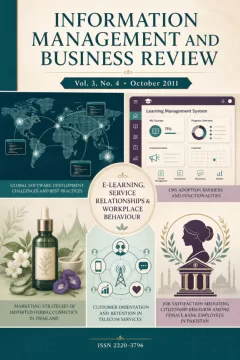 Vol. 3 No. 4 (2011)
E-Learning, Service Relationships & Workplace Behaviour
View issue contents
Published
Submissions
Have research to publish? Information Management and Business Review welcomes submissions.
Make a Submission