Abstract
This research investigated the factors that influence marketing strategies of imported herbal cosmetic products in Thailand. The study is qualitative research using in - depth interview to collect primary data and use content analysis to analyze the obtained data. The facial herbal cosmetics products using in this study were moisturizer, whitening lotions, creams, powder, toner, make up cleansing, mask, cleansing oil, soap bar, anti-aging lotions and creams which imported from Australia and the USA. Findings from the study found that product A positioned itself as a premium biodynamic natural plus innovation technology product using the greenhouse concept. The shops were decorated using recycle woods. The products’ packaging give customers a sense of the source, herb images grow around the boxes and bottles, whilst the text grows with the image, creating a sense of energy. Product A conscious of the environment and strive to source and use the most environmentally aware materials where possible. The retail price strategy depends on local marketing promotions. It has the stand-alone shops plus day spa and counters in department stores. The advertisement media strategies focus on magazine, direct mail, social network advertisement; facebook. Product B sets the position as an innovative organic beauty solution using pure certified organic ingredients without paraben, petroleum, and silicones. Recycled materials were used to make packaging and printed using soy ink. It has shop online and 12 counters in department stores. The local price strategy is discount on vocation. The promotion strategies focused on premium product and cash discount. The advertisement strategies of product B focused on magazines, direct mail, social network advertisement; facebook and popular brand ambassadors. Product C set position as ancient herbal product. The product’s formulations have made with the unique natural ingredients, effective botanical extracts with the latest innovations from around the world since a 160 years old formula. The products avoid using of preservative and perfume. It has 8 counters in department stores and used the recyclable packaging so that product C concentrate the efforts and cost on the substance and quality of products which reflex selling price. The advertisement strategies focused on brochure and social network advertisement (facebook and twitter) while selling promotion strategies of the product are free premium sampling, customers refer friends, and 28 days satisfaction guarantee for refund.
Keywords
- Cosmetic Search this journal for Cosmetic (opens in a new tab)
- Herbal Search this journal for Herbal (opens in a new tab)
- Import Search this journal for Import (opens in a new tab)
- Marketing Strategy Search this journal for Marketing Strategy (opens in a new tab)
- Products Search this journal for Products (opens in a new tab)
- Thailand Search this journal for Thailand (opens in a new tab)
References
- Cosmetic Products Market-Thailand. (2009).Retrieved April14,2009 from http://www.buyusa.gov/asianow/thcosmetic.html
- Draelos, Z., Dover, J. & Alam, M. (2009). Cosmeceuticals. (2nd ed) USA : Elsevier.
- Ergin, E., Ozdemir, H. & Parilti, N. (2005). Brand Loyalty in the Cosmetic Industry: A field study on Turkish women’s brand loyalty among cosmetic product. Journal of Business &Economics Research, 3(5) , 5-16.
- Ferrell, O. C. & Hirt, G. (2009). Customer Driven Marketing. Business A changing World ( 17th ed) USA:McGraw.Hill. 369-379.
- Guthrie, M. & Kim, H. (2009). The relationship between consumer involvement and Brand perceptions of female cosmetic consumers. Journal of Brand Management, (17), 114-133.
- Jalalkamali, M. & Nikbin, A. (2010). The effects of motivation on purchase decision. Interdisciplinary Journal of Contemporary Research in business , 2, 234-245.
- Jui-Yen, Y., Mei-Liang, C. & Yi- chieh, C. (2008). The Study of Direct Selling Management Strategies: An example of the Avon cosmetics company in Taiwan.
- New Zealand Trade and Enterprise. (2010). Market Profile for skincare and cosmetic products in the Hong Kong market, March, 2-6.
- Oh, C. & Rugman, A. (2007). Regional multinationals and the Korean cosmetics industry. Asia Pacific Journal of management , 24(1), 27 – 42.
- Rajagopal .(2007). Buying decisions towards organic products: an analysis of customer value and brand drivers. Journal of Emerging Markets , 2, 236-246.
- Rowey, J. & Spiezia, M. (2006). Spiezia Organics:an SME Marketing. The Marketing Review , 6, 253-264. Sameer, K., Massie, C. & Michelle, D. (2006). Comparative innovative business strategies of major players in cosmetic industry. Industrial Management Data , 106, 285-306.
- Sun, P. & Hwang, I. (2005). The Impact of New Product Launch Strategies on the Reaction of Competitors in the Taiwanese Cosmetic Industry . International Journal of Management, (22), 442-453.
Downloads
No downloads have been recorded for this article yet. Figures appear here once readers begin downloading the full text.
How to Cite
Share this article
License
Copyright (c) 2011 Rojanadilok Thanisorn, Bunchapattanasakda (Author)

This work is licensed under a Creative Commons Attribution 4.0 International License.
Author (s) should affirm that the material has not been published previously. It has not been submitted and it is not under consideration by any other journal. At the same time author (s) need to execute a publication permission agreement to assume the responsibility of the submitted content and any omissions and errors therein. After submission of revised paper in the light of suggestions of the reviewers, the editorial team edits and formats manuscripts to bring uniformity and standardization in published material.
This work will be licensed under Creative Commons Attribution 4.0 International (CC BY 4.0) and under condition of the license, users are free to read, copy, remix, transform, redistribute, download, print, search or link to the full texts of articles and even build upon their work as long as they credit the author for the original work. Moreover, as per journal policy author (s) hold and retain copyrights without any restrictions.
Keywords
- Cosmetic Search this journal for Cosmetic (opens in a new tab)
- Herbal Search this journal for Herbal (opens in a new tab)
- Import Search this journal for Import (opens in a new tab)
- Marketing Strategy Search this journal for Marketing Strategy (opens in a new tab)
- Products Search this journal for Products (opens in a new tab)
- Thailand Search this journal for Thailand (opens in a new tab)
Section
Published in
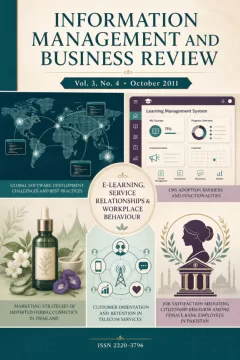 Vol. 3 No. 4 (2011)
E-Learning, Service Relationships & Workplace Behaviour
View issue contents
Published
Submissions
Have research to publish? Information Management and Business Review welcomes submissions.
Make a Submission