Abstract
In this study, an effort has been made to disclose the influence of customer orientation on customer retention. It has also revealed that customer orientation influences on customer satisfaction and customer trust and their ultimate effect on customer Retention. Primary data was collected through questionnaire survey.290 questionnaires were distributed out of which 219 were received and supposed for analysis purpose, 75.51% which is considered as a serious response rate of our respondents. Customer orientation has positive effect on customer satisfaction as well as on customer trust, which shows significant relationship of customer orientation on customer satisfaction and customer trust. Moreover, satisfaction and trust of customer has effect on customer retention. Satisfaction of customer has negative effect due to one or more reason, whereas, customer trust has positive and significant effect on customer retention. Customer orientated organizations earn more profit and can control customer retention. Findings of this study can also be used to control the customer retention. While customer orientation is under discussion then it has two major factors i.e. customer satisfaction and customer trust, organizations should more focus on these factors. Sometime when customer retention takes place even focusing these factors then current competitor’s strategies can also be kept in mind. This study is done in a developing country where there is a very tough competition among service providers to enhance their market share. The focus of this research is to control the switching customer, which is the one of the important problems facing by the service providers.
Keywords
- Customer Orientation Search this journal for Customer Orientation (opens in a new tab)
- Customer Satisfaction Search this journal for Customer Satisfaction (opens in a new tab)
- Customer Trust Search this journal for Customer Trust (opens in a new tab)
- Customer Retention Search this journal for Customer Retention (opens in a new tab)
References
- Pakistan Telecommunication Authority (2010). Annual Report 2009-10 from http://www.Pta.Gov.Pk/annualreports/annrep10 (26-32). Anderson, W. E., Fornell, C. & Roland T. R. (1997). Customer Satisfaction, Productivity, and Profitability: Differences Between Goods and Services. Marketing Science , 16(2), 129-145.
- Bauer, H. H., Grether, M. & Leach, M. (2001). Building customer relations over the Internet. Industrial Marketing Management , 31, 155–163.
- Bentler, P. M. & Bonett, D. G. (1990). Comparative fit indices in structural models. Psychological Bulletin , 107(2), 238-46.
- Berry, L. L. (1995). Relationship marketing of services-growing interest, emerging perspectives. Journal of the Academy of Marketing Science , 23(4), 236-45.
- Chin, W., Peterson, R. & Brown, S. (2008). Structural equation modeling in marketing: Some practical reminders. Journal of Marketing Theory and Practice , 16(4), 287-98.
- Chu, W. & Desai, S. P. (1995). Channel Coordination Mechanisms for Customer Satisfaction. Marketing Science , 14(4), 343-359.
- Crosby, L. A., Evans, K. A. & Cowles, D. (1990). Relationship quality in services selling: an interpersonal influence perspective. Journal of Marketing , 54(3), 68-81.
- Diaz, M. A., Audustin, A. & Rodolfo, V. (2000). The use of quality expectations to segment a service market. Journal of Services marketing , 14(2), 132-146.
- Fornell, C. (1992). A national customer satisfaction barometer: The Swedish experience. Journal of Marketing , 56, 6–21.
- Fornell, C., Johnson, M. D., Anderson, E. W., Jaesung, C. & Bryant, B. E. (1996). The American customer satisfaction index: nature, purpose, and findings. Journal of Marketing , 60(4), 7-18.
- Garbarino, E. & Johnson, M. S. (1999). The different roles of satisfaction, trust, and commitment in customer relationships. Journal of Marketing , 63, 70-87.
- Hennig-Thurau, T. (2004). Customer orientation of service employees: its impact on customer satisfaction, commitment, and retention. International Journal of Service Industry Management , 15(5), 460-78.
- Huang, M.H (2007). The influence of selling behaviors on customer relationships in financial services. International Journal of Service Industry Management , 19(4), 458-473.
- Huang, J. H. & Dastmalchian, A. (2006). Implications of trust and distrust for organizations Role of customer orientation in a four-nation Study. Personnel Review , 35(4), 361-377.
- Joreskog, K. G. & Sorbom, D. (1993). LISREL 8: A Guide to the Program and Applications, Scientific Software International, Chicago, IL.
- Michaels, R. E. & Day, R. L. (1985). Measuring customer orientation of salespeople: a replication with industrial buyers. Journal of Marketing Research , 22, 443-446.
- Saxe, R. & Weitz, B. A. (1982). The SOCO Scale: a measure of the customer orientation of salespeople. Journal of Marketing Research , 19, 343-51.
- Sirdeshmukh, D., Singh, J. & Sabol, B. (2002). Consumer trust, value, and loyalty in relational exchanges. Journal of Marketing , 66, 15-37.
- Wray, B., Palmer, A. & Bejou, D. (1994). Using neural network analysis to evaluate buyer-seller relationships. European Journal of Marketing , 28(10), 32-48.
Downloads
No downloads have been recorded for this article yet. Figures appear here once readers begin downloading the full text.
How to Cite
Share this article
License
Copyright (c) 2011 Junaid-Ul-Haq, Awais Ijaz, Saqib Mehmood (Author)

This work is licensed under a Creative Commons Attribution 4.0 International License.
Author (s) should affirm that the material has not been published previously. It has not been submitted and it is not under consideration by any other journal. At the same time author (s) need to execute a publication permission agreement to assume the responsibility of the submitted content and any omissions and errors therein. After submission of revised paper in the light of suggestions of the reviewers, the editorial team edits and formats manuscripts to bring uniformity and standardization in published material.
This work will be licensed under Creative Commons Attribution 4.0 International (CC BY 4.0) and under condition of the license, users are free to read, copy, remix, transform, redistribute, download, print, search or link to the full texts of articles and even build upon their work as long as they credit the author for the original work. Moreover, as per journal policy author (s) hold and retain copyrights without any restrictions.
Keywords
- Customer Orientation Search this journal for Customer Orientation (opens in a new tab)
- Customer Satisfaction Search this journal for Customer Satisfaction (opens in a new tab)
- Customer Trust Search this journal for Customer Trust (opens in a new tab)
- Customer Retention Search this journal for Customer Retention (opens in a new tab)
Section
Published in
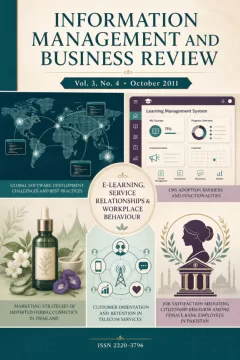 Vol. 3 No. 4 (2011)
E-Learning, Service Relationships & Workplace Behaviour
View issue contents
Published
Submissions
Have research to publish? Information Management and Business Review welcomes submissions.
Make a Submission