Abstract
Financial planning for retirement for gig workers is relatively hard given their insecure employment. Factors like employer misplacement of gig workers, a lack of employer-sponsored pension plans, uncertain income, and insufficient financial guidance may make it difficult and stressful for gig workers to arrange their money for retirement. The researchers offer a relationship model in this study, with a quantitative research design chosen to validate the hypothesized elements and construct linkages between them. The main factors that may influence financial planning for retirement stated as financial literacy, retirement goals, future time perspective, social influence, and saving attitude as a mediator. To confirm that, a design questionnaire, which is reliable and acceptable, two steps of verification have followed. First, there is a validation phase in which the questionnaire is reviewed by a panel of experts. Before moving on to the next level, the feedback gathered was followed up on. Second, the pilot study proceeding to investigate the consistency of the instrument analyzed through Cronbach’s Alpha coefficient reliability screening in SPSS 26 software package. Moreover, the results found that all the items were reliable and the Cronbach’s Alpha coefficient above 0.7.
Keywords
- Financial Planning for Retirement Search this journal for Financial Planning for Retirement (opens in a new tab)
- Gig Workers Search this journal for Gig Workers (opens in a new tab)
- Pilot Study Search this journal for Pilot Study (opens in a new tab)
- Questionnaire Search this journal for Questionnaire (opens in a new tab)
References
- Alekam, E., Salniza, M., Salleh, B. M., Sanuri, S., Com, W. A., Mohammed, J. & Mokhtar, M. (2018). INTERNATIONAL JOURNAL OF ORGANIZATIONAL LEADERSHIP The Effect of Family, Peer, Behavior, Saving and Spending Behavior on Financial Literacy among Young Generations. In International Journal of Organizational Leadership, (Vol. 7).
- Alex, T. C. X., Cheong, W. L., Chong, C. J., Lee, R. & Liou, Y. H. (2019). The individual savings behaviour in Malaysian new villages.
- Ali, S. B. & Frank, H. A. (2019). Retirement Planning Decisions: Choices Between Defined Benefit and Defined Contribution Plans. American Review of Public Administration, 49(2), 218–235. https://doi.org/10.1177/0275074018765809
- Alkhawaja, S. O. & Albaity, M. (2022). Retirement saving behavior: evidence from UAE. Journal of Islamic Marketing, 13(2), 265–286. https://doi.org/10.1108/JIMA-03-2020-0072
- Awang, W. Q. & Abdullah, A. (2021). Financial Literacy, Social Influence, Goal Clarity, And Retirement Experience. E-Proceeding 8th International Conference On Public Policy and Social Science (ICOPS) 2021.
- Ba?ová -Lenka Kostovi?ová, V. (2018). Too far away to care about? Predicting psychological preparedness for retirement financial planning among young employed adults (Vol. 66).
- Baker, H. K., Tomar, S., Kumar, S. & Verma, D. (2021). Are Indian professional women financially literate and prepared for retirement? Journal of Consumer Affairs, 55(4), 1416–1441. https://doi.org/10.1111/joca.12332
- Bello, H. (2019). Planning towards a successful retirement: Issues and Opportunities Impact of Changing Lifestyle on Municipal Solid Waste Generation in Residential Areas: Case Study of Qatar View Project the Six Factor Building Assessment Tool: Application on the Qatar Faculty of Islamic Studies (QFIS) Building, Doha View project. https://www.researchgate.net/publication/334193308
- Bucciol, A. & Zarri, L. (2019). Saving education received in early life and future orientation in adulthood. Journal of Financial Counselling and Planning, 30(1), 67–82. https://doi.org/10.1891/1052-3073.30.1.67
- Burchi, A., W?odarczyk, B., Szturo, M. & Martelli, D. (2021). The effects of financial literacy on sustainable entrepreneurship. Sustainability (Switzerland), 13(9). https://doi.org/10.3390/su13095070
- Cucinelli, D. & Bongini, P. (2019). University students and retirement planning: never too early. International Journal of Bank Marketing, 37(3), 775–797. https://doi.org/10.1108/IJBM-03-2018-0066
- Eismann, M., Verbeij, T. & Henkens, K. (2019). Older workers’ plans for activities in retirement: The role of opportunities, spousal support, and time perception. Psychology and Aging, 34(5), 738–749. https://doi.org/10.1037/pag0000377
- Fiergbor, D. D. (2020). The habit of savings among college students. Global Economics Science, 38–43. https://doi.org/10.37256/ges.11202069.38-43
- Gass, R. H. (2015). Social Influence, Sociology of. International Encyclopaedia of the Social & Behavioral Sciences, 22. https://doi.org/http://dx.doi.org/10.1016/B978-0-08-097086-8.32074-8
- Gavurova, B., Kubak, M., Huculova, E., Popadakova, D. & Bilan, S. (2019). Financial Literacy and Rationality of Youth in Slovakia. Transformations In Business & Economics, 18(3), 43–53.
- Ghadwan, A., Wan Ahmad, W. M. & Hanifa, M. H. (2022). Financial planning for retirement: The mediating role of culture. Risks, 10(5), 104. https://doi.org/10.3390/risks10050104
- Hajam, M. A. (2020). The Effect of Future Orientation and Financial Literacy on Family Retirement Planning Mediated by Saving Attitude. Jurnal Sosial Humaniora (JSH) 2020, 13. http://creativecommons.org/licenses/by/4.0/
- Hansson, I. (2019). Retirement and life satisfaction: a resource-based dynamic perspective.
- Haron, H., Razali, N. N. S. M. & Mohamad, F. (2019). Factors influencing financial planning retirement amongst employees in the private sector in East Coast Malaysia: Literature Review and research agenda. KnE Social Sciences. https://doi.org/10.18502/kss.v3i22.5115
- Hassan, Z. A., Schattner, P. & Mazza, D. (2006). Doing A Pilot Study: Why is it Essential? Malaysian Family Physician, 1(2). http://www.ejournal.afpm.org.my/
- Hastings, J. & Mitchell, O. S. (2020). How financial literacy and impatience shape retirement wealth and investment behaviors. Journal of Pension Economics and Finance, 19(1), 1–20. https://doi.org/10.1017/S1474747218000227
- Hauff, J. C., Carlander, A., Gärling, T. & Nicolini, G. (2020). Retirement Financial Behaviour: How Important Is Being Financially Literate? Journal of Consumer Policy, 43(3), 543–564. https://doi.org/10.1007/s10603-019-09444-x
- Herrador-Alcaide, T. C., Hernández-Solís, M. & Topa, G. (2021). A model for personal financial planning towards retirement. Journal of Business Economics and Management, 22(2), 482–502. https://doi.org/10.3846/jbem.2020.13978
- Hershey, D. A., Jacobs-Lawson, J. M. & Austin, J. T. (2013). Effective financial planning for retirement. In M. Wang (Ed.), The Oxford handbook of retirement (pp. 402–430). Oxford University Press, Inc. https://doi.org/10.1093/oxfordhb/9780199746521.013.0133
- Hutabarat, A. S. S. & Wijaya, C. (2020). Analysis the effect of financial literacy on financial planning for retirement (case study lecturers and administrative staffs in Universitas Indonesia). International Journal of Management, 11(5), 741–750. https://doi.org/10.34218/IJM.11.5.2020.066
- Jais, J. B. & Asokumar, A. (2020). Psychological Process, Social and Environmental Influence on Retirement Planning: Malaysian Energy Industry Perspective. Management and Marketing, 15(2), 134–153. https://doi.org/10.2478/mmcks-2020-0009
- Jiun, T. Y., Satar, N. H. M. & Ishak, N. A. (2021). Malaysian Undergraduate Students’ Expectation of Life Satisfaction After Retirement: The Role of Parental Influence and Financial Knowledge. Journal of Wealth Management & Financial Planning, 8.
- Kadir, J. M. A. & Fadhilah, R. (2020). Retirement Planning and its Impact on Working Individuals Intention to Use Biodegradable Drinking Straw View Project Developing a Fuel Subsidy Framework View project. https://www.researchgate.net/publication/359576348
- Kerry, M. J. (2018). Psychological antecedents of retirement planning: A systematic review. Frontiers in Psychology, 9. https://doi.org/10.3389/fpsyg.2018.01870
- Kim, Y. J., & Hollingshead, A. B. (2015). Online social influence: Past, present, and future. Annals of the International Communication Association, 39(1), 163–192. https://doi.org/10.1080/23808985.2015.11679175
- Kimiyagahlam, F., Safari, M. & Mansori, S. (2019). Influential Behavioral Factors on Retirement Planning Behavior: The Case of Malaysia. https://doi.org/10.1891/1053-3073.30.2.244
- Kooij, D. T. A. M., Kanfer, R., Betts, M. & Rudolph, C. W. (2018). Future Time Perspective: A systematic review and meta-analysis. Journal of Applied Psychology, 103(8), 867–893. https://doi.org/10.1037/apl0000306
- Larisa, L. E., Njo, A. & Wijaya, S. (2021). Female workers’ readiness for retirement planning: an evidence from Indonesia. Review of Behavioral Finance, 13(5), 566–583. https://doi.org/10.1108/RBF-04-2020-0079
- Leon, A. C., Davis, L. L. & Kraemer, H. C. (2011). The role and interpretation of pilot studies in clinical research. Journal of Psychiatric Research, 45(5), 626–629. https://doi.org/10.1016/j.jpsychires.2010.10.008
- Li, Y., Burr, J. A. & Miller, E. A. (2019). Pension Plan Types and Financial Literacy in Later Life. Gerontologist, 59(2), 260–270. https://doi.org/10.1093/geront/gnx135
- Liu, C., Bai, X. & Knapp, M. (2021). Multidimensional Retirement Planning Behaviors, retirement confidence, and post-retirement health and well-being among Chinese older adults in Hong Kong. Applied Research in Quality of Life, 17(2), 833–849. https://doi.org/10.1007/s11482-020-09901-7
- Moffatt, S. & Heaven, B. (2016). ‘planning for uncertainty’: Narratives on retirement transition experiences. Ageing and Society, 37(5), 879–898. https://doi.org/10.1017/s0144686x15001476
- Murari, K., Shukla, S. & Adhikari, B. (2021). Do psychological social and financial perceptions of post-retirement life and demography influence the retirement planning behaviour? International Journal of Social Economics, 48(11), 1545–1566. https://doi.org/10.1108/IJSE-08-2020-0581
- Nivalainen, S. (2022). From plans to action? Retirement thoughts, intentions and actual retirement: An eight-year follow-up in Finland. Ageing and Society, 42(1), 112–142. https://doi.org/10.1017/S0144686X20000756
- Ong, K. T., Awang, S. R., Zakuan, N., Sulaiman, Z., Chin, T. A., Mas’od, A., Jusoh, A. & Ahmad, U. N. U. (2020). Goal Clarity and Financial Literacy towards Retirement Confidence among Working Adults in Southern Region, Malaysia. Test Engineering & Management, 83, 9965–9971.
- Pavia, S. & Grima, S. (2019). Retirement planning by Maltese nationals: A study of influential factors. In Contemporary Studies in Economic and Financial Analysis, 101, 227–259. Emerald Group Publishing Ltd. https://doi.org/10.1108/S1569-375920190000101016
- Ponchio, M. C., Cordeiro, R. A. & Gonçalves, V. N. (2019). Personal factors as antecedents of perceived financial well-being: evidence from Brazil. International Journal of Bank Marketing, 37(4), 1004–1024. https://doi.org/10.1108/IJBM-03-2018-0077
- Rai, K., Vidyapeeth, J., Tyagi, A. & Sahni, S. (2020). Modelling The Factors of Financial Planning for Retirement Among Individuals Using Ism. https://doi.org/10.13140/RG.2.2.15973.32484
- Rameli, R. S. & Marimuthu, M. (2018). A Conceptual Review on the Effect of Attitudes towards Retirement on Saving Intentions and Retirement Planning Behavior. SHS Web of Conferences, 56, 02005. https://doi.org/10.1051/shsconf/20185602005
- Rasiah, R., Mathew Bilong, F., James Turner, J., Waheed, H., Somasundram, S., Pei Leng, K., Taylor, J. & Jaya, S. (2020). A Structural Equation Modelling Study of the Determinants of Retirement Preparedness. In International Journal of Innovation, Creativity and Change. www.ijicc.net (Vol. 11, Issue 6). www.ijicc.net
- Rostamkalaei, A., Nitani, M., & Riding, A. (2022). Self-employment, financial knowledge, and retirement planning. Journal of Small Business Management, 60(1), 63–92. https://doi.org/10.1080/00472778.2019.1695497
- Seidl, J., Neiva, E. R. & Murta, S. G. (2021). Planning and Reasons for Retirement: Focus Groups with Brazilian Workers. Trends in Psychology, 29(3), 456–473. https://doi.org/10.1007/s43076-021-00063-5
- Shariff, N. S. M. & Ishak, W. W. M. (2021). Statistical analyses on factors affecting retirement savings decision in Malaysia. Mathematics and Statistics, 9(3), 243–248. https://doi.org/10.13189/ms.2021.090305
- Stolarski, M., Fieulaine, N. & Zimbardo, P. G. (2018). Putting time in a wider perspective: The past, the present, and the future of time perspective theory. https://doi.org/10.4135/9781526451163.n28ï
- Tan, Z. M., Aggarwal, N., Cowls, J., Morley, J., Taddeo, M. & Floridi, L. (2021). The ethical debate about the gig economy: A review and critical analysis. Technology in Society, 65, 101594. https://doi.org/10.1016/j.techsoc.2021.101594
- Teijlingen, E. V., & Hundley, V. (2002). The importance of pilot studies. Nursing Standard, 16(40), 33–36. https://doi.org/10.7748/ns.16.40.33.s1
- Tomar, S., Kent Baker, H., Kumar, S. & Hoffmann, A. O. I. (2021). Psychological determinants of retirement financial planning behavior. Journal of Business Research, 133, 432–449. https://doi.org/10.1016/j.jbusres.2021.05.007
- Topa, G., Lunceford, G. & Boyatzis, R. E. (2018). Financial planning for retirement: A psychosocial perspective. Frontiers in Psychology, 8(JAN). https://doi.org/10.3389/fpsyg.2017.02338
- Watson, F. A. (2016). Lessons learned on approaches to data collection and analysis from a pilot study. Nurse Researcher, 24(1), 32–36. https://doi.org/10.7748/nr.2016.e1444
- Watson, G. P., Kistler, L. D., Graham, B. A. & Sinclair, R. R. (2021). Looking at the gig picture: Defining gig work and explaining profile differences in gig workers’ job demands and resources. Group & Organization Management, 46(2), 327–361. https://doi.org/10.1177/1059601121996548
- Yeung, D. Y. & Zhou, X. (2017). Planning for retirement: Longitudinal Effect on retirement resources and post-retirement well-being. Frontiers in Psychology, 8. https://doi.org/10.3389/fpsyg.2017.01300
- Yong, C. C., Yew, S. Y. & Wee, C. K. (2018). Financial Knowledge, Attitude and Behaviour of Young Working Adults in Malaysia. In Institutions and Economies, 10(4).
- Zandi, G., Torabi, R., Yu, O. T., Sivalingam, A. D. & Khong, T. T. (2021). Factors affecting the intention of generation y in Malaysia to invest for retirement. Advances in Mathematics: Scientific Journal, 10(3), 1485–1507. https://doi.org/10.37418/amsj.10.3.36
- Zhu, A. Y. F. & Chou, K. L. (2018). Retirement Goal Clarity, Needs Estimation, and Saving Amount: Evidence from Hong Kong, China.
Downloads
No downloads have been recorded for this article yet. Figures appear here once readers begin downloading the full text.
How to Cite
Share this article
License
Copyright (c) 2023 Muhammad Eddy Aizad Anuar, Shafinar Ismail, Khairunnisa Abd Samad (Author)

This work is licensed under a Creative Commons Attribution 4.0 International License.
Author (s) should affirm that the material has not been published previously. It has not been submitted and it is not under consideration by any other journal. At the same time author (s) need to execute a publication permission agreement to assume the responsibility of the submitted content and any omissions and errors therein. After submission of revised paper in the light of suggestions of the reviewers, the editorial team edits and formats manuscripts to bring uniformity and standardization in published material.
This work will be licensed under Creative Commons Attribution 4.0 International (CC BY 4.0) and under condition of the license, users are free to read, copy, remix, transform, redistribute, download, print, search or link to the full texts of articles and even build upon their work as long as they credit the author for the original work. Moreover, as per journal policy author (s) hold and retain copyrights without any restrictions.
Keywords
- Financial Planning for Retirement Search this journal for Financial Planning for Retirement (opens in a new tab)
- Gig Workers Search this journal for Gig Workers (opens in a new tab)
- Pilot Study Search this journal for Pilot Study (opens in a new tab)
- Questionnaire Search this journal for Questionnaire (opens in a new tab)
Section
Published in
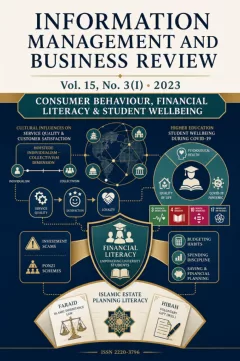 Vol. 15 No. 3(I) (2023)
Consumer Behaviour, Financial Literacy & Student Wellbeing
View issue contents
Published
Submissions
Have research to publish? Information Management and Business Review welcomes submissions.
Make a Submission