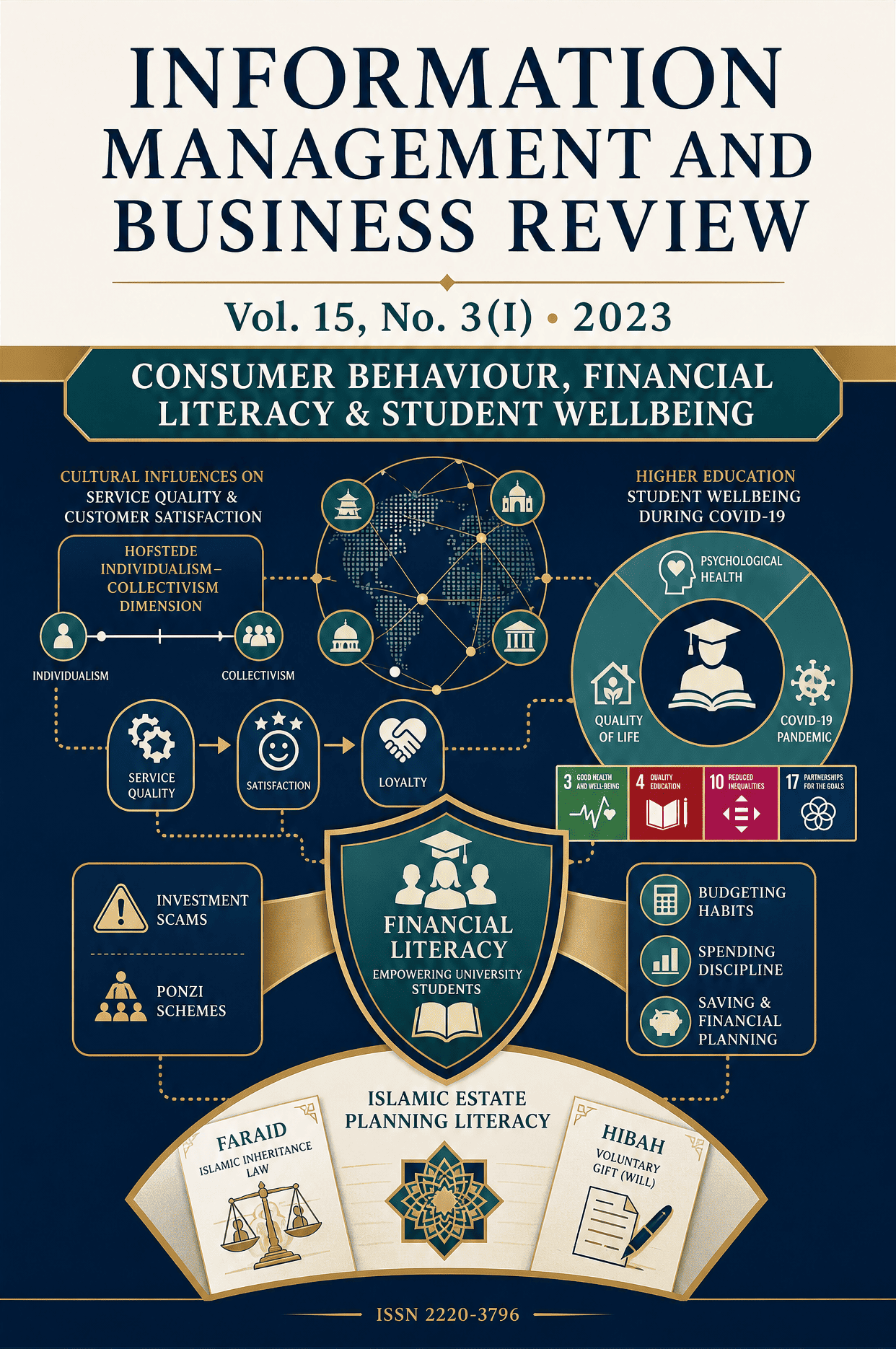
Articles 1–10 of 49

  • Article 1 in this issue

    Exploring the Influence of Technology, Lifestyle and Flexible Working Arrangements on Cyber Psychology among Employees at a Malaysian Investment Holding Company

    • Author: Marina Hazlin Harun, Idaya Husna Mohd, Muhamad Khalil Omar, Siti Mujanah, Shereen Noranee

    This study explores the relationship between cyberpsychology and its influencing factors among employees at an investment holding company (which will be addressed as XYZ Berhad). Understanding the impact of technology, lifestyle, and flexible working arrangements on employees' psychological well-being and behavior is crucial in today's digital workplace. With the prevalence of remote work and flexible arrangements, it becomes essential to examine how these factors influence employees' cyberpsychology experiences. Using a quantitative correlational approach, data was collected from 123 participants out of a total employee population of 174 at XYZ Berhad. The survey utilized Likert scale items to assess respondents' perspectives on technology usage, lifestyle choices, flexible working arrangements, and cyberpsychology. The findings reveal significant relationships between cyberpsychology and the influencing factors. Technology has a strong positive relationship, indicating its substantial impact on employees' psychological well-being and work behaviors. Similarly, lifestyle choices show a moderate positive relationship, highlighting the relevance of personal lifestyle preferences in shaping cyberpsychological experiences. Additionally, flexible working arrangement displays a medium positive relationship, underscoring the importance of work arrangements in influencing employees' psychological responses. The study recommends implementing awareness programs to help employees manage the psychological effects of technology usage and promoting the usage of online communication platforms to foster a positive organizational culture. Guidelines for employees working under flexible arrangements are advised to support their well-being and maintain a healthy work-life balance.

    Pages 1-11

    PDF - Exploring the Influence of Technology, Lifestyle and Flexible Working Arrangements on Cyber Psychology among Employees at a Malaysian Investment Holding Company (opens in a new tab)
  • Article 2 in this issue

    A Comparative Analysis of Individualism and Collectivism Effects on Customer Satisfaction in the Retail Sector: Examining Asian and Western Cultures

    • Author: Abdul Hamid Abdul Halim, Wan Soraya Wan Abdul Ghani

    Customer satisfaction is the result of a customer's assessment of how well a service has performed, stemming from the differences between their initial expectations and the actual service they have encountered. While various elements play a role in shaping customer satisfaction, numerous factors come into play. This study focuses on exploring cultural differences, considering the multicultural environment of Malaysia. This is particularly intriguing since businesses in Malaysia cater to both local and international customers from Asian and Western regions. The objective of this study is to examine the correlation between individualism and collectivism about customer service satisfaction, with a specific focus on the retail sector involving multinational brands and diverse customers. The utilization of Geert Hofstede's Dimension theory is justified as it is a widely recognized framework for cultural differences research. A quantitative methodology was employed, surveying 103 participants, with 51.5% originating from Asian cultures and 48.5% from Western cultures. The findings demonstrate that while both individualism and collectivism significantly influence customer service satisfaction in the retail sector, collectivism plays a more significant role in determining overall satisfaction levels. To enhance the understanding of this topic, it is suggested that future studies expand beyond the Klang Valley area and explore additional explanatory variables that consider the impact of cultural differences on customer satisfaction.

    Pages 12-18

    PDF - A Comparative Analysis of Individualism and Collectivism Effects on Customer Satisfaction in the Retail Sector: Examining Asian and Western Cultures (opens in a new tab)
  • Article 3 in this issue

    A Conceptual Framework to Study Factors Influencing Volunteers’ Motivation

    • Author: Aziana Hizazi, Maliza Delima Kamarul Zaman, Adem Gonulal, Dayang Nailul Munna Abg Abdullah

    Many researchers agree that motivation plays a key role for people to volunteer. This is because volunteering sometimes offers them no money or recognition. Understanding volunteer motivations and variances between groups of people will enable management to build management methods that will help volunteers perform better. Little study has been conducted on the volunteer motivational factors due to crisis although there were many studies on other forms of factors related to volunteerism. By understanding volunteer motivation, volunteers can be better managed to ensure that the benefits of helping outweigh the potential negative consequences for individuals and the community as a whole. The Malaysian Ministry of Youth and Sports was selected because although the initiative has just been launched recently but the Ministry able to attract more than 200,000 volunteers. Therefore, the purpose of this study is to examine the factors that influence people to volunteer as trained Satria. This will help government and non-profit organizations understand the factors that influence people to motivate during crises and emergencies as well as less-emergencies situations. Therefore, this paper aims to examine the factors influencing volunteers’ motivation from a population of 508 trained Satria volunteers of the Malaysian Ministry of Youth and Sports throughout Malaysia.

    Pages 19-30

    PDF - A Conceptual Framework to Study Factors Influencing Volunteers’ Motivation (opens in a new tab)
  • Article 4 in this issue

    The Role of Personality Peculiarities on Depression and Anxiety of Medical Doctors Using the JobDemands Resources Model: The Mediating Effect of Job Burnout

    • Author: Nor Farehan Omar, Saiful Effendy bin Md Sharif, Muhammad Syukri bin Abdullah

    Prolonged stress also known as job burnout refers to psychological conditions resulting from excessive fatigue due to work-related factors. However, distinguished features in personality might affect how people cope with job burnout which has implications for their mental health especially for their depression and anxiety. Therefore, this study intends to respond to the existing practical and empirical gaps by investigating the relationships between personality differences such as neuroticism and extraversion and mental health with the role of job burnout as the mediator. A cross-sectional study was conducted at eight public hospitals within Peninsular Malaysia. A total of 471 medical doctors from six departments participated. The result has shown that job burnout mediates the relationship between neuroticism and mental health. Job burnout made no difference to associations between extraversion and mental health.

    Pages 31-40

    PDF - The Role of Personality Peculiarities on Depression and Anxiety of Medical Doctors Using the JobDemands Resources Model: The Mediating Effect of Job Burnout (opens in a new tab)
  • Article 5 in this issue

    Boosting Customer Satisfaction and Unleashing Inventory Mastery through the Dynamic PDCA Cycle at a Trendsetting Outlet in Malaysia: A Case Study of PKS Fashion Outlet

    • Author: Azlina Muhammad, Nur Fadzrina Rosdin, Sisvan Gopalakrishna Pillai, Veera Pandiyan Kaliani Sundram, Muhammad Zaly Shah Muhammad Hussein, Li Lian Chew, Nur’Asyiqin Ramdhan, Nazura Mohamed Sayuti

    This study aims to investigate how PKS Fashion Outlet utilizes the PDCA methodology to enhance inventory management which eventually will boost customer satisfaction. As the department responsible for order-taking, customer feedback, and issue resolution over various channels, including phone and social media platforms, maintaining high customer satisfaction is crucial for PKS Fashion Outlet's primary business of selling fashion products. The research seeks to establish a continuous improvement process and enhance product quality by implementing the PDCA technique. Through a literature review, this study contrasts various approaches that have employed PDCA methods, demonstrating that PKS Fashion Outlet can improve service quality and inventory management through the Plan-Do-Act-Check process. The research provides recommendations and solutions to address the identified issues, leading to improved customer happiness and reduced complaints. It is important to note that this study focuses solely on customer service departments and enhancing customer satisfaction within PKS Fashion Outlet. The originality of this research lies in its application of the PDCA approach and fishbone analysis to identify the root causes of problems and their impact, contributing to the existing body of literature.

    Pages 41-49

    PDF - Boosting Customer Satisfaction and Unleashing Inventory Mastery through the Dynamic PDCA Cycle at a Trendsetting Outlet in Malaysia: A Case Study of PKS Fashion Outlet (opens in a new tab)
  • Article 6 in this issue

    The Influence of Perceived Risk Factors on Online Purchase Intention among Millennials in Malaysia

    • Author: Nur Nadiah Mahbob, Muhammad Asyraf Hasim, Mohd Fikri Ishak

    This study investigates perceived risk factors that influence online purchase intention among Millennials in Malaysia. The study examined several predictor variables, namely financial risks, product risks, and non-delivery risks, whereas the result variable under investigation was online purchase intention. The study employs structured questionnaires verified for data collection through face and content validity. The data were analyzed using descriptive statistics through the Statistical Package for Social Sciences (SPSS) version 23. Multiple regression analysis was conducted to ascertain the association between the predictor factors and the outcome variable. The findings indicate a significant relationship between the predictor variables, namely financial risks, product risks, and non-delivery risks, and the outcome variable. The analysis shows that non-return risks exhibited the highest association with online purchase intention. The findings of this study offer significant contributions to the advancement of future research and the enhancement of online entrepreneurs' ability to optimize their online operations and give enhanced consumer value experiences.

    Pages 50-58

    PDF - The Influence of Perceived Risk Factors on Online Purchase Intention among Millennials in Malaysia (opens in a new tab)
  • Article 7 in this issue

    Occupational Stress and Work-Life Balance in the Manufacturing Industry

    • Author: Nurul Asyilah binti CheNoordin, Sharifah Fazirah Syed Ahmad, Murni Zarina Mohamed Razali, Mohamad Fahimi Ahmad, Hairunnisa Ma’amor

    The manufacturing industry has become a crucial sector in Malaysia, leading to a high demand for employees, especially in management positions. However, job stress is a prevalent issue that can affect employees' work-life balance. Thus, this study aims to identify the factors that contribute to job stress in the private sector, specifically at the management level, which is vital for ensuring smooth daily operations. Private sector employees have the most control over occupational stress. The study focuses on conflict at work, job requirements, and job environment as contributing factors. A self-administered survey questionnaire was used to gather data, with 201 sets distributed to employees in food manufacturing at Selangor. The analysis of 190 valid questionnaires using the latest version of Statistic Packages for Social Science (SPSS) revealed that there is a significant influence of occupational stress on employees' work-life balance in the manufacturing industry with the work environment as the most influential factor. Conflict at work is the second most influential factor, while job requirements do not significantly contribute to job stress. The findings of this study can help managers and business owners in the manufacturing industry to understand the factors that cause employee, and job stress and encourage them to focus on implementing strategies to reduce stress in the workplace.

    Pages 59-69

    PDF - Occupational Stress and Work-Life Balance in the Manufacturing Industry (opens in a new tab)
  • Article 8 in this issue

    Awareness of Microtakaful Development among Low-Income Earners in Malaysia

    • Author: Arnida Jahya, Nur Diyana Yusoff, Azreen Roslan, Mohd Faizol Rizal Rasid, Anis Sofia Binti Roslan

    Malaysia is the third largest takaful market globally and the takaful sector in Malaysia shows sound growth in 2022. Takaful had a penetration rate of 20.1% in 2022, up from 18.6% the previous year. However, only 25% of adult employees in the low-income group have some form of life insurance or family takaful cover, in contrast with 59% of those who are employed in the overall population who have takaful or insurance protection. The Malaysian population can be classified into three income segments: the T20 group, comprising the top 20% of income earners; the M40 group, representing the middle 40% of income earners; and the B40 group, encompassing the bottom 40% of income earners. This study will only focus on the B40 group with a median income of RM3,860. The B40 has minimal wealth and ownership of assets, making them heavily dependent on government assistance to improve their living standards if the economy suffers a shock. Microtakaful is a kind of takaful product entailed for addressing the financial needs of households with low incomes in times of significant expenses. The main objective of this study was to examine the factors influencing the awareness of microtakaful development among the low-income group (B40). This study examines the relationship between (i) income level (ii) knowledge, and (iii) loss of exposure to the awareness of microtakaful. Data was collected by distributing 320 questionnaires to the residents in (PPR) Kerinchi Lembah Pantai, Kuala Lumpur. Based on the findings, it can be concluded that the three independent variables, namely income level, knowledge, and loss exposures, have a strong positive relationship with microtakaful awareness. However, it is found that income level has the biggest impact on the awareness of microtakaful.

    Pages 70-81

    PDF - Awareness of Microtakaful Development among Low-Income Earners in Malaysia (opens in a new tab)
  • Article 9 in this issue

    Instructional Elements Assessments of Entrepreneurship Education in a Technical University in Malaysia

    • Author: Khairul Saidah Abas Azmi, Azzarina Zakaria

    The technical and vocational education and training (TVET) program occupies the national education system to allow the students to learn practical, hands-on skills aligned with the industries' needs, ultimately preparing the students for the inexorable integration of technology brought about by the Fourth Industrial Revolution (IR 4.0). The rapid pace of change and broad impacts featuring IR 4.0 demand specific critical thinking skills, creativity, and readiness for risks, the qualities that are connected to entrepreneurship. Thus, it clarifies offering entrepreneurship education (EE) alongside a TVET program. There are arguments that EE is poorly embedded into the TVET program in Malaysia. The instructional elements concerned with the content, techniques, and activities through which students engage in creating entrepreneurial knowledge and value are considered essential for EE's success in a TVET program. This study assesses the state of instructional elements (i.e. content, teaching methods, infrastructure facilities, and learning assessments) of EE offered within a TVET program in Malaysia. Data were obtained from 37 students of a private technical university in Malaysia who enrolled for their entrepreneurship course through a series of group interviews. The study enlightens a few meaningful findings to propagate the entrepreneurial culture within a TVET program: (1) the content should be tailored to the readiness of the students, (2) action-based teaching methods should be engaged, (3) prior entrepreneurship experience should be specified for the entrepreneurship lecturer; (4) presence of ideal infrastructure facilities, and (5) learning assessments must be focusing in developing attributes of entrepreneurs.

    Pages 82-95

    PDF - Instructional Elements Assessments of Entrepreneurship Education in a Technical University in Malaysia (opens in a new tab)
  • Article 10 in this issue

    The Relationship between Employability Skill and Job Mismatch towards Graduates’ Unemployment

    • Author: Nurin Farzana Mohd Salahuddin, Nurul Salizawatee Mahpar, Mohd Fikri Ishak

    Academic graduates are expected to contribute more significantly to industry and the national economy by bringing in skills, knowledge, innovation, and productivity. Their role is essential in driving industrial growth, sustainability, and overall development for economic growth. However, in Malaysia, the difficulty of finding employment for graduates has become a major problem, not only from the graduates’ point of view but also from the employer. While the graduates are struggling to find job openings that match their skills, the employers at the other end find it difficult to locate people who are compatible with their businesses' vision. In Malaysia, several causes contributed to an increase in the unemployment rate for recent graduates including graduates' lack of employability skills and job mismatches. Quality such as communication, soft skills, problem-solving, and creative abilities, are shown to be weak in unemployed graduates. This research attempts to examine the relationship between employability skills and job mismatches towards the graduate’s unemployment. A questionnaire has been developed to gather the data. Graduates of the Faculty of Business and Management (FBM), UiTM have been identified as the population. Descriptive and regression analyses were run using SPSS software. Findings suggested that both independent variables (employability skills and job mismatches) contributed significantly towards the graduate’s unemployment. This study is significant as it highlights the need for graduates to improve necessary skills such as leadership, communication, and interpersonal skills (Briones, G. et al., 2021) needed within the industry to land a job.

    Pages 96-104

    PDF - The Relationship between Employability Skill and Job Mismatch towards Graduates’ Unemployment (opens in a new tab)