Abstract
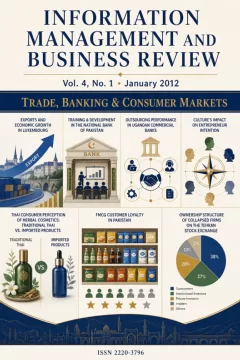
The key purpose of this article is to analyze the significant impact of Exports, Government expenditures and Education expenditures on the economic growth of the developed economy of the Luxemburg, which is the member state of the EU: the biggest exporter in the world. The span of time is from the year 1975 to 2009 on yearly basis with total no. of observations of 35. Present analysis is based on the simple ordinary least square method to indentify the important linkage between the export and the growth considering the economy of Luxemburg. Experimental results reveal a significant positive relationship of exports, government spending, educational expenditure, on growth of the economy. Export shows that one unit increase in the export cause a positive change of .17 in the economic growth. In the same way government, exp. and education exp. show a coefficient of 2.67 and 9.93 with positive sign. This article identifies the association between the export and the economic growth with respect to Luxemburg.
Keywords
- Government Exp. Growth Search this journal for Government Exp. Growth (opens in a new tab)
- Export Search this journal for Export (opens in a new tab)
- Luxemburg Search this journal for Luxemburg (opens in a new tab)
- Ordinary Least Square Search this journal for Ordinary Least Square (opens in a new tab)
References
- Akram, M., Khan. A. J., Atif. M., & Shafique, F. (2011). Exports and Economic Growth: Empirical evidence from Canada. Interdisciplinary Journal of Contemporary Research in Business , 3(2), 849-858.
- Amit, K. C. & Mallick, S. K. (2005). Income Distribution Dependence of Poverty Measure: A Theoretical Analysis, Quantitative Finance Papers physics/0507035, arXiv.org.
- Anand, S. & Ravallion, M. (1993). Human-development in poor countries – on the role of private incomes and public services. Journal of Economic Perspectives , 7(1), 133-150.
- Aschauer, A. D. (1988). Is Public Expenditure Productive? Journal of Monetary Economics, 23, 122-137.
- Aschauer, A. D. (1989). Is Public Expenditure Productive? Journal of Monetary Economics, 23, 177-200.
- Bhattacharya, P. C. & Sivasubramaniam, M. N. (2003). Financial development and economic growth in India: 1970-71 to 1998-99. Applied Financial Economics , 13, 905-09.
- Balassa, B. (1978). Exports and growth: further evidence. Journal of Development Economics , 5(2), 181-189.
- Barro, R. J. (1991). Economic growth in a cross section of countries. Quarterly Journal of Economics , 106(2), 407-33.
- Barro, R. J. (1991) . Economic growth in cross section countries. Quarterly Journal of Economics , 106, 407-443. Beck, K., Wu, L., Brunner, J. & Muller, M. (2000). Discrimination between SRP- and SecA/SecB-dependent substrates involves selective recognition of nascent chains by SRP and trigger factor. EMBO J , 19, 134–143.
- Bhagwati, J. N. & Srinvasan, T. (1979). Trade policy and development, International Economic Policy: Theory and Evidence. John Hopkins University Press, Baltimore, MD.
- Calderon, C. & Liu, L. (2003). The direction of causality between .nancial development and economic growth. Journal of Development Economics , 72, 321.334.
- Chandra, S. (2002). A Test of the Regional Growth-Instability Frontier Using State Data, Land Economics. University of Wisconsin Press , 78(3), 442-462.
- Demetraiades, P. & Luitel, K. B. (1996). Financial Development, Economic Growth and Banking Sector Control: Evidence from India. Economic Journal, 106 , 359-374.
- Devarajan, S., Swaroop, V. & Zue, H. (1996). The Composition of Public Expenditure in Economic Growth. Journal of Monetary Economics, 37, 313-344.
- Edwards, S. (1992). Trade orientation, distortions and growth in developing countries. Journal of Development Economics , 39, 31-57.
- Frankel, J. A. & Romer, D. (1999). Does Trade Cause Growth. American Economic Review , 89(3), 379-399.
- Grossman, G. & Helpman, E. (1991). Innovation and Growth in the Global Economy, Cambridge: MIT Press, 1991, Chapters 1-5.
- Heller, P. S. & Porter, R. C. (1978). Exports and Growth: An Empirical Reinvestigation. Journal of Development Economics , 5(2), 191-193.
- Jung. S. H. & Thorcecke, E. (2003). The impact of public education expenditure on human development. Growth and Poverty in Tanzania and Zambia: A General Equilibrium approach. Journal of Policy Modelling, 25, 701-725.
- Krueger, A. O. (1980). Trade policy as an input to development. American Economic Review, 70(2), 120.
- Li, H. & Haung, L. (2008). Health education and economic growth in china: Imperial findings and implications. China Economic Review, 20, 374-387.
- Lim, D. (1976). Export Instability and Economic Growth: A Return to Fundamentals. Oxford Bulletin of Economics and Statistics , 46 (1), 31-77.
- Mankiw, N. G. (1995). The growth of nations Papers on Economic Activity. American Economic Review, 70(2), 124.
- Michaely, M. (1977). Exports and growth: An Empirical investigation. Journal of Development Economics , 04(01), 49-53.
- Nandi, S. & Kumar, S. (2005). Variability of exports and imports in Indian perspective: An empirical study. Asia-Pacific Business Review , 01(01), 68-75.
- Pradhan, P. J. (2010). R&D Strategy of Small and Medium Enterprises in India, EERI Research Paper Series EERI_RP_2010_14, Economics and Econometrics Research Institute (EERI), Brussels.
- Qureshi, M. A. (2008). Challenging trickle-down approach: Modelling and simulation of public expenditure and human development–The case of Pakistan. International Journal of Social Economics, 35(4), 269282.
- Romer, P. M. (1990). Endogenous Technical Change. Journal of Political Economy, 5, 71-102.
- Tadesse, S. (2002). Financial architecture and economic performance: International evidence, J. Finan. Intermediation, this issue.
- Tanzi, V. & Chu, K. Y. (1998). Income distribution and high quality growth. Cambridge: MA: MIT Press.
- Tyler, W. G. (1981). Growth and export expansion in developing countries: Some empirical evidences. Journal of Development Economics, 9, 121-30.
- Wang, S. (1996). Study of education input and output. Hebei Education Press.
- Zhu, k., Guo, H., Diao, F. & Xu, S. (2008). A better estimate to the contribution on economic growth to china from 1999 - 2003. Export Systems with Application, 34, 1371-1383.
Downloads
No downloads have been recorded for this article yet. Figures appear here once readers begin downloading the full text.
How to Cite
Share this article
License
Copyright (c) 2012 Muhammad Usman, Muzaffar Ali, Hafiz Waqas Kamran, Hassan Khalid (Author)

This work is licensed under a Creative Commons Attribution 4.0 International License.
Author (s) should affirm that the material has not been published previously. It has not been submitted and it is not under consideration by any other journal. At the same time author (s) need to execute a publication permission agreement to assume the responsibility of the submitted content and any omissions and errors therein. After submission of revised paper in the light of suggestions of the reviewers, the editorial team edits and formats manuscripts to bring uniformity and standardization in published material.
This work will be licensed under Creative Commons Attribution 4.0 International (CC BY 4.0) and under condition of the license, users are free to read, copy, remix, transform, redistribute, download, print, search or link to the full texts of articles and even build upon their work as long as they credit the author for the original work. Moreover, as per journal policy author (s) hold and retain copyrights without any restrictions.
Keywords
- Government Exp. Growth Search this journal for Government Exp. Growth (opens in a new tab)
- Export Search this journal for Export (opens in a new tab)
- Luxemburg Search this journal for Luxemburg (opens in a new tab)
- Ordinary Least Square Search this journal for Ordinary Least Square (opens in a new tab)
Section
Published
Submissions
Have research to publish? Information Management and Business Review welcomes submissions.
Make a Submission