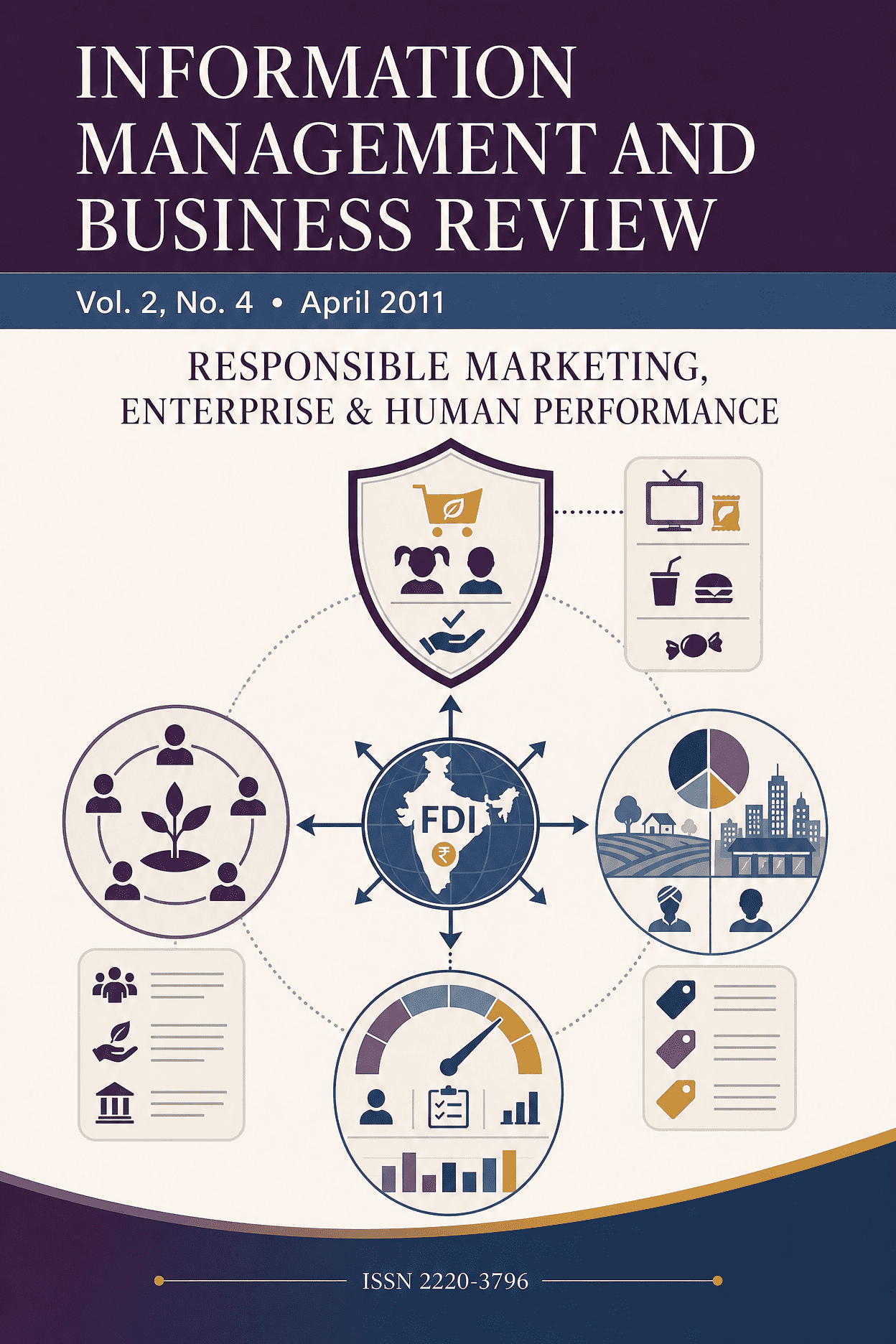
Articles

  • Article 1 in this issue

    Foods Promotion to Children: Understanding the Need of Responsibility in Marketing to Children

    • Author: Pavleen Kaur

    Children are bombarded with various forms of promotional activities by marketers of food products. It is known that children lack the necessary ability to understand that marketers direct promotions at them after a rigorous analysis of child psychology. They use simple criteria to evaluate products, get carried away by the use of cartoon characters, beautiful/irregular shapes or premiums offered to them. Therefore, relentless promotion often leads to overconsumption of nutrition poor and high density foods, leading to several health problems in children. Although parents also need to control food intake of their children or the government should intervene to check unethical practices of marketers, yet, their efforts are rendered unsuccessful if foods marketing companies themselves do not exercise self-restraint in marketing unhealthy foods to children and also market these foods ‘heavily’. The present paper discusses these issues and seeks to attract interest of academicians, marketers and policy makers in India.

    Pages 133-137

    PDF - Foods Promotion to Children: Understanding the Need of Responsibility in Marketing to Children (opens in a new tab)
  • Article 2 in this issue

    Invest In India–The Foreign Direct Investment Scenario

    • Author: Kamaladevi B

    Invest in India is an initiative to market India as an investment destination all over the globe, to provide a networking platform to the Indian businesses at a global level and to provide information to the international investors about investment opportunities in India. It is the policy of the Government of India to attract and promote productive Foreign Direct Investment (FDI) from non-residents in activities which significantly contribute to industrialization and socio-economic development. FDI supplements the domestic capital and technology. This paper firstly speaks about the FDI culture in India, secondly, reviews economic reforms in India and global response to India’s reforms, the next level discusses the policy issues that would address India’s relative lack of success in attracting FDI and the ‘Expanding Opportunities for Global Retailers’ with reference to the retail sector. The last part reveals the key recommendations towards attracting Diaspora FDI. Based on the objective analysis, the key recommendations towards attracting FDI are revealed like allow 100 % FDI in retail and Small & Medium Enterprises (SME), develop a strategic vision for FDI with focus on latest technology, reduce the transaction costs & improve the infrastructure, international and domestic entrepreneurship, decentralize the administration process, reduce overly bureaucratic FDI facilities, private public partnership with private sector taking the lead, Indian professionals placed in key decision making positions, creative joint ventures and partnership to tap entrepreneurship and fix the policies to convert remittances into investment & create venture capital.

    Pages 138-153

    PDF - Invest In India–The Foreign Direct Investment Scenario (opens in a new tab)
  • Article 3 in this issue

    Social Entrepreneurs and the Vision to Build the Society with Ethical Sustainability

    • Author: Ashish Mathur, Meeta Nihalani

    Social entrepreneurs are related to the issues of social justice and fairness to the society taking the ventures in the public interest. This type of entrepreneurship is related to the promoting the activities on low profit or no profit to benefit the weaker sections in such a way that they are can live a better life. The leadership and decision-making have to be in the interest of society and for the future too. The world of social entrepreneurship is created by the values of self efficiency with the faith to build an honest world of hope and respect...the basic qualities guiding the social entrepreneurial behaviour to form the business empires depends on the quality of social and moral judgement supported by the social norms. The society in turn supports people who work for the benefit of human survival so that the future is built on the values of sustainability and trust and hope. The generations to come, need the resources for the growth of the society and civilisation as a whole. They should use them in such a way that they are able to build the source for sustainable management of resources and for the larger benefit of the society. The basic aim of the paper is to analyse the issues and trends associated with the social fairness and to frame a strategic base for the better design of the social entrepreneurship variables. The basic objective of this paper is to identify and build the entrepreneurship abilities that shape the social entrepreneurial behaviour.

    Pages 154-161

    PDF - Social Entrepreneurs and the Vision to Build the Society with Ethical Sustainability (opens in a new tab)
  • Article 4 in this issue

    Brand Categorization Process for Staple Goods: Comparison between Rural and Urban Customers

    • Author: Manash Pratim Kashyap, Dibyojyoti Bhattacharjee

    The main purpose of the paper is to measure and compare the awareness set, consideration set and choice set of rural and urban population. The brand categorization process in an important aspect of consumer behavior and is useful in understanding how a consumer chooses a particular brand. The focus of this work is to compare the brand categorization process of rural and urban consumers. The consumer’s choice process, on some selected staple goods viz. rice, salt, edible oil and tea for rural and urban customers are considered. The study reaches the conclusion that the awareness set size and the consideration set size does not differ significantly for urban and rural consumers but the choice set size differs for rice. For salt and edible oil the rural customers seems to be more aware though there consideration set size and choice set size do not show any significant difference. However, for tea the urban folk have a bigger consideration set and choice set compared to the rural population.

    Pages 162-172

    PDF - Brand Categorization Process for Staple Goods: Comparison between Rural and Urban Customers (opens in a new tab)
  • Article 5 in this issue

    Performance Appraisal System and Its Practices in Local Private Business Organizations of Bangladesh

    • Author: Taskina Ali, Nargis Akter

    This present paper focuses on the performance appraisal practices of local private organizations in Bangladesh. Here, the researchers found that, almost all the organizations have formal performance evaluation systems. Though there is variation in their methods, frequency of occurrence and parties involved in evaluation system. In terms of method majority (16%) of the organizations prefer Management by Objective (MBO) method. Concerning the frequency of performance appraisal 69.23% local organizations evaluate their employees annually. It is also observed that majority of the employees are satisfied with present performance appraisal systems. The researchers also recommend a comparative analysis between the performance appraisal practice of local private business enterprises of Bangladesh and performance appraisal practice of multinational business enterprises.

    Pages 173-180

    PDF - Performance Appraisal System and Its Practices in Local Private Business Organizations of Bangladesh (opens in a new tab)