Articles 11–20 of 49

  • Article 11 in this issue

    Policies, Technology and Leadership Support on Work-Life Balance among Employees of Selected Private Hospital in Klang Valley

    • Author: Wan Edura Wan Rashid, Dayang Nur Hayati Datu Zainal, Norfadzilah Abd Razak

    Work-life balance experience has significant consequences on employees' engagement towards the organization. Hence, the objective of this research was to investigate the relationship between organizational support namely policy support, technology support and leadership support on work-life balance. The researcher conducted quantitative research and used a structured survey by distributing electronic questionnaires to a sample size of 225 employees of in private hospital. To assess and measure the level of the relationship under investigation, descriptive analysis, normality analysis, reliability analysis, Pearson’s correlation analysis and linear regression were used to assess the significance of the relationship between the independent variables and dependent variable of this study. The result of the finding concluded that the most influential independent variable to the work-life balance was the leadership support, followed by the technology support. This result suggested that the better the leadership and technology support on the employees the better the work-life balance can be. The leadership passion for providing tangible and nontangible support and making available relevant technology infrastructure, and the leader’s ability to drive effective work-life balance policies for the employees to enable them to effectively perform their jobs are essential for an engaged employees and productive organization. As the outcome of this research, it is hoped that the organization will be able to make a decisive decision in helping its employees improves their worklife balance by providing clear guideline in term of written policy, appropriate leadership supports and the right technology tool which in turn will enhances the employee's engagement and organizational efficiency.

    Pages 105-114

    PDF - Policies, Technology and Leadership Support on Work-Life Balance among Employees of Selected Private Hospital in Klang Valley (opens in a new tab)
  • Article 12 in this issue

    Determinants of Using Reusable Eco-Friendly Shopping Bags among Gen-Y

    • Author: Mohd Fikri Ishak, Nur Nadiah Mahbob, Muhammad Asyraf Hasim

    Reusable eco-friendly shopping bag usage among consumers in Malaysia as well as in the world is on the rise considering the requirement for environmental sustainability. Therefore, this study explores the Gen-Y intention towards reusable eco-friendly shopping bags and finds the reasons for them to buy and use them. Data was collected from 385 Malaysian Gen-Y in Kuala Lumpur via structured questionnaires. Applying the Theory of Planned Behavior, this study's results demonstrated that many respondents were not aware of the reusable eco-friendly shopping bags. The findings also highlight that the shopping bag price and design influence the intention to use reusable eco-friendly shopping bags. The results of this study will be useful not only for policymakers, NGOs, and business owners but also for marketers to find ways to improve their marketing policies and create awareness among consumers.

    Pages 115-123

    PDF - Determinants of Using Reusable Eco-Friendly Shopping Bags among Gen-Y (opens in a new tab)
  • Article 13 in this issue

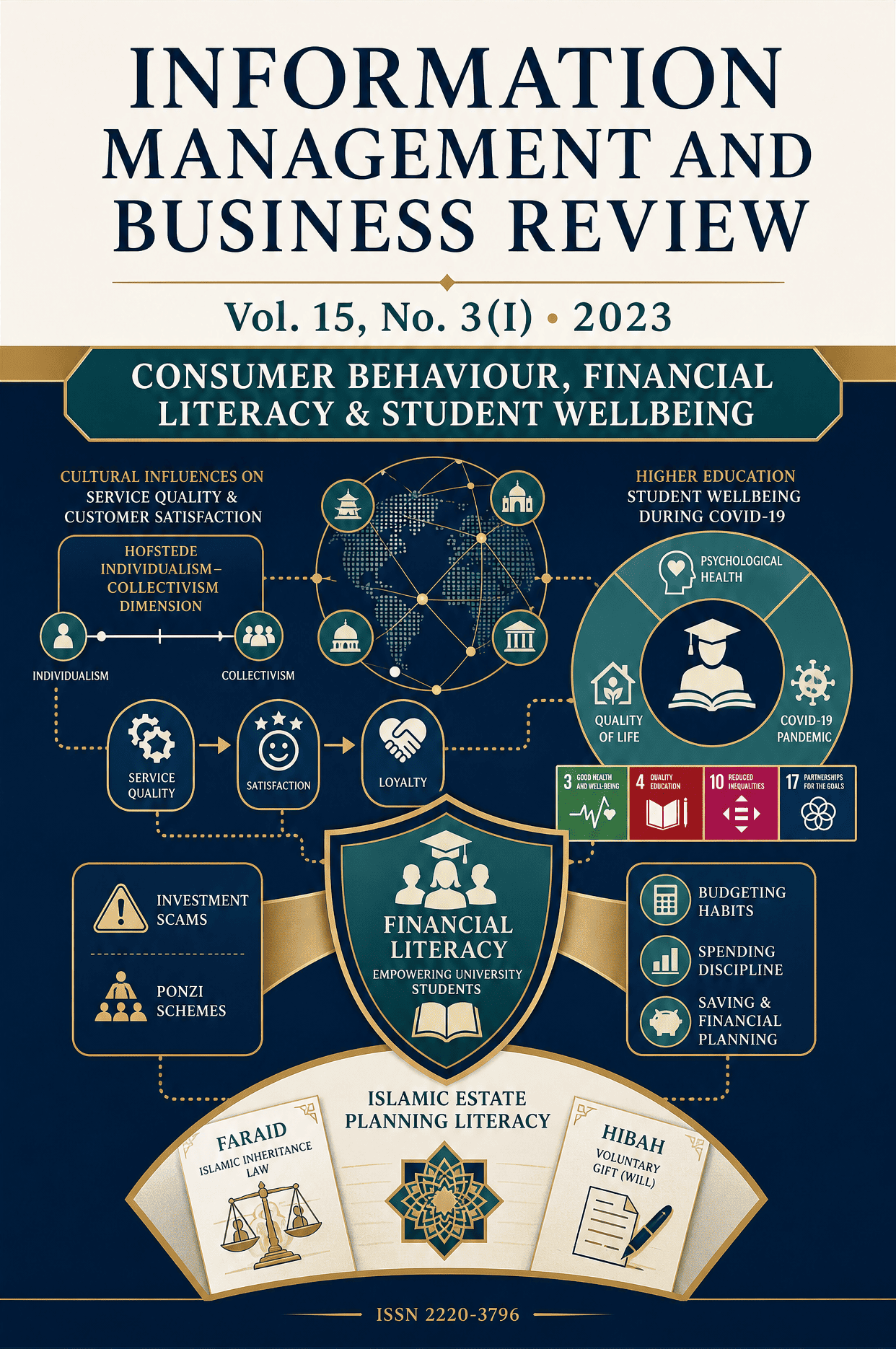
    Financial Literacy among University Students and its Implications towards Financial Scams

    • Author: Norzitah Abdul Karim, Zainora Ab Wahid, Syahrul-Niza Kamarul Ariffin, Sharifah Heryati Syed Nor, Ahmad Najib Nazlan, Salina Kassim

    The acquisition of financial literacy is crucial in facilitating improved financial decision-making and promoting the long-term financial stability of individuals, families, and the nation as a whole. It is anticipated that increased levels of financial literacy, particularly among younger cohorts, will result in enhanced economic indicators, improved payment records, and more sustainable levels of debt for both people and the nation. The attainment of a high quality of life is of paramount importance for Malaysia's progression towards achieving the status of a developed nation. However, it is worth noting that a significant proportion of Malaysians, specifically one out of every three individuals, perceive their level of financial awareness to be relatively low. Moreover, a significant disparity exists in the level of financial literacy among 15-year-old pupils in OECD and partner countries, such as Malaysia. This study attempts to explore conceptually the relationship between financial literacy and its impacts on financial scams among university students. This study will increase the level of financial literacy among Malaysians before embarking on any financial investments.

    Pages 124-128

    PDF - Financial Literacy among University Students and its Implications towards Financial Scams (opens in a new tab)
  • Article 14 in this issue

    Unraveling the Internationalization Barriers among Oil and Gas SMEs: A Path to Global Expansion

    • Author: Janiffa Saidon, Amir Afiq Mohd Yusof, Nurul Ainun Ahmad Atory, Faizah Mashahadi, Mohd Zulkifli Abdullah, Hairulnizam Hashim, Siti Nor Bayaah Ahmad

    The remarkable expansion of globalization stands as one of the most significant phenomena in the twenty-first century, shaping both the business landscape and robust strategic approaches that prioritize the internationalization of domestic firms. In addition to large multinational corporations, small and mediumsized enterprises (SMEs) also recognize the vast opportunities international markets offer for business growth and development. Furthermore, SMEs that venture into global markets can strengthen their competitiveness and global presence by integrating valuable global experiences and incorporating their benefits into their domestic operations. Despite the potential, SMEs' involvement in the global market has remained disappointingly low, with little improvement since 2011. In light of this challenge, our study endeavors to unravel the multifaceted factors contributing to SMEs' internationalization dilemmas. Analyzing a total of 409 valid datasets, the findings highlighted the main factor behind SMEs' hesitancy to engage in internationalization: a lack of resources. Consequently, it becomes crucial for SMEs, particularly those in the Oil and Gas Equipment and Service segments, to focus on strengthening their resources to facilitate the internationalization process. Complementing this resource-centric approach, adjustments in managers' attitudes are equally crucial, as they have the potential to ignite SMEs' active engagement in international markets, ultimately contributing to national economic growth.

    Pages 129-138

    PDF - Unraveling the Internationalization Barriers among Oil and Gas SMEs: A Path to Global Expansion (opens in a new tab)
  • Article 15 in this issue

    Mediating Effect of Self-Resilience on the Relationship between Financial Anxiety and Psychological Distress among University Students

    • Author: Nor Zaihan Mat Hasan@Mat Hussin, Aziz Jamal, Mohamad Shahril Mohamad Besir, Saadiah@Juliana Saadun, Nor Intan Shamimi Abdul Aziz, Nor Azzura Nordin

    The purpose of this study was to investigate the role that self-resilience plays as a mediator in the relationship between financial anxiety and psychological distress experienced by university students. In total, one hundred twenty undergraduate university students were sent an online invitation to take part in the research as survey respondents, and the survey instruments used were pre-tested to ensure their reliability. When the scores for respondents' financial anxiety, self-resilience, and psychological distress were compared with the characteristics of the respondents, the statistics suggest that there was no statistically significant difference. The primary finding reveals that self-resilience statistically and significantly mediated the association between financial anxiety and psychological distress, even though the effect size was relatively small. This is even though all variables were shown to have statistically significant correlations with one another. This study suggests that self-resilience can operate as a buffer against the potentially harmful impact that financial concern can have on psychological well-being. It is recommended that the university, in addition to providing continuous financial-related support to the students, provide a variety of programs on campus and off campus aimed at improving students' self-resilience. This will assist students in better managing their financial-related psychological distress.

    Pages 139-145

    PDF - Mediating Effect of Self-Resilience on the Relationship between Financial Anxiety and Psychological Distress among University Students (opens in a new tab)
  • Article 16 in this issue

    Factorial Structure and Psychometric Validation of Social Media Intelligence Quotient (SMIQ) Scales among Graduates

    • Author: Nadhrathul Ain Ibrahim, Rosidah Musa

    The Social Media Intelligence Quotient (SMIQ)'s underlying factorial structure will be extracted, and validated, and its psychometric properties will be examined in this study. Self-administered questionnaires from the universities that produce the most employable graduates in Malaysia, such as Universiti Malaya, Universiti Kebangsaan Malaysia, and Universiti Teknologi Mara, were utilized by the researcher to gather the data. It involved 352 final-year students from the Faculty of Business Management. To ascertain the factorial structure of the SMIQ, the researcher used the Exploratory Factor Analysis (EFA). Additionally, the confirmatory factorial analysis (CFA) was used to evaluate the psychometric characteristics of each item to confirm and validate it. A structural model was also developed to measure the nomological validity between social media dependency and SMIQ. It revealed that SMIQ is second order with three factorial structure constructs and met the psychometric criteria. Thus, the findings have essential implications for future research directions and the management of social media skills.

    Pages 146-158

    PDF - Factorial Structure and Psychometric Validation of Social Media Intelligence Quotient (SMIQ) Scales among Graduates (opens in a new tab)
  • Article 17 in this issue

    Exploring the Role of Student Exchange Programs in Fostering Halal Understanding among South Korean Non-Muslims

    • Author: Erne Suzila Kassim, Ismah Osman, Emi Normalina Omar, Faridah Hj Hassan

    One of the challenges in halal is the acceptance among non-Muslims of the values, due to their lack of appreciation in understanding its concept. Media bias, culture, personal beliefs, racism and Islamophobia are some of the common causes. Past studies concluded that the concept of misjudgment could be realigned to a positive attitude by providing the appropriate information and education. Therefore, the study was conducted with the aim, of assessing how the provision of halal knowledge through the concept of a student exchange program could change a group of non-Muslims’ attitude, acceptance and behavior towards halal. A research experiment was administered that involved a group of university students from a privateuniversity in South Korea, who voluntarily took part in a 7-day halal program in Malaysia. The study involved 1) a pretest assessment, 2) participation in the student exchange heutagogy program and 3) a post-test assessment. Based on the paired sample test results, overall, there was a significant increase in the halal understanding among non-Muslims of South Koreans. The novelty of the study stems from the need to understand nonMuslims’ perception of halal, specifically from the learning and cultural perspectives.

    Pages 159-172

    PDF - Exploring the Role of Student Exchange Programs in Fostering Halal Understanding among South Korean Non-Muslims (opens in a new tab)
  • Article 18 in this issue

    Development in Electric Vehicle Intention and Adoption: Integrating the Extended Unified Theory of Acceptance and Use of Technology (UTAUT) and Religiosity

    • Author: Faizah Mashahadi, Razmah Mahmod, Janiffa Saidon

    Environmental sustainability has become an urgent problem that cannot be avoided and ignored. To mitigate the greenhouse effect in the road transportation sector, Malaysia is articulating a blueprint to reduce emissions through significant national contribution. As such, Malaysia is committed to further promote and adopt energy-efficient vehicles to reduce its carbon footprint under the United Nations Sustainable Development Goal (SDG) 2030 on climate change. The transportation sector is the main cause of greenhouse gas emissions. Many suggest electric vehicles (EVs) as a mechanism for reducing environmental degradation since EVs release less greenhouse gas as compared to combustion cars. However, the sales of EVs in Malaysia are still low compared to the achievements recorded by the neighboring countries. Despite being the earliest to promote electric vehicles, in the first quarter of 2023, Malaysia has only represented 2.4% of the EV market in Southeast Asia. It seems that the success rate in promoting environmental conservation through the adoption of EVs is still minimal. For this reason, the existing study seeks to explore factors related to EV behavioral intention and adoption by using the extended UTAUT (performance expectancy, effort expectancy, social influence, facilitating condition, perceived value/cost, hedonic motive, and habit). The proposed study believes that environmental protection and sustainability must be related to individuals’ values and principles which could have been shaped based on religiosity. Therefore, in addition to the extended UTAUT that views EV intention and adoption from the technical and personal perspective, this study proposes religiosity as a predecessor in determining EV intention and adoption. The use of extended UTAUT and religiosity in the model will clarify the extent to which the influence of technical factors, personal factors and religiosity is determining the intention and adoption of EVs.

    Pages 173-182

    PDF - Development in Electric Vehicle Intention and Adoption: Integrating the Extended Unified Theory of Acceptance and Use of Technology (UTAUT) and Religiosity (opens in a new tab)
  • Article 19 in this issue

    The Determinants of Household Debt in Malaysia

    • Author: Norliza Che Yahya, Bushra Mohd Zaki, Nik Norain Izzati Nik Azid, Nur Fatihah Mohd Ali, Nor Amanie Najihah Hussain

    This study aims to observe the determinants of the factors affecting household debt in Malaysia. This study has listed six independent variables that would affect Malaysia’s household debt: real interest rate, inflation rate, unemployment rate, household consumption expenditure, gross domestic product (GDP), and housing price index (HPI). This research was conducted by using annual data for 30 years (1991-2021); this study also used a quantitative approach to the collection of data using secondary data such as the website of the World Bank, Department of Statistics Malaysia, Eikon Thomson Reuters, and Bank Negara Malaysia. A theoretical model with the hypothesized relationships was tested with the help of the structural equation modelling procedures. Findings showed that the unemployment rate and gross domestic product have a positive and significant relationship with household debt. These determinants are directly affecting household debt in Malaysia, especially in microeconomic factors. This study will contribute to a better understanding that household debt can be influenced by other factors. Further study on the other determinants of household debt may result in varying results.

    Pages 183-194

    PDF - The Determinants of Household Debt in Malaysia (opens in a new tab)
  • Article 20 in this issue

    Factors Influencing the Price of Gold in Malaysia

    • Author: Siti Aminah Mainal, Arina Haziqah Mohd Selamat, Nur Dinie Syafia Abd Majid, Khaliff Nabill Irfan Noorzee

    Despite price increases, gold, a valuable and precious metal, has been used as real estate and financial assets. The price of gold keeps rising over the long term, but it is quite fluctuating and volatile over the short term. Investors will turn to gold as a backup investment during a financial crisis because gold may be used as a hedge against inflation. In addition, investors will swarm to the gold market as a hedge against uncertainty during an uncertain economic climate. Before, during, and after the financial crisis, it is unknown what variables in particular affected the price of gold. The main objective of this research is to assess the determinants that are influencing the price of gold in Malaysia. The secondary data is collected to measure the relationship and fluctuation of gold prices, the data collected is quarterly from 2005–2021. This paper uses descriptive statistical analysis for the description of data, coefficient matrix analysis and regression analysis for determining the impact of dependent and independent variables. In this research paper, gross domestic product (GDP), inflation rate (IR), interest rate (IR), unemployment rate (UR), and exchange rate (ER) are included in macroeconomic indicators and considered as independent variables. The gold price is considered a dependent variable.

    Pages 195-205

    PDF - Factors Influencing the Price of Gold in Malaysia (opens in a new tab)