Articles

  • Article 1 in this issue

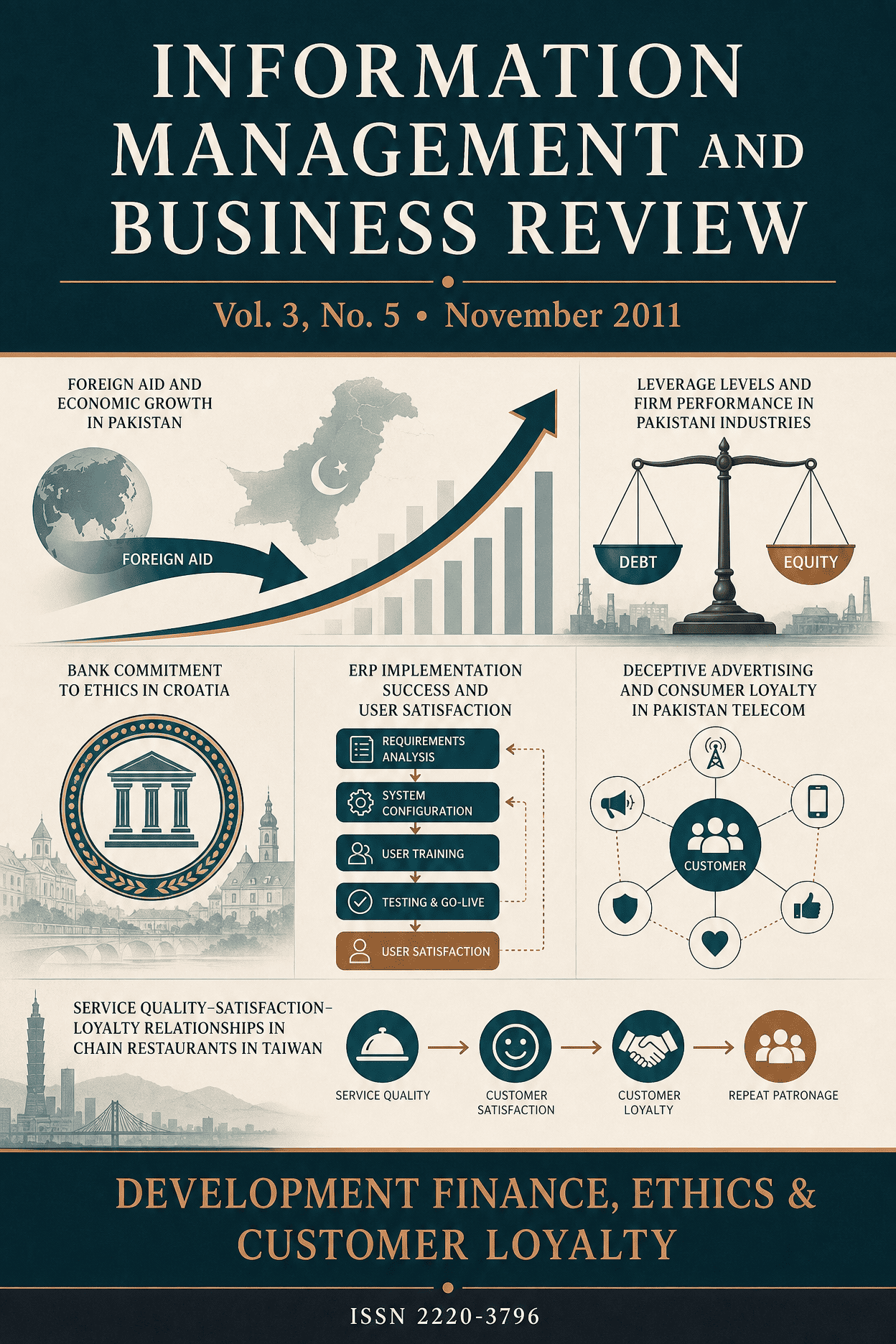
    An Empirical Analysis of Impact of Foreign Aid on Economic Growth: The Case of Pakistan

    • Author: Muhammad Akram, Hafiza Hadia Mansoor, Mahpara

    The objective of this study is to analyze the effects of foreign aid on economic growth of Pakistan. The time series data for the period 1980-2008 is used by applying OLS regression model and two diagnostic methods namely Breusch-Pagon and Durbin-Watson tests. Results depict that foreign aid is insignificantly related to the economic growth to Pakistan for short-run and long-run. By excluding the foreign direct investment, results are significant but still a negative relationship exists. This study will help to government organizations by recognizing about the impact of foreign aid on economic growth.

    Pages 235-241

    PDF - An Empirical Analysis of Impact of Foreign Aid on Economic Growth: The Case of Pakistan (opens in a new tab)
  • Article 2 in this issue

    The Impact of Leverage Levels on Firm’s Performance and Profitability: a case of Pakistani Industries

    • Author: Waqas Rasool, Aasia Asif, Farheen Kayani, Mohsin Zafar

    This paper examines the relationship between the leverage levels, performance and profitability of the 19 Pakistanis firms with in three sectors, commercial banking, cement and fertilizer sector starting from 2004 to 2010. The purpose was to check the trends which are being followed by these industries and how much their capital structure policy is dynamic and relating to their sale, earnings, performance and stock values. Arithmetic Mean (A.M), standard derivation (S.D) were used to check the trend of data and then correlation was used sector wise to check the relationship of dependent and independent variables. At the end Regression test was employed on data .Study finds that there is relationship between leverage ratio i.e. DTCM (independent variable) and its determinants i.e size, tangibility, return on asset and RET except cash. A debt does not represent a suitable form of financing with value-enhancing investment projects of the firms, as an alternative, such firms issue equity. On the other hand, when there is a lack of profitable projects, a firm prefers issuing debts and increasing dividends. Management can increase the performance and profit indicators just by changing the debt equity structure.

    Pages 242-249

    PDF - The Impact of Leverage Levels on Firm’s Performance and Profitability: a case of Pakistani Industries (opens in a new tab)
  • Article 3 in this issue

    Bank Commitment to Ethics

    • Author: Tea Golja, Paulišić Morena, Krstinić – Nižić, Marinela

    This paper brings theoretical approach of ethics in financial industry as well as research results from Croatian banks. The role of ethics in financial industry becomes every day more important issue, also there are no more questions of ethics institutionalisation - it is a question of ethical behaviour. Research limitation was subject matter so sample was reduced to seven major banks in Croatia which are actively involved in creating ethical values. The paper implies stakeholders’ orientations which assure understanding, learning and improving organisation; as well as identification, development and implementation of appropriate strategy also larger attention in future should be given to institutionalisation of ethics, on every level, because main ethical dilemmas according to bank managers trace roots in society culture. The value of this paper is based on the uniqueness of the research results about ethics in Croatian banks.

    Pages 250-260

    PDF - Bank Commitment to Ethics (opens in a new tab)
  • Article 4 in this issue

    Effects of Deceptive Advertising on Consumer Loyalty in Telecommunication Industry of Pakistan

    • Author: Syed Akif Hasan, Muhammad Imtiaz Subhani, Ana Mateen

    This study is an attempt to interrogate the effects of deceptive advertising on consumer loyalty in telecommunication industry of Pakistan. Four variables, Call Charges (CC), Network Coverage (NC), Network Quality (NQ) and Customer Service (CS) were used to measure deception in Telecom Ads and then its effect on consumer loyalty while the consumer preference is used as the proxy of consumer loyalty. 10,000 random individuals from telecom industry were selected to conclude the results. Testing specification confirmed that the deception overwhelmingly exists in telecom ads and none of the telecom companies were providing exactly the same quality of service in terms of Call Charges, Network Coverage, Network Quality and Customer Service, as they promise in their advertisements, while, the consumers are inclined towards the services where the deceptions are seemingly meager.

    Pages 261-264

    PDF - Effects of Deceptive Advertising on Consumer Loyalty in Telecommunication Industry of Pakistan (opens in a new tab)
  • Article 5 in this issue

    Users Satisfaction and ERP Implementation Success
    • Author: Muhammad Jamil Anjum

    An Enterprise Resource Planning (ERP) system encompasses the mechanisms and inklings conducted for the solidified management of enterprise as all-inclusive from the discernment of consequential exertion of management expedients to embellish the expedience of the business. Several organizations have implemented ERP system but none of them has claims the desire results. User satisfaction is considered as central indicators of ERP project success. This study was conducted in Pakistani industry with the purpose to indentify and ensure potential success factors of ERP implementation. On the bases of extensive theoretical underpinning, measurement constructs of success factors of ERP implementation were identified. Survey instrument was developed from those success factors. Total three hundred and fifty questionnaires were distributed randomly to ERP users working in Telecom, engineering, Oil and Gas and Government sector. Out of distributed questionnaires two hundred and twenty eight (N=228) questionnaires were retrieved back. The responses were systematically entered, cleaned, and screened in statistical package for social science (SPPS). The core statistical techniques used in this study are regression and correlation analysis. The study finds that user satisfactions have positive and significance relationship with perceived usefulness of ERP system, Perceived ease of use of ERP, Internal support and compatibility of ERP system whereas as results demonstrability of ERP system is found to insignificantly related to ERP user satisfaction. The study further investigates that perceived usefulness, perceived ease of use, internal support, and compatibility of ERP system is perceived as important factors for ERP success. The findings suggests that all those interested in better business results and reliable business solutions should consider proper procedure review of software capabilities with confined focus on results demonstrability before embarking on ERP system implementation.

    Pages 265-272

    PDF - Users Satisfaction and ERP Implementation Success (opens in a new tab)
  • Article 6 in this issue

    Relationships among Service Quality, Customer Satisfaction and Customer Loyalty in Chain Restaurant

    • Author: Yu-Te Tu, Shean-Yuh Lin, Yu-Yi Chang

    Chain restaurant is one of the fastest growing restaurants in the food service industry. In America, Service industry contributes about 60% of the annual GDP and 70% of new jobs. According to the statistics of Executive Yuan of Taiwan, the service industry contributes over 70% of the annual GDP in 2008. The ultimate goal for companies is to build customer loyalty. With loyal customers, companies can reduce the operating cost and acquisition expenses. An improvement of 5 percent in customer retention leads to an increase of 25 percent to 75 percent in profit. It costs more than five times as much to obtain a new customer than to keep an existing one. This initial study was from relevant literature, then set up research structure and hypotheses. Survey was employed, and respondents were from the customers of Taoban in Taiwan. There were 182 usable questionnaires to analyze descriptive statistics, reliability, validity, and SEM model. The research found that service quality significantly affects customer satisfaction, and customer satisfaction has strong impact on customer loyalty for the sample. Therefore, firms have to specifically focus on these factors in order to build a long-term and mutually profitability relationship with a customer and create loyalty as competitive advantages in the market.

    Pages 273-282

    PDF - Relationships among Service Quality, Customer Satisfaction and Customer Loyalty in Chain Restaurant (opens in a new tab)