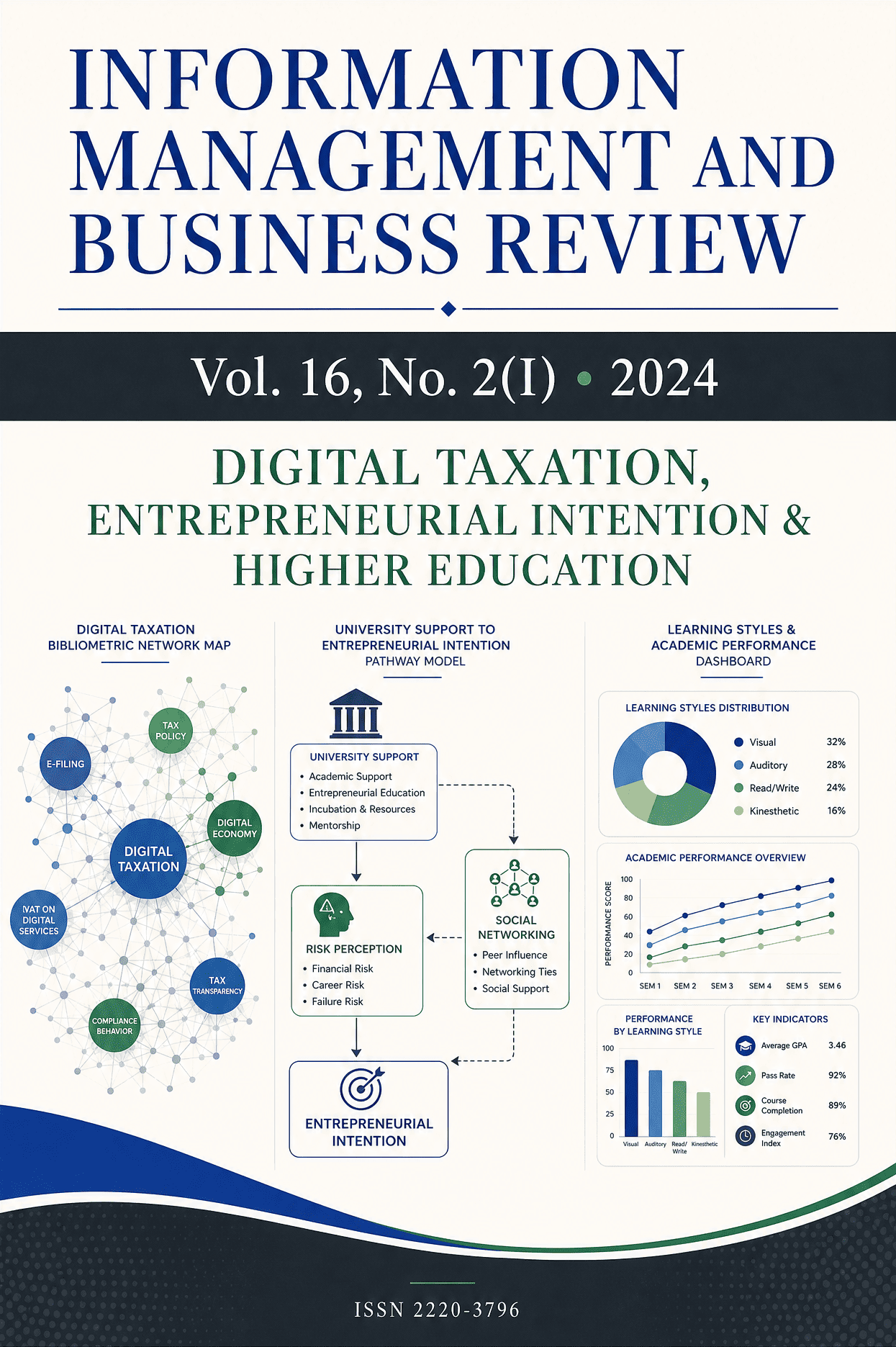
Articles 1–10 of 21

  • Article 1 in this issue

    Institutions and Sustainability Entrepreneurship in SMEs: A Conceptual Model

    • Author: Noorain Mohd Nordin, Wei-Loon Koe

    The government has integrated sustainability management into its agenda to rectify environmental degradation. A new study called “sustainability entrepreneurship”, which relates sustainability management with entrepreneurial endeavors has also been established. Sustainability management is crucial because it allows small and medium enterprises (SMEs) to develop competitive advantages by fulfilling customers’ demand for sustainable products. However, the participation of SMEs in sustainability management is low and many of them fail to disclose their environmental information. This phenomenon has caused problems in encouraging sustainability management commitment among SMEs and failure in achieving 17 Sustainable Development Goals (SDGs). Therefore, this paper aims to unravel the relationships of institutional elements on proclivity on sustainability entrepreneurship among SMEs. Based on a review of existing literature on Institutional factors, a proposed model was developed to assess proclivity towards sustainability entrepreneurship among SMEs. The result of this study would be useful to create the knowledge of institutional theory and the actual behavior of proclivity of sustainability entrepreneurship, to create new knowledge in the future. This research contributes to universities, policymakers and business practitioners. As for universities, it helps to develop a new model to enrich the literature in entrepreneurship studies. In terms of policymakers and business practitioners, it helps to identify important factors in developing true sustainability entrepreneurs among SMEs.

    Pages 1-8

    PDF - Institutions and Sustainability Entrepreneurship in SMEs: A Conceptual Model (opens in a new tab)
  • Article 2 in this issue

    Preferences of Learning Styles among Non-Accounting Students in Accounting Subject

    • Author: Nur Farahah Mohd Pauzi, Khairiah Ahmad, Adriana Shamsudin, Mohd Syazwan Karim, Norlela Abas, Nurjeehan Ayub

    Learning style is a crucial component in encouraging quality teaching and promoting effective learning. Every student possesses distinct learning objectives, prior knowledge, cognitive ability, and cognitive style. Therefore, it is essential to understand students’ learning style preferences for high-quality and effective teaching and learning methods. This paper aims to examine the variation of learning styles among nonaccounting students from one of the higher learning institutions in Melaka, Malaysia. Data were gathered from self-administered questionnaires given to students enrolled in diploma courses during financial accounting class sessions. The survey received a response from a total of 398 students. This study discovered that most students use an unimodal learning style in their studies, regardless of whether the subject is theoretical or calculative. However, the distribution of learning style modalities is significantly different between male and female respondents. Overall, the visual learning style was discovered as the most dominant among male and female students in learning accounting subjects through seeing or observing visual materials. Hence, it is vital to understand how students’ learning style affects their acquisition of knowledge, which could provide useful insights into designing teaching strategies concerning the profiles of the students and enhancing the teachinglearning process.

    Pages 9-18

    PDF - Preferences of Learning Styles among Non-Accounting Students in Accounting Subject (opens in a new tab)
  • Article 3 in this issue

    Young People's Involvement in Reused Cooking Oil

    • Author: Noorita Mohammad, Basri Badyalina, Shahira Ariffin, Nani Ilyana Syafie, Intan Syafinas Mat Shafie, Khamisah Abd Manaf

    Uncontrolled recycling practices have led to increased waste disposal in landfills over the past ten years, especially using cooking oil. If more young folks choose to recycle their wasted cooking oil and turn it into more affordable biodiesel fuel, this issue may be avoided. Thus, to better understand young adults' intentions to recycle, this study looks at the relationships between attitude, subjective norms, perceived behavioral control, environmental values, and moral standards. A survey was created and disseminated online to reach university students in Peninsular Malaysia. The investigation results demonstrated a significant association between the influence of perceived behavioral control, environmental values, and subjective norms on young adults. Moral standards and attitude, however, did not significantly correlate. While businesses can enhance their marketing strategies, policymakers should concentrate on recycling measures. Outreach efforts in the form of education and community initiatives can help to encourage sustainable behaviors. This will make it easier to optimize the procedures involved in resource recovery and lessen environmental damage.

    Pages 19-27

    PDF - Young People's Involvement in Reused Cooking Oil (opens in a new tab)
  • Article 4 in this issue

    Financial Distress Prediction of Islamic Banks in Top Sukuk-Issuing Countries: An Application of Altman’s Z-Score Model

    • Author: Siti Nurulhuda Ibrahim, Shafinar Ismail, Nur Hayati Abd Rahman, Irfah Najihah Basir Malan, Wan Musyirah Wan Ismail

    Financial stability and solvency are essential for manufacturing and service businesses driven by profit, especially the banking sector. As a service sector organization, the banking industry is vital to economic growth. Along with the financial market, both achieved significant progression, particularly in the sukuk market. Despite the possibility of complementary interaction between the sukuk market and Islamic banking institutions, there are also concerns about competitive likelihood. Thus, the study of the finance scope of these Islamic banks in top sukuk issuing countries is crucial. This study applies the Altman Z-score model to measure private-sector banks’ financial health from 2018 to 2022. The sample comprises of Islamic banks in the top sukuk-issuing countries (i.e. Malaysia, Saudi Arabia, Indonesia, Turkiye, United Arab Emirates, Bahrain, and Pakistan). It concludes that UAE, Indonesia, and Saudi Arabia are experiencing financial distress since these banks fall into the “Distress Zone” according to Z-score criteria. Meanwhile, Turkiye, Bahrain, and Pakistan are categorized under the “Grey Zone” and require further improvement on specific financial ratios. Lastly, Malaysia is the only country under the top sukuk-issuing countries that merely achieved the “Safe Zone” criteria, implying that the Islamic banks in this country have greater financial stability rather than others.

    Pages 28-36

    PDF - Financial Distress Prediction of Islamic Banks in Top Sukuk-Issuing Countries: An Application of Altman’s Z-Score Model (opens in a new tab)
  • Article 5 in this issue

    Understanding Innovative Work Behaviour: A Proposed Framework For University Lecturers in Malaysia

    • Author: Muhammad Syukri Abdullah, Siti Rohana Daud, Nor Farehan Omar

    This paper aims to explore the relationship between knowledge sharing, rewards, and charismatic leadership with innovative work behavior among university lecturers in Malaysia. This paper discusses the importance of innovation and innovative work behavior in organizations, particularly in the context of higher education institutions. It highlights the role of academics in generating new knowledge and the need to examine the impact of innovative work behavior on academics. This study proposed quantitative research that involves public university lecturers as respondents and implementing purposive sampling. Later, this study also proposes to analyze the data using Smart Partial Least Squares (SmartPLS) to test the hypothesis development. According to the discussions, universities play an important role in encouraging innovative performance, and knowledge sharing among academicians promotes collective learning and stimulates innovation. Overall, the discussion emphasizes the urgency of conducting a study on the influence of innovative work behavior on academics and the importance of developing a structured framework to enhance innovative work behavior among university lecturers.

    Pages 37-45

    PDF - Understanding Innovative Work Behaviour: A Proposed Framework For University Lecturers in Malaysia (opens in a new tab)
  • Article 6 in this issue

    Academic Performance (CGPA) Influences Mental Health: A Study of Students at Seremban Medical Assistant College (SMCA)

    • Author: Nur Hani Syazwani Bakri, Nur Aisyah Nabila Mat Razali, Mohamad Firdaus Ahmad, Nur Syazwani Zulaikha Safwan, Nur Dalilah Dahlan, Ummi Khalthum Mokhtar

    Medical students, especially in Malaysia, face many challenges due to their field of study and expectations of their profession. It is widely acknowledged that medical courses are among the hardest academic pursuits. In Malaysia, medical students must undergo a five-year undergraduate program, continuing with a clinical rotation and practical experience to sharpen their knowledge and skills. Despite the awareness given, the stigma of mental health persists, leading medical students to hesitate in seeking help out of fear of being perceived as weak. The study identifies whether mental health influences academic performance (CGPA) among medical students at Seremban Medical Assistant College (SMCA). This study used a quantitative method, and a questionnaire was distributed to 215 respondents. The data were analyzed using the Statistical Package for Social Science (SPSS). It was found that there were significant areas where CGPA influenced the mental health of SMCA medical students. Specifically, it was observed that as CGPA increased, there was a corresponding decrease in mental health among the students. This shows that the students are experiencing mental health issues due to their responsibility to maintain a good academic performance in their field of study. In addition, this study offers valuable insight to health practitioners and students on the importance of maintaining mental health and helps in raising awareness.

    Pages 46-52

    PDF - Academic Performance (CGPA) Influences Mental Health: A Study of Students at Seremban Medical Assistant College (SMCA) (opens in a new tab)
  • Article 7 in this issue

    Factors influencing patients’ intention to use the Health Clinic Online Appointment System app

    • Author: Zatul Fahany Harun, Nur Shahrulliza Muhammad, Zuhal Hussein, Amily Fikry, Azreen Joanna Abdul

    Online mobile appointment systems have become important for the patient and the clinics. This research attempts to look into the variables that influence patients' intentions to use the app “Sistem Janji Temu Klinik KKM’ through the development of a research framework according to the Unified Theory of Acceptance and Use of Technology (UTAUT). Information was gathered from 238 patients across Selangor. The results suggest that governments must implement suitable strategies to foster patients’ motivation in using the mobile application apps could be raised. In summary, this study concludes that the main results, as determined by the regression analysis, support that subjective norms have a significant influence on individuals’ intention to use Health Clinic Online Appointment System apps.

    Pages 53-62

    PDF - Factors influencing patients’ intention to use the Health Clinic Online Appointment System app (opens in a new tab)
  • Article 8 in this issue

    Conundrum and Considerations in Cognitive Diagnostic Assessment for Language Proficiency Evaluation

    • Author: Muhamad Firdaus Mohd Noh, Mohd Effendi Ewan bin Mohd Matore

    Since its first appearance in the field of language testing, cognitive diagnostic assessment (CDA) has attracted attention for its ability to extract the intricacies of students' cognitive abilities. However limited research has discussed the issues in the implementation of CDA. Therefore, this article offers an overview of CDA's implementation in language proficiency evaluation. The article also engages in a comprehensive discussion on the conundrum and considerations within CDA, particularly the ongoing debate between distinct classifications of cognitive diagnostic models. It elaborates on the distinctions between the models and their implications for assessment depth and diagnostic insights. Additionally, this article delves into the clash between retrofitting existing items and developing new diagnostic items, highlighting the strategic considerations in each approach. Apart from that, the contentious issue of validating Q-matrices, crucial in CDA, is thoroughly examined, presenting the battle between expert-based and empirical validation methods. The persistent challenges in CDA have profound implications for both theoretical frameworks and practical applications. The theoretical debate not only influences our understanding of cognitive processes but also shapes the conceptualization of diagnostic information extraction. In practical terms, decisions regarding item development, retrofitting strategies, and Q-matrix validation methods directly impact the effectiveness of CDA in providing targeted interventions and personalized learning strategies in real-world educational contexts. Future research directions are also presented, emphasizing the need for more development of entirely new diagnostic items, hybrid CDMs, and adaptive cognitive diagnostic assessments. Practical recommendations are provided for practitioners, encouraging a strategic approach based on specific assessment goals.

    Pages 63-72

    PDF - Conundrum and Considerations in Cognitive Diagnostic Assessment for Language Proficiency Evaluation (opens in a new tab)
  • Article 9 in this issue

    Factors Influencing Changes in Consumer Behavior amidst Post COVID-19 Pandemic

    • Author: Cheam Chai Li, Azyanee Luqman, Suraya Husin, Nur Hazelen Mat Rusok, Mohd Afifie Mohd Alwi

    The COVID-19 pandemic had an immediate and significant impact on consumer behavior, radically changing attitudes and behaviors, as reflected in sales figures. While some researchers believed the pandemic would lead to lasting changes, others expected a return to pre-pandemic behavioral patterns. Despite this ambiguity, there has been little research on the factors influencing consumer behavior, especially about the demand for everyday goods. This study, rooted in the theory of planned behavior (TPB) and the protection motivation theory (PMT), investigated the determinants of consumer behavior in the purchase of daily necessities following the COVID-19 outbreak. In light of the possibility that the pandemic could have caused a new pattern of consumer behavior during the endemic phase, a convenience sampling of 1438 respondents was conducted. Using Partial Least Square Structural Equation Modelling (PLS-SEM), the present study found that choice, information, and perceived economic stability (PES) positively affected consumer behavior, while COVID-19 and risk had negative effects. Interestingly, stress had no impact on consumer behavior. These findings provide valuable insights for companies desiring to understand and anticipate customer behavior during and beyond the pandemic. The present study not only identifies the factors influencing consumer behavior but also enables salespeople to develop strategies to proactively address changes in consumer behaviors.

    Pages 73-85

    PDF - Factors Influencing Changes in Consumer Behavior amidst Post COVID-19 Pandemic (opens in a new tab)
  • Article 10 in this issue

    Analyzing the Research Landscape on Digital Tax: A Bibliometric Analysis of Digital Tax Worldwide

    • Author: Siti Nasuha Muhmad, Nor Haliza Che Hussain, Noor Emilina Mohd Nasir

    The emergence of the digital economy has fundamentally changed traditional business models and tax frameworks. The digital services tax has been proposed as a strategic measure to address the taxation challenges posed by large digital businesses. This study uses a bibliometric analysis to examine the research environment related to the digital services tax. By analyzing articles published in the Scopus database between 2001 and 2023, this study investigates publication patterns, identifies prominent authors and institutions, and explores citation metrics. The study provides insight into the scientific discussion on the digital services tax, including the network on the co-occurrence of keywords, using VOSviewer. The data shows that scholars from all over the world have published 158 articles. According to the data, 107 of the 158 published documents (67.72%) come from articles as a source type. The data also shows that more than two-thirds of all articles originate from the social sciences. The article written by Mpofu from Zimbabwe ranked first in terms of dissemination and was cited a total of 17 times by academics. The keyword trends were also used to identify further research topics for this theme. This study provides valuable insights into the academic discourse on the digital services tax, including the global research focus, leading academics, and influential institutions. This comprehensive examination of the intellectual framework for the study of digital services tax provides valuable guidance for future research endeavors and ultimately contributes to a deeper understanding of the evolving landscape of digital taxation.

    Pages 86-98

    PDF - Analyzing the Research Landscape on Digital Tax: A Bibliometric Analysis of Digital Tax Worldwide (opens in a new tab)