Abstract
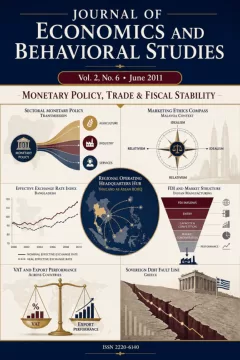
The purpose of this paper is to investigate the antecedents and the consequences of the Greece debt crisis as well as highlighting the reforms capacity. The approach adopted in this paper is to answer the questions such as “what is the background of the Greece debt crisis and how it is originated?”, “which antecedents caused the Greece vulnerable to the crisis?”, “what are the twin constraints being faced by Greece and its consequences?”, “which measures are taken to gain fiscal stability in the Greece under Stability and Growth Pact?” and “what are the rescue possibilities available to Greece to withstand the crisis? Is bail out the only possible solution?” These questions are used to guide the search or studies and analysis thereof and major emerging themes are presented. The key findings of the study are some main factors that triggered the crisis. These are misstated statistics by Greek government, weak co-ordination and organization, high expenditures in comparison to revenues, corruption, tax evasion, weak welfare system and inflexible employment laws. The research limitation is based on the limited scope of the study as some important question regarding the Greece debt crisis is yet to be answered and some aspects of literature are needed to be explored further. Since the main objective of this study is to explore the antecedents that caused Greece vulnerable to the crisis and its aftermaths, it also aims at explaining the fiscal stability measures under taken by Greece under Stability and Growth Pact along with explaining the bail- out alternative available to the Greece perhaps as a last resort. Moreover, this paper highlights the various steps being upheld for reforming Economic Monetary Union (EMU) governance. Thus, this study provides an opportunity to probe into the overall economic and fiscal scenario of Greece under debt crisis.
Keywords
- Debt Crisis Search this journal for Debt Crisis (opens in a new tab)
- Maastricht Search this journal for Maastricht (opens in a new tab)
- Stability and Growth Pact Search this journal for Stability and Growth Pact (opens in a new tab)
- Greece Search this journal for Greece (opens in a new tab)
- Euro-Zone Search this journal for Euro-Zone (opens in a new tab)
References
- Adelman, J. (1998). Tequila Hangover: Latin America’s Debt Crisis. Studies in Political Economy , 55, 5–36. BNP Paribas (2010). Greece, Portugal and Spain: Contagion amid the Confusion. EcoWEEK , 10(18).
- Buckley, R. (2006). Why Some Developing Countries are Better Placed than the International Monetary Fund to Develop Policy Responses to the Challenges of Global Capital. Tulane Journal of International and Comparative Law , 15, 53-121.
- Buckley, R. (2010). The Bankruptcy of Nations: Let the Law Reflect Reality. Banking and Financial Services Policy Report , 29(6), 1–17.
- Commission of the European Communities (2010d). EU economic governance: the Commission delivers a comprehensive package of legislative measures. Press Releases Rapid, IP/10/1199, 29 September. Retrieved from: http://europa.eu/.
- Council of the European Union (2010). Legislative Acts and Other Instruments. (OR.en), 6145/10, LIMITE, ECOFIN 78, UEM 35, Brussels, 16 February.
- De Grauwe, P. (2010). The Greek Crisis and the Future of the Euro-Zone. Eurointelligence . Retrieved from: http://www.eurointelligence.com/.
- Der Standard (2010). Außenminister Dzurinda Kritisiert EU-Griechenhilfe. Accesed August 22, 2010 from: http://derstandard.at/1282273322231/Slowakei-Aussenminister-Dzurinda-kritisiert-EUriechenhilf.
- Dyson, K. and Featherstone, K. (1999). The Road to Maastricht: Negotiating Economic and Monetary Union. Oxford University Press.
- Euroactiv (2010a). Paris, Berlin Issue Joint Plans for EU “Economic Governance”. Accessed July 22, 2010 from: http://www.euractiv.com/en/euro/paris-berlinissue-joint-plans-eu-economic-governancenews-496566.
- Euroactiv (2010b). ECB Backs Treaty Change for EU’s “Economic Government”. Accessed July 6, 2010 from: http://www.euractiv.com/en/euro/ecb-backstreaty-change-eus-economic-governmentnews-496016.
- Eurointelligence (2010). The Van Rompuy Task Force: Unambitious and Vague. Accessed September 28, 2010 from: http://www.eurointelligence.com/index.php?id=581&tx_ttnews[pointer]= 1&tx_ttnws [tt_news]=2905&tx_ttnews[backPid]=743&cHash=3b3617d98d.
- Featherstone, K. (2005). “Soft” Co-ordination Meets “Hard” Politics: The European Union and Pension Reform in Greece. Journal of European Public Policy , 12(4), 50-733.
- Featherstone, K. & Tinios, P. (2006). Facing Up the Gordian Knot: The Political Economy of Pension Reform. In Petmesidou, M. and Mossialos, E. (eds) Social Policy Developments in Greece London: Ashgate.
- Featherstone, K. (2008). Greece and EMU: A Suitable Accommodation? In Dyson, K. (ed.) The Euro at Ten: Europeanization, Power and Convergence. Oxford: Oxford University Press.
- Featherstone, K. and Papadimitriou, D. (2008). The Limits of Europeanization: Reform Capacity and Policy Conflict in Greece. NewYork: Palgrave Macmillan.
- Featherstone, K. (2011). The Greek Sovereign Debt Crisis and EMU:A Failing State in Skewed Regime. Journal of common market studies ,49( 2), 127-193.
- Finance Minister (2010). Speech to the Hellenic Parliament, Accessed May 6, 2010 from: http://www.minfin.gr/portal/el/resource/contentObject/id/4e92985a-41df-40bc-857e5393907b3466.
- Glassner, V., & Watt, A. (2010). Cutting Wages and Employment in the Public Sector: Smarter Fiscal Consolidation Strategies Needed. Intereconomics .
- Gros, D. and Mayer, T. (2010). Towards a Euro(pean) Monetary Fund. Economic Policy Centre for European Policy Studies Policy Briefs , No. 202.
- Ignatius, D. (2010, Feburary). A Tea Party for Europe. New york: Washington Post .
- Katrougalos, G. and Lazaridis, G. (2003). Southern European Welfare States: Problems, Challenges and Prospects . Basingstoke: Palgrave Macmillan.
- Lykogiannis, A. (2002). Britain and the Greek Economic Crisis, 1944–1947: From Liberation to the Truman Doctrine. Columbia, MO/London: University of Missouri Press.
- McKay, D. (1999). The Political Sustainability of European Monetary Union. British Journal of Political Science , (29), 41-519.
- Mitsopoulos, M. and Pelagidis, T. (2006). Analysis of the Greek Economy: Rent-Seeking and the Reforms [An_lush thς Ellhnik_ς Oikonom_aς: H Prosodoqhr_a kai oi Metarruqm_seiς] . Athens: Papazisis.
- Mitsopoulos, M. and Pelagidis, T. (2010). Explaining the Greek Crisis: From Boom to Bust . Basingstoke: Palgrave Macmillan.
- Olivares-Caminal, R. (2009). To Rank Pari Passu or Not to Rank Pari Passu ? That is the Question in Sovereign Bonds after the Latest Episode of the Argentine Saga. American Law and Business Review , (15), 78-745.
- Papadimitriou, D. (2005). The Limits of Engineering Collective Escape: The 2000 Reform of the Greek Labour Market. In Featherstone, K. (ed.) Politics and Policy in Greece: The Challenge of ‘Modernisation ’. London: Routledge.
- Papandreou, G. A. (2010b). Speech of the Prime Minister George A. Papandreou at the Parliament [Omil_a Prwqupourgo_ Gi_rgou A. Papandr_ou sth Boul_], Accessed May 21, 2010 from: http://www.primeminister.gr/2010/05/21/1983.
- Pisani-Ferry, J. and Sapir, A. (2009). Weathering the Storm: Fair Weather versus Stormy Weather Governance in the Euro Area’. Bruegel Policy Contributions , (286).
- Porzecanzki, A. (2005). From Rogue Creditors to Rogue Debtors: Implications of Argentina’s Default. Chicago Journal of International Law , 6(1), 32-311.
- Roberts, A. (2010). “An Ungovernable Anarchy”: The United States’ Response to Depression and Default, 1837-1848. Intereconomics .
- Rossi, V., & Aguilera, R. D. (2010). No Painless Solution to Greece's Debt Crisis. International Economics , Programme Paper IE PP 2010/03.
- Schneider, F., Buehn, A. and Montenegro, C.E. (2010). Shadow Economies All over theWorld: New Estimates for 162 Countries from 1999 to 2007. Policy Research Working Paper 5356. Washington, DC: World Bank.
- Story L., Thomas L. & Schwartz N., D. (2010a). Wall St Helped to Mask Debt Fueling Europe’s Crisis. Accessed February 13, 2010 from: http://www.nytimes.com/2010/02/ 14/business/global/14debt.html.
- Transparency International (2010). Corruption Perceptions Index 2009 . Retrieved from: http://www.transparency.org/policy_research/surveys_indices/cpi/2009/ cpi_2009_table.
- Trichet, J. (2010). Hearing of the Committee on Economic and Monetary Affairs of the European Parliament . Accessed September 27, 2010 from : http://www.ecb.int/press/.
- Wheatcroft, F. (2010). A Crisis of Sovereignty as Well Debt. Wall Street Journal , Febuary issue.
- World Economic Forum (2009). The Global Competitiveness Report, 2009–2010. Geneva: World Economic Forum.
Downloads
No downloads have been recorded for this article yet. Figures appear here once readers begin downloading the full text.
How to Cite
Share this article
License
Author (s) should affirm that the material has not been published previously. It has not been submitted and it is not under consideration by any other journal. At the same time author (s) need to execute a publication permission agreement to assume the responsibility of the submitted content and any omissions and errors therein. After submission of revised paper in the light of suggestions of the reviewers, the editorial team edits and formats manuscripts to bring uniformity and standardization in published material.
This work will be licensed under Creative Commons Attribution 4.0 International (CC BY 4.0) and under condition of the license, users are free to read, copy, remix, transform, redistribute, download, print, search or link to the full texts of articles and even build upon their work as long as they credit the author for the original work. Moreover, as per journal policy author (s) hold and retain copyrights without any restrictions.
Keywords
- Debt Crisis Search this journal for Debt Crisis (opens in a new tab)
- Maastricht Search this journal for Maastricht (opens in a new tab)
- Stability and Growth Pact Search this journal for Stability and Growth Pact (opens in a new tab)
- Greece Search this journal for Greece (opens in a new tab)
- Euro-Zone Search this journal for Euro-Zone (opens in a new tab)
Section
Published
Submissions
Have research to publish? Journal of Economics and Behavioral Studies welcomes submissions.
Make a Submission