Articles

  • Article 1 in this issue

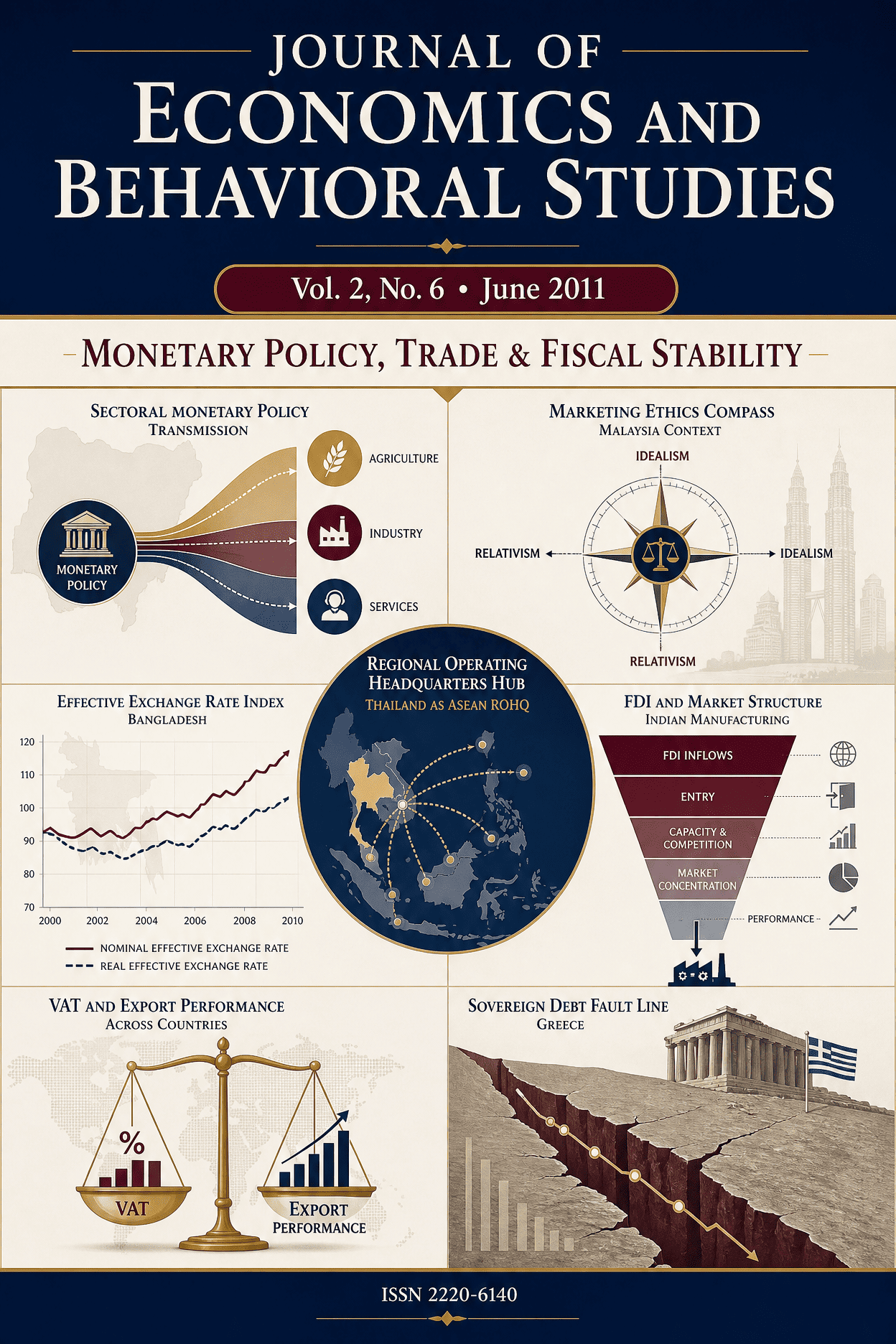
    Effects of Monetary Policy on Sectoral Output Growth in Nigeria (1986 to 2008)

    • Author: Saibu M. O, Nwosa I. P.

    This study examines the effects of monetary policy on sectoral output growth in Nigeria over the period 1986:1 to 2008:4. The study utilized an Autoregressive Distributed lag (ARDL) model and the findings showed that manufacturing sector is not sensitive to any of the monetary policy variables. In sharp contrast with manufacturing sector, agricultural sector is responsive to changes in interest rate only while service and wholesale/retail economic activities are responsive to exchange rate. Furthermore, interest rate and exchange rate are the major determinants of mining output growth while building/construction sector is more responsive to changes in exchange rate and bank credit. In general exchange rate is the most important and influential monetary policy measure in Nigeria. The study concludes that monetary policy will be more effective if the inherent differences in these sectors are factor in the design of policies in Nigeria.

    Pages 245-254

    PDF - Effects of Monetary Policy on Sectoral Output Growth in Nigeria (1986 to 2008) (opens in a new tab)
  • Article 2 in this issue

    Marketers’ Perception about Marketing Ethics: Evidence from Malaysia

    • Author: Khurram Ghani, Ahmad Puad Mat Som, Sher Akbar, Ijaz- Ur- Rehman

    This paper presents the results of a study that investigates the role of religiosity and perceived ethical values of marketers on marketing ethics, using the measure developed by Forsyth (1980). One dimension of the study is relativism and idealism affecting the importance of ethics moderated by religion. The study showed that people having high idealism have high ethics but having high relativism does not show that there is a decrease in ethics even both idealism and relativism were moderated by one’s strength of a religion. Overall, the study was found significant to as it and provides an understanding of marketing ethics in different cultures and company’s practices

    Pages 255-262

    PDF - Marketers’ Perception about Marketing Ethics: Evidence from Malaysia (opens in a new tab)
  • Article 3 in this issue

    Nominal and Real Effective Exchange Rates for Bangladesh: 1973:07–2008:12

    • Author: Gour Gobinda Goswami, Mohammad Monirul Islam Sarker

    Bilateral real exchange rate is used in examining the price of domestic goods in terms of partner’s goods and it is especially useful for bilateral modelling. On the other hand, real effective exchange rate serves as the price of domestic goods in terms of a basket of foreign goods and is especially useful for aggregate or multilateral modelling.The method of construction of both the bilateral and the multilateral or effective exchange rate depends on the definition of nominal bilateral exchange rate (direct or indirect), the method of averaging (arithmetic or geometric), and the calculation of trade weight (considering either the value of export or import or total trade). This paper uses both the arithmetic and the geometric mean as averaging technique and considers three kinds of trade weights, namely, export weights, import weights, and total trade weights in the construction of effective exchange rate indices. Using twenty one major trading partners of Bangladesh, which covers about 80 percent of her total trade, we prepare a comprehensive data base on nominal effective exchange rates, real effective exchange rates, trade policy bias index etc. both by using the fixed and the variable weight for the period 1973:07– 2008:12 on a monthly basis. From this study it has been observed that there is a declining trend in the effective exchange rates of Bangladesh, which indicates an overall devaluation of Bangladeshi taka against her partner currencies both bilaterally and multilaterally. The result is robust no matter whether we use the fixed or the variable weight. As a supplementary exercise, the prepared data has been used in estimating the trade policy bias index and it is found that Bangladesh’s trade policy has become proexport starting from December 2000. However, the process has been slowed down slightly in the most recent time.

    Pages 263-274

    PDF - Nominal and Real Effective Exchange Rates for Bangladesh: 1973:07–2008:12 (opens in a new tab)
  • Article 4 in this issue

    Analyzing the Factors Contributing to the Establishment of Thailand as a Hub for Regional Operating Headquarters

    • Author: Myat Su Yin, John Walsh

    In June 2010, the Thai government proposed improved investment tax incentive schemes to attract more foreign companies to establish Regional Operating Headquarters (ROH) in Thailand. The major theme of incentive packages has historically been the waiving of income tax on ROHs locating in the Kingdom. In the wake of recent political crises, these tax benefits are considered as important measures in reinforcing the Kingdom’s position as an important manufacturing and service hub for the ASEAN region. While investor confidence was wavering because of the unstable political environment that has appertained since 2006, investors are weighing business continuity and safety concerns against the provided and proposed incentives. This paper briefly compares the original ROH tax incentives from 2002 with the new ones, examines the factors contributing to the establishment of Thailand as a hub for ROHs and analyzes the competitiveness of Thailand in comparison with Hong Kong, Singapore and Malaysia in the context of national competitiveness for establishing ROH. National competitiveness is measured by using the Double Diamond-based nine factor model (IPS Model) from the IPS national competitiveness research study.

    Pages 275-285

    PDF - Analyzing the Factors Contributing to the Establishment of Thailand as a Hub for Regional Operating Headquarters (opens in a new tab)
  • Article 5 in this issue

    Inward Investment and Market Structure in an Open Developing Economy: A Case of India’s Manufacturing Sector

    • Author: Jatinder Singh

    India announced series of liberalization measures since mid 1980s that inter-alia led to an unprecedented increase in the inflow of foreign direct investment (FDI). Evidence suggests that the rising inflows of FDI have influence on host country market structure though the direction is uncertain. Analytically, market structure has implications on the long run growth path of an economy through its effect on the allocation of economic resources among various economic activities including innovation. In this context, the objective of this paper is to analyze the bearing of FDI on market concentration with special reference to India’s manufacturing industries during the post-reform period. The study made use of firm level and product level data and panel regression techniques to fulfill the objective. The estimated model has shown a positive and significant influence of FDI on market concentration. If the result of the study is any indication, the increased inflow of FDI is likely to make India’s manufacturing sector more concentrated and calls for policy measures to mitigate undesirable outcomes of FDI inflows.

    Pages 286-297

    PDF - Inward Investment and Market Structure in an Open Developing Economy: A Case of India’s Manufacturing Sector (opens in a new tab)
  • Article 6 in this issue

    Value Added Tax & Export: the Case of Selected Countries around the World

    • Author: Ahmad Jafari samimi, Mehrnoosh Abdolahi

    The purpose of the present paper is to compare the impact of implementing Value Added Tax on Export of goods and services in selected countries. In this paper, we used four different indices for export; export of goods and services, export of goods and services (BOP), export of goods and services (annual % growth), export of goods and services (% of GDP) to investigate the sensitivity to different definitions .To do so, study concentrated on a sample of 140 countries that have applied Value Added Tax in their tax system from 1990 to 2008. Findings of the study based on Mean Difference Statistical Test in a two threeyear periods before and after introduction of VAT. In general, the results show that, in different indices, the impact of VAT on export is positive. Therefore, it is suggested that other countries have not yet introduced the VAT to reform their tax system by introducing the VAT.

    Pages 298-305

    PDF - Value Added Tax & Export: the Case of Selected Countries around the World (opens in a new tab)
  • Article 7 in this issue

    The Greek Sovereign Debt Crisis: Antecedents, Consequences and Reforms Capacity

    • Author: Muhammad Akram, Liaqat Ali, Hafsa Noreen, Monazza Karamat

    The purpose of this paper is to investigate the antecedents and the consequences of the Greece debt crisis as well as highlighting the reforms capacity. The approach adopted in this paper is to answer the questions such as “what is the background of the Greece debt crisis and how it is originated?”, “which antecedents caused the Greece vulnerable to the crisis?”, “what are the twin constraints being faced by Greece and its consequences?”, “which measures are taken to gain fiscal stability in the Greece under Stability and Growth Pact?” and “what are the rescue possibilities available to Greece to withstand the crisis? Is bail out the only possible solution?” These questions are used to guide the search or studies and analysis thereof and major emerging themes are presented. The key findings of the study are some main factors that triggered the crisis. These are misstated statistics by Greek government, weak co-ordination and organization, high expenditures in comparison to revenues, corruption, tax evasion, weak welfare system and inflexible employment laws. The research limitation is based on the limited scope of the study as some important question regarding the Greece debt crisis is yet to be answered and some aspects of literature are needed to be explored further. Since the main objective of this study is to explore the antecedents that caused Greece vulnerable to the crisis and its aftermaths, it also aims at explaining the fiscal stability measures under taken by Greece under Stability and Growth Pact along with explaining the bail- out alternative available to the Greece perhaps as a last resort. Moreover, this paper highlights the various steps being upheld for reforming Economic Monetary Union (EMU) governance. Thus, this study provides an opportunity to probe into the overall economic and fiscal scenario of Greece under debt crisis.

    Pages 306-318

    PDF - The Greek Sovereign Debt Crisis: Antecedents, Consequences and Reforms Capacity (opens in a new tab)