Abstract
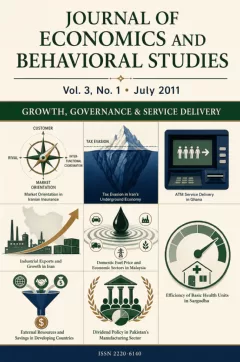
The key of successes by service providers can be found in their market-orientation. These are organizations which pay more attention to customers and rivals and attempt to provide services with the highest quality. Present paper has studied experimentally the relationship between market-orientation and performance of agencies and brokers of Asia Insurance Company in Kerman province. Here, the scale of market-orientation in service sector is applied. The methodology is field study and the tool to gather information is questionnaire. Factors analysis shows that there are four hidden aspects in the title of market-orientation: customer-orientation, rival-orientation, organizational responsiveness, propensity to customer satisfaction. Findings suggest that customer–orientation and propensity to customer satisfaction have remarkable impacts on performance relative to other aspects. Rival-orientation has lower impact on performance and organizational responsive has an inconsistency relationship with performance.
Keywords
- Market-Orientation Search this journal for Market-Orientation (opens in a new tab)
- Customer-Orientation Search this journal for Customer-Orientation (opens in a new tab)
- Rival-Orientation Search this journal for Rival-Orientation (opens in a new tab)
- Responsiveness Search this journal for Responsiveness (opens in a new tab)
- Customer Satisfaction Search this journal for Customer Satisfaction (opens in a new tab)
References
- Akbari, R. (2009). Survey the effective variables on satisfying customers of MELLAT bank. M.S. Thesis. Imam Sadiq University, Faculty of Management.
- Alimirzaei, G. (2009). Survey relationship between market orientation, network learning and entrepreneur ship orientation with organizational innovation. M.S. Thesis. Bahonar university of Kerman, faculty of management.
- Augusto, M. & Coelho, F. (2009). Market orientation and new-to-the- world products: Exploring the moderating effects of innovativeness, competitive strength, and environmental forces. Industrial Marketing Managemen t, 38(1), 94-108.
- Birchall, D. & Tovstiga, G. (2005). Capabilities for strategic advantage, Palgrave Macmillan
- Cadogan, J. W. & Diamantopoulos, A. (1995). Narver and Slater, Kohli & Jaworski and the Market Orientation Construct: Integration and Internationalization, Journal of Strategic Marketing, 3(1), 41-60.
- Chen, C. & Quester, G. P. (2009). A value-based perspective of market orientation and customer service. Journal of Retailing and Consumer Services , 16(3), 197-206
- Deng, S. & Dart, J. (1994) Measuring market orientation: A multifactor, multi-item approach. Journal of Marketing Management , 10(8), 725–742.
- Gotteland, D. & Boule, J-M. (2006). The Market orientation- new product performance relationship: Redefining the moderating role of environmental conditions. International Journal of Research in Marketing , 23(2), 171-185.
- Harries, L. & Ogbonna, E. (2001). Leadership style and market orientation: An empirical study. European Journal of Marketin g, 35(5/6), 744-764.
- Hsieh, M., Tsai, K. & Wang, J. (2008). The moderating effects of market orientation and launch proficiency on the product advantage- performance relationship. Industrial Marketing Management , 37(5), 580-592.
- Hunt, S. D. & Morgan, R. M. (1995). The Comparative Advantage Theory of Competition. Journal of Marketing , 59, 1-15.
- Im, S., Hussain, M. & Sengupta, S. (2008). Testing interaction effects of the dimensions of market orientation on marketing program creativity. Journal of Business Research, 61(8), 859–67.
- Jaworski, B. J. & Kohli, A. K. (1993). Market orientation: Antecedents and consequences. Journal of Marketing , 57(3), 53– 70.
- Jimenez, D., Cegarra, G. & Navarro, J. (2007). The performance effect of organizational learning and market orientation. Journal of Industrial Marketing Management , 36(6), 694-708.
- Kirca, A. Cavusgil, S. T. & Hult, G. T. (2009). The effects of national culture on market orientation: conceptual framework and research propositions. International Business Review , 18, 111-118.
- LedWith, A. & Odwyer, M. (2009). Market orientation, NPD Performance, and organizational performance in small firms. J Product development & management Association; 26, 652-661.
- Mir Shahi, S. & Peidaei, M. (2007). Responsiveness principles 1. Tafahom Magazine.
- Morgan, R. & Strong, C. (1997). Market orientation and dimensions of strategic orientation. European Journal of Marketing ; 32(11/12), 1051-1073.
- Narver, C. J. & Slater, F. S. (1990). The Effects of a Market Orientation on Business Profitability, Journal of Marketing, 54, 20-35.
- Noory- Nia, R. (2007). Market orientation, the heart of marketing. Tadbir Magazine, 181, 17-25.
- Panigyrakis, G. G. & Theodoridis, K. P. (2007). Market orientation and performance: An empirical investigation in the retail industry in Greece. Journal of Retailing and Consumer Services ; 14(2), 137-149.
- Santos-Vijande, M., Sanzo-Peres, M. & Alvarez-Gonzales, L. (2005). Organizational learning and market orientation: interface and effects on performance. Industrial Marketing Management . 34, 187-202
- Saxe, R. & Weitz, B. A. (1982). The SOCO Scale: A Measure of the Customer Orientation of Salespeople, Journal of Marketing Research , 19(3), 343-351.
- Sing, S. & Ranchhod, A. (2004). Market orientation and customer satisfaction: Evidence from British machine tool industry. Industrial Marketing Management , 33(2), 135-144.
- Zheng-Zhou, K. R., Brown, J. S. & Dev, C. (2009). Market orientation, competitive advantage and performance: A demand- based perspective. Journal of Business Research , 62(11), 1063-1070.
Downloads
No downloads have been recorded for this article yet. Figures appear here once readers begin downloading the full text.
How to Cite
Share this article
License
Author (s) should affirm that the material has not been published previously. It has not been submitted and it is not under consideration by any other journal. At the same time author (s) need to execute a publication permission agreement to assume the responsibility of the submitted content and any omissions and errors therein. After submission of revised paper in the light of suggestions of the reviewers, the editorial team edits and formats manuscripts to bring uniformity and standardization in published material.
This work will be licensed under Creative Commons Attribution 4.0 International (CC BY 4.0) and under condition of the license, users are free to read, copy, remix, transform, redistribute, download, print, search or link to the full texts of articles and even build upon their work as long as they credit the author for the original work. Moreover, as per journal policy author (s) hold and retain copyrights without any restrictions.
Keywords
- Market-Orientation Search this journal for Market-Orientation (opens in a new tab)
- Customer-Orientation Search this journal for Customer-Orientation (opens in a new tab)
- Rival-Orientation Search this journal for Rival-Orientation (opens in a new tab)
- Responsiveness Search this journal for Responsiveness (opens in a new tab)
- Customer Satisfaction Search this journal for Customer Satisfaction (opens in a new tab)
Section
Published
Submissions
Have research to publish? Journal of Economics and Behavioral Studies welcomes submissions.
Make a Submission