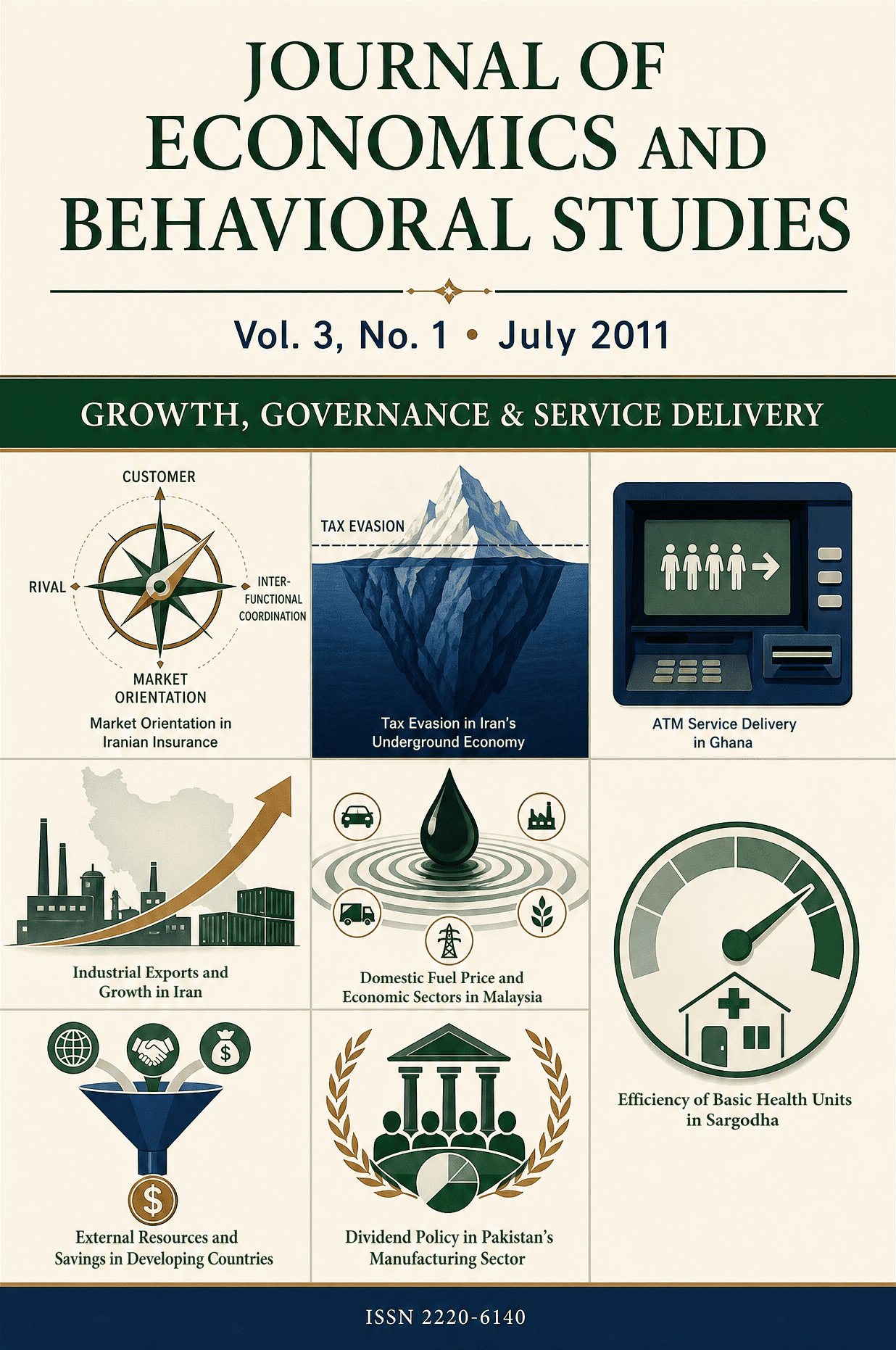
Articles

  • Article 1 in this issue

    Market-Orientation and Its Impact on the Performance of Asia Insurance Company in Kerman Province

    • Author: Gholamreza Jandaghi, Mahdi Nik Seresht, Ali Mokhles, Hassan Kharazi

    The key of successes by service providers can be found in their market-orientation. These are organizations which pay more attention to customers and rivals and attempt to provide services with the highest quality. Present paper has studied experimentally the relationship between market-orientation and performance of agencies and brokers of Asia Insurance Company in Kerman province. Here, the scale of market-orientation in service sector is applied. The methodology is field study and the tool to gather information is questionnaire. Factors analysis shows that there are four hidden aspects in the title of market-orientation: customer-orientation, rival-orientation, organizational responsiveness, propensity to customer satisfaction. Findings suggest that customer–orientation and propensity to customer satisfaction have remarkable impacts on performance relative to other aspects. Rival-orientation has lower impact on performance and organizational responsive has an inconsistency relationship with performance.

    Pages 1-7

    PDF - Market-Orientation and Its Impact on the Performance of Asia Insurance Company in Kerman Province (opens in a new tab)
  • Article 2 in this issue

    An Estimation of Tax Evasion in Iran

    • Author: Saeed Karimi Petanlar, Mohamad Taghi Gilak, Ahmad Jafari Samimi, Alireza Aminkhaki

    The aim of this research is to estimate the size of tax evasion between 1971 and 2007 in Iran. Among the present direct and indirect approaches, the indirect approach presented by Tanzi based on currency demand, is used to estimate the size of the underground economy, then taking the effective tax rate into consideration, the amount of the underground economy taxes. Our results show that the size of the underground economy is increasing in a long-term trend and also the ratio of the underground economy to gross domestic product has increased during the period under consideration. Our findings also indicate that tax evasion has markedly increased during the period. Therefore, policies to alleviate the tax evasion in the country should be implemented by policy makers.

    Pages 8-12

    PDF - An Estimation of Tax Evasion in Iran (opens in a new tab)
  • Article 3 in this issue

    Using ATMs as Workload Relievers for Ghanaian Bank Tellers: The Customer Behavioral Challenge

    • Author: Mohammed-Aminu Sanda, Eric Arhin

    This study explored the issue of whether the use of the Automated Teller Machines (ATM) as a service delivery tool in the banking industry of many developing countries has achieved its intended objective of increasing the effectiveness of customer service provision and reducing the workload of bank tellers. The purpose is to understand customers’ behaviour towards the use of ATM as a banking service delivery tool, and the influence of such customer-usage behaviour on the banks’ human resource capacity building, in terms of employee workload relief and performance. This is because most banks in subSaharan African countries have introduced the ATM in bids to satisfying customers’ service needs and making the work of employees easier. Data was collected using questionnaires that were administered to bank customers who use the ATM facility, as well as bank managers. The findings showed that though most bank customers who use the ATM services perceive the ATM as a convenient, reliable, accurate and suitable service delivery tool for their banking transactions; they still underutilize the ATM’s service capacity by choosing to go to the banking halls to make cash withdrawals of amounts that could be obtained from the ATMs. It is also found that by virtue of this customer behaviour of not using the ATM’s to their full potential, the relief that it is expected to provide bank tellers is not realized. It is concluded that because of customer behavioral challenges to the effective utilization of the ATM technology, banks in developing economies not benefiting from its full potential as a customer service delivery tool, and also as a strategic workload reliever for tellers who service customers inside the banking halls. Keywords : Automated teller machine; customer behavior; bank teller; workload reliever; developing economy

    Pages 13-21

    PDF - Using ATMs as Workload Relievers for Ghanaian Bank Tellers: The Customer Behavioral Challenge (opens in a new tab)
  • Article 4 in this issue

    Industrial Exports and Economic Development in Iran

    • Author: Safdari Mehdi, Motiee Reza

    This research seeks to determine the effect of human capital and physical and non-oil exports of industrial sector, the real Gross Domestic Product (GDP) in the country during 1959 to 2007. The purpose of this study is to determine the relationship between Industrial exports and economic growth in Iran. The theoretical framework was designed based on this assumption that the total GDP in the economy is divided into two sections, production for inside and production for export. The data were collected from 1959 to 2007 and was analyzed using Ordinary Least Squares (OLS) model. The result of the analyses shows that there is significant relationship between Industrial exports and economic growth. Together, the independent variables explained 93% of the variance in the dependent variables. In relation to that, it is concluded that explanatory power is high for the equation that shows that one percent change in Industrial exports rate lead to 44% in economic growth. Therefore, an Industrial export is regarded as an important factor in Iran's economic growth. Keywords: Gross Domestic Product (GDP), Augmented Dickey-Fuller (ADF) test, Ordinary Least Squares (OLS) model

    Pages 22-27

    PDF - Industrial Exports and Economic Development in Iran (opens in a new tab)
  • Article 5 in this issue

    Domestic Fuel Price and Economic Sectors in Malaysia

    • Author: Hui-Siang JEE Brenda, Evan LAU, Chin-Hong PUAH, Shazali ABU MANSOR

    This study empirically examines the relation between the domestic fuel prices with the ten disaggregated economic sectors in Malaysia with the spanning of data from 1990:Q1 to 2007:Q4. We found that only three sectors (agriculture, trade and other services sectors) are cointegrated with the fuel price and fuel price does Granger cause these sectors. Despite the evidence of non-cointegrated in most of the economic sectors, fuel price able to influence these sectors over a longer period. Policy recommendation from this study includes the utilization of the renewable energy (RE) as a strategic plan is the long-term solution due to the high dependency and increasing demand of energy. While energy prices have experienced some correction in response to signs of slower global growth, sufficient government enforcement and support need to be established to facilitate successful renewable energy implementation in Malaysia.

    Pages 28-41

    PDF - Domestic Fuel Price and Economic Sectors in Malaysia (opens in a new tab)
  • Article 6 in this issue

    Analyzing the Efficiency Differences among Basic Health Units in Sargodha District

    • Author: Touqeer Abbas, Masood Sarwar Awan, Muhammad Amir Aslam, Muhammad Waqas

    Pakistan has adequate infrastructure for health services delivery at primary level. The study aims to calculate the technical efficiency of Basic Health Units (BHUs) in Sargodha by using the Data Envelopment Analysis (DEA) with the choice of inputs and outputs being specific to BHUs operation. DEA model results reveals that the mean technical efficiency under, Constant Returns to Scale (CRS) and Variable Returns to Scale (VRS) was 0.719 and 0.807 while the mean scale efficiency was 0.88. Study exposed that 77 % BHUs were technically inefficient under CRS while 66 % BHUs were technically inefficient under VRS modal. Overall 76% BHUs were inefficient and destructing the infrastructure. Moreover, findings evidently point to adverse inefficiency of BHUs in health services delivery. Study concluded that existing high level of inefficiency in BHUs needs institutional fascination for scaling up BHUs to meet both regional as well international targets such as Millennium Development Goals (MDGs) and recommended such measures that may curb the waste.

    Pages 42-50

    PDF - Analyzing the Efficiency Differences among Basic Health Units in Sargodha District (opens in a new tab)
  • Article 7 in this issue

    External Resources and Savings Rate: A Pooled Mean Group Analysis for Developing Countries

    • Author: Anupam Das

    To examine the effect of external resources on savings dynamics, this paper employs the pooled mean group (PMG) technique to a large sample of 65 developing countries over the period of 1970 to 2009. The panel results for all the countries together suggest that approximately 33% of domestic savings are displaced by the inflow of external resources. Similar results are also found when regional panels (SubSaharan Africa, Asia and the Pacific, and Latin America and the Caribbean) are estimated. Additionally, foreign aid is found to have a stronger effect on domestic savings than private financial flows. All types of external flows are insignificant in determining the savings ratio in the Middle East and North Africa. These results have important implications for developing countries, in particular during the period of global recession. Specific attention to these results is necessary in developing countries to ensure a successful mobilization of domestic resources to support existing investment projects and other development programs.

    Pages 51-62

    PDF - External Resources and Savings Rate: A Pooled Mean Group Analysis for Developing Countries (opens in a new tab)
  • Article 8 in this issue

    The Dividend Policy in Manufacturing Sector of Pakistan: The Perception of Corporate Managers

    • Author: Fazli Haleem, Ijaz-Ur-Rehman, Attiya Y. Javid

    Using a survey approach, this paper examines the perceptions of managers of dividend-paying firms listed on Karachi Stock Exchange (KSE) on factors influencing dividend policy, issues relating dividend policy and the corporate governance practices. The survey shows that the most important factors that affect dividend policy are; the level of current earnings, the projection about the future state of the economy, the stockholders characteristics, concerns about the stock prices, need of current stockholders. From a practical perspective, there is little discrimination among the top ranked factors. All the surveyed firms formulate their dividend policies according the theoretical model of Lintner (1956). The survey also shows that there is no difference in responses about these factors with respect to various titles of the respondents such as chief financial officer or Chief Exceptive Officer. The survey also finds strong support for the life cycling theory followed by agency theory, signaling theory and the catering theory respectively. The survey also shows the presence of corporate governance practices in the surveyed firms.

    Pages 63-75

    PDF - The Dividend Policy in Manufacturing Sector of Pakistan: The Perception of Corporate Managers (opens in a new tab)