Abstract
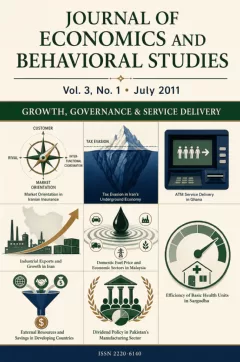
The aim of this research is to estimate the size of tax evasion between 1971 and 2007 in Iran. Among the present direct and indirect approaches, the indirect approach presented by Tanzi based on currency demand, is used to estimate the size of the underground economy, then taking the effective tax rate into consideration, the amount of the underground economy taxes. Our results show that the size of the underground economy is increasing in a long-term trend and also the ratio of the underground economy to gross domestic product has increased during the period under consideration. Our findings also indicate that tax evasion has markedly increased during the period. Therefore, policies to alleviate the tax evasion in the country should be implemented by policy makers.
Keywords
- Tax Evasion Search this journal for Tax Evasion (opens in a new tab)
- Underground Economy Search this journal for Underground Economy (opens in a new tab)
- Currency Demand Approach Search this journal for Currency Demand Approach (opens in a new tab)
- Iran Search this journal for Iran (opens in a new tab)
References
- Ahmed, M. & Ahmed, Q. M. (1995). Estimation of the Black Economy of Pakistan through the Monetary Approach. The Pakistan Development Review , 34(4), 791–807.
- Aslam, S. (1998). The underground Economy and Tax Evasion in Pakistan: Annual Estimates (1960-1998) and the Impact of Dollarization of the Economy. The Pakistan Development Review, 37(4), 621– 631.
- Cagan, P. (1958). The Demand for Currency Relative to the Total Money Supply. Journal of Political Economy, 66, 303-328.
- Cashin, P. (2008). Measuring the Informal Economy in Latin America and the Caribbean. IMF Working Paper, 25(4), 521–531.
- Feld, L. & Larsen, C. (2005). Black Activities in Germany in 2001 and 2004: A Comparison Based on Survey Data. The Rockwool Foundation Research Unit.
- Guttman, M. (1977). The Subterranean Economy. Financial Analysts Journal , 34, 24-27.
- Iqbal, Z., Qureshi, S. K. & Mahmood, R. (1998). The Underground Economy and tax Evasion in Pakistan. Pakistan Institute of Development Economics, Research Report No. 158.
- Johnson, S., Kaufmann, D. & Zoido-Lobatón (1998). Corruption, Public Finances and the Unofficial Economy. World Bank Discussion Paper. No. 254.
- Kemal, M. A. (2003). Underground Economy and Tax Evasion in Pakistan: A Critical Evaluation. Pakistan Institute of Development Economics, Research Report No. 184.
- Kemal, M. A. (2007). A Fresh Assessment of the underground Economy and Tax Evasion in Pakistan: Causes, Consequences, and Linkages with the Formal Economy, PIDE Working Papers No. 13, Quaid-i-Azam University, Islamabad.
- Khalid, M. (2002). Estimation of Underground Economy, Causality and Business Cycle Analysis of Pakistan. M. Phil Thesis, Department of Economics, Quaid-i-Azam University, Islamabad.
- Kirchgaessner, G. (1983). Size and Development of the West German Shadow Economy, 1955– 1980. Zeitschrift für die gesamte Staatswissenschaft, 139(2), 197–214.
- Kirchgaessner, G. (1984). Verfahren zur Erfassung des in der Schattenwirtschaft erarbeiteten Sozialprodukts. Allgemeines Statistisches Archive, 68(4), 378–405.
- Klovland, J. (1984). Tax Evasion and the Demand for Currency in Norway and Sweden: Is there a Hidden Relationship? Scandinavian Journal of Economics, 86(4), 423–39.
- Pedersen, S. (2003). The Shadow Economy in Germany, Great Britain and Scandinavia: A Measurement Based on Questionnaire Service. The Rockwell Foundation Research Unit, Copenhagen, Study No. 10.
- Schneider, F. (1986). Estimating the size of the Danish shadow economy using the currency demand approach: An attempt. The Scandinavian Journal of Economics , 4, 643-668.
- Schneider, F. (1994). Can the shadow economy be reduced through major tax reforms? An empirical investigation for Austria. Public Finance, 49, 137-152.
- Schneider, F. (2000). The increase of the size of the shadow economy of 18 OECD-Countries: Some preliminary explanations, Paper presented at the Annual Public Choice Meeting, March 10-12, 2000, Charleston, S.C.
- Schneider, F. (2004). Arbeit im Schatten: Wo Deutschlands Wirtschaft wirklich wächst., Wiesbaden, Gabler Verlag.
- Schneider, F. (2005). Shadow Economies around the World: What do we really know? European Journal of Political Economy, 21(3), 598-642.
- Schneider, F. & Enste, D. (2000). Shadow Economies: Size, Causes and Consequences. The Journal of Economic Literature , 38(1), 77–114.
- Schneider, F. & Enste, D. (2002). The Shadow Economy: Theoretical Approaches, Empirical Studies, and Political Implications. Cambridge (UK): Cambridge University Press.
- Shabsigh, G. (1995). The Underground Economy: Estimation, and Economic and Policy Implications—The Case of Pakistan. IMF Working Papers, 95, 101.
- Tanzi, V. (1980). The underground Economy in the United States: Estimates and Implications. Banca Nazonale Del Lavoro – Rome.
- Tanzi, V. (1983). The underground Economy in United States: Annual Estimates, 1930-80. IMF Staff Papers, 30(2), 283–305.
- Thomas, J. (1999). Quantifying the black economy: 'measurement without theory' yet again? The Economic Journal, 109, 381-389.
- Yasmin, B. & Rauf, H. (2003). Measuring the underground Economy and its Impact on the Economy of Pakistan. The Lahore Journal of Economics , 9(2), 93–103.
Downloads
No downloads have been recorded for this article yet. Figures appear here once readers begin downloading the full text.
How to Cite
Share this article
License
Author (s) should affirm that the material has not been published previously. It has not been submitted and it is not under consideration by any other journal. At the same time author (s) need to execute a publication permission agreement to assume the responsibility of the submitted content and any omissions and errors therein. After submission of revised paper in the light of suggestions of the reviewers, the editorial team edits and formats manuscripts to bring uniformity and standardization in published material.
This work will be licensed under Creative Commons Attribution 4.0 International (CC BY 4.0) and under condition of the license, users are free to read, copy, remix, transform, redistribute, download, print, search or link to the full texts of articles and even build upon their work as long as they credit the author for the original work. Moreover, as per journal policy author (s) hold and retain copyrights without any restrictions.
Keywords
- Tax Evasion Search this journal for Tax Evasion (opens in a new tab)
- Underground Economy Search this journal for Underground Economy (opens in a new tab)
- Currency Demand Approach Search this journal for Currency Demand Approach (opens in a new tab)
- Iran Search this journal for Iran (opens in a new tab)
Section
Published
Submissions
Have research to publish? Journal of Economics and Behavioral Studies welcomes submissions.
Make a Submission