Abstract
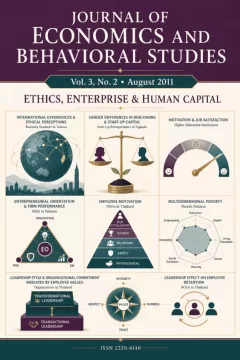
International experiences have gained increasing attentions by business professionals in the era of business globalization. Business ethics has also received substantial attentions due to those unceasing business scandals and their significant impact on stakeholders. As a result, research on business ethics and international experiences has no doubt brought about a growing attention lately. Nevertheless, little empirical research investigated the association between international experiences and ethical perceptions. Therefore, this study intends to explore the relationships between international experiences and ethical perceptions of business students. A questionnaire survey which takes business students in Taiwan as research subjects was used to probe participants’ ethical perceptions and their international experiences. The Multidimensional Ethics Scales is employed to measure students’ ethical perceptions, and an international experience questionnaire was developed to determine students’ international experiences. The findings reveal significant relationships exist between international experiences and ethical perceptions of business students. The study can promote further understanding of the associations of international experiences and ethical perceptions of future business professionals. Furthermore, the results of the study can help higher education institutions and international businesses to realize the possible impact of international experiences on ethical perceptions for business students.
Keywords
- International Experiences Search this journal for International Experiences (opens in a new tab)
- Ethical Sensitivity Search this journal for Ethical Sensitivity (opens in a new tab)
- Ethical Intention Search this journal for Ethical Intention (opens in a new tab)
- Business Students Search this journal for Business Students (opens in a new tab)
- Multidimensional Ethics Scales Search this journal for Multidimensional Ethics Scales (opens in a new tab)
References
- Berger, J. B. (2000). Organizational behavior at college and student outcomes: A new perspective on college impact. Review of Higher Education, 23 (2), 177-198.
- Brislin, R. W. (Ed.). (1990). Applied cross-cultural psychology (14) Cross-cultural research and methodology series, Newbury Park, CA: Sage.
- Butterfield, K. D., Trevino, L. K., & Weaver, C. R. (2000). Moral awareness in business organizations: influences of issue-related and social context factors. Human Relations, 53 (7), 981-1018.
- Carpenter, M. A., Sanders, W. G., & Gregersen, H. B. (2001). Bundling human capital with organizational context: The impact of international experience on multinational firm performance and CEO pay. Academy of Management Journal, 44 , 493-511.
- Cherry, J., Lee, M., & Chien, C. S. (2003). A cross-cultural application of a theoretical model of business ethics: Bridging the gap between theory and data . Journal of Business Ethics, 44(4), 359-376.
- Cohen, J. R., Pant, L. W., & Sharp, D. J. (1993). A validation and extension of a multidimensional ethics scale. Journal of Business Ethics, 12 (1), 13-26.
- Cohen, J. R., Pant, L. W., & Sharp, D. J. (1998). The effect of gender and academic discipline diversity on the ethical evaluations, ethical intentions and ethical orientation of potential public accounting recruits. Accounting Horizons, 12(3), 250-270.
- Daily, C. M., Certo, S. T., & Dalton, D. R. (2000). International experience in the executive suite: The path to prosperity? Strategic Management Journal, 21 , 515-523.
- Derryberry, W., & Thoma, S. (2000). The friendship effect: Its role in the development of moral thinking in students. About Campus, 5 (2), 13-18.
- Endicott, L., Bock, T., & Narvaez, D. (2003). Moral reasoning, intercultural development, and multicultural experiences: Relations and cognitive underpinnings. International Journal of Intercultural Relations, 27 , 403-419.
- Gall, M. D., Gall, J. P., & Borg, W. R. (2003). Educational research: An introduction (7th ed.). Boston, MA: Allyn & Bacon.
- Ingulsrud, J. E., Kai, K., Kadowaki, S., Kurobane, S., & Shiobara, M. (2002). The assessment of cross-cultural experience: measuring awareness through critical text analysis. International Journal of Intercultural Relations, 26 , 473-491.
- Ishino, H., Masaki, M., Visgatis, B., & Kimura, S. (1999). Tanki kaigai kenshu no motarasu mono ﹝ How short-term overseas study effects students ﹞ . The Language Teacher, 23 (6), 37-42.
- Isoda, T. (1999). A study of personality change and English proficiency: A report on Japanese college students in a one-month English intensive program in America. Annual Review of English Learning and Teaching, 4 , 51-62.
- Jones, J., Massey, D. W., & Thorne, L. (2002, August). A review and synthesis of the empirical research on the ethical dimension of accountants' professional judgment. Paper presented at the meeting of American Accounting Association, Professionalism and Ethics Symposium, San Antonio, TX.
- Kauffman, N. L. (1983). The impact of study abroad on personality change. Unpublished doctoral dissertation, Indiana University, Bloomington.
- Kohlberg, L. (1969). Stage and sequence: The cognitive developmental approach to socialization. In D. A. Goslin (Ed.), Handbook of socialization theory and research . (pp.347-480). Chicago: Rand-McNally.
- Lampe, J. C., & Finn, D. W. (1992). A model of auditors' ethical decision processes. Auditing: A Journal of Practice and Theory, 11(Supplement), 33-59.
- Lee, R. M., & Davis III, C. (2000). Cultural orientation, past multicultural experience, and a sense of belonging on campus for Asian American college students. Journal of College Students Development, 41 (1), 110-115.
- Leonidou, L. C., Katsikeas, C. S., & Hadjimarcou, J. (2002). Executive insights: Building successful export business relationships: A behavioral perspective. Journal of International Marketing, 10 (3), 96-115.
- Lin, C.Y. (2009). Multicultural experiences and moral development: an empirical study of purchasing managers. Social Behavior and Personality: An International Journal , 36(9), 1213-1222.
- Lin, C.Y., & Ho, Y. H. (2008). An examination of cultural differences in ethical decision making using the multidimensional ethics scale. Social Behavior and Personality: An International Journal , 36(9), 1213-1222.
- McNeel, S. P. (1994). College teaching and student moral development. In J. R. Rest & D. Narvaez (Eds.), Moral development in the professions: Psychology and applied ethics (pp. 27-49). Hillsdale, NJ: Lawrence Erlbaum Associates.
- Nguyen, N. T., Basuray, M. T., Smith W. P., Kopka, D., & McCulloh, D. (2008). Moral issues and gender differences in ethical judgment using Reidenbach and Robin’s (1990) Multidimensional Ethics Scale: implications in teaching of business ethics. Journal of Business Ethics , 77(4), 417-430.
- Patel, C. (2003). Some cross-cultural evidence on whistle-blowing as an internal control mechanism’, Journal of International Accounting Research, 2, 69-96.
- Rest, J. R. (1986). Moral development: Advances in research and theory . New York, NY: Praeger Publishers.
- Richmond, K. A. (2001). Ethical reasoning, Machiavellian behavior, and gender: The impact on accounting students' ethical decision making. Unpublished doctoral dissertation, Virginia Polytechnic Institute and State University.
- Selmer, J. (2002). Practice makes perfect? International experience and expatriate adjustment. Management International Review, 42 , 71-87.
- Sharp, D. J. (2006). Cases in business ethics. Thousand Oaks, CA: Sage.
- Takeuchi, R., Tesluk, P. E., Yun, S., & Lepak, D. P. (2005). An integrative view of international experience. Academy of Management Journal, 48 (1), 85-100.
- Taylor, C. E. (1994). International experience and idealism in medical education. Academic Medicine, 69 (8), 631-634.
- Thomlinson, T. D. (1991 February). Effects of a study-abroad program on university students: Toward a predictive theory of intercultural contact . Paper presented at the Eighth Annual Intercultural and Communication Conference, Miami.
- Thorne, L. (2000). The development of two measures to assess accountants’ prescriptive and deliberative moral reasoning. Behavioral Research in Accounting, 12 , 139-169.
- Townsend, P., & Wan, C. (2007). The impact of multicultural experience in the development of socio-cultural adaptation for international business students. International Journal of Educational Management, 21(3), 194-212.
- Velasquez, M. G. (1992). Business ethics: Concepts and cases (3rd ed.). Englewood Cliffs, NJ: Prentice-Hall.
- Vincenti, V. B. (2001). Exploration of the relationship between international experiences and the interdisciplinary work of university faculty. Journal of Studies in International Education, 5 (42), 42-63.
Downloads
No downloads have been recorded for this article yet. Figures appear here once readers begin downloading the full text.
How to Cite
Share this article
License
Author (s) should affirm that the material has not been published previously. It has not been submitted and it is not under consideration by any other journal. At the same time author (s) need to execute a publication permission agreement to assume the responsibility of the submitted content and any omissions and errors therein. After submission of revised paper in the light of suggestions of the reviewers, the editorial team edits and formats manuscripts to bring uniformity and standardization in published material.
This work will be licensed under Creative Commons Attribution 4.0 International (CC BY 4.0) and under condition of the license, users are free to read, copy, remix, transform, redistribute, download, print, search or link to the full texts of articles and even build upon their work as long as they credit the author for the original work. Moreover, as per journal policy author (s) hold and retain copyrights without any restrictions.
Keywords
- International Experiences Search this journal for International Experiences (opens in a new tab)
- Ethical Sensitivity Search this journal for Ethical Sensitivity (opens in a new tab)
- Ethical Intention Search this journal for Ethical Intention (opens in a new tab)
- Business Students Search this journal for Business Students (opens in a new tab)
- Multidimensional Ethics Scales Search this journal for Multidimensional Ethics Scales (opens in a new tab)
Section
Published
Submissions
Have research to publish? Journal of Economics and Behavioral Studies welcomes submissions.
Make a Submission