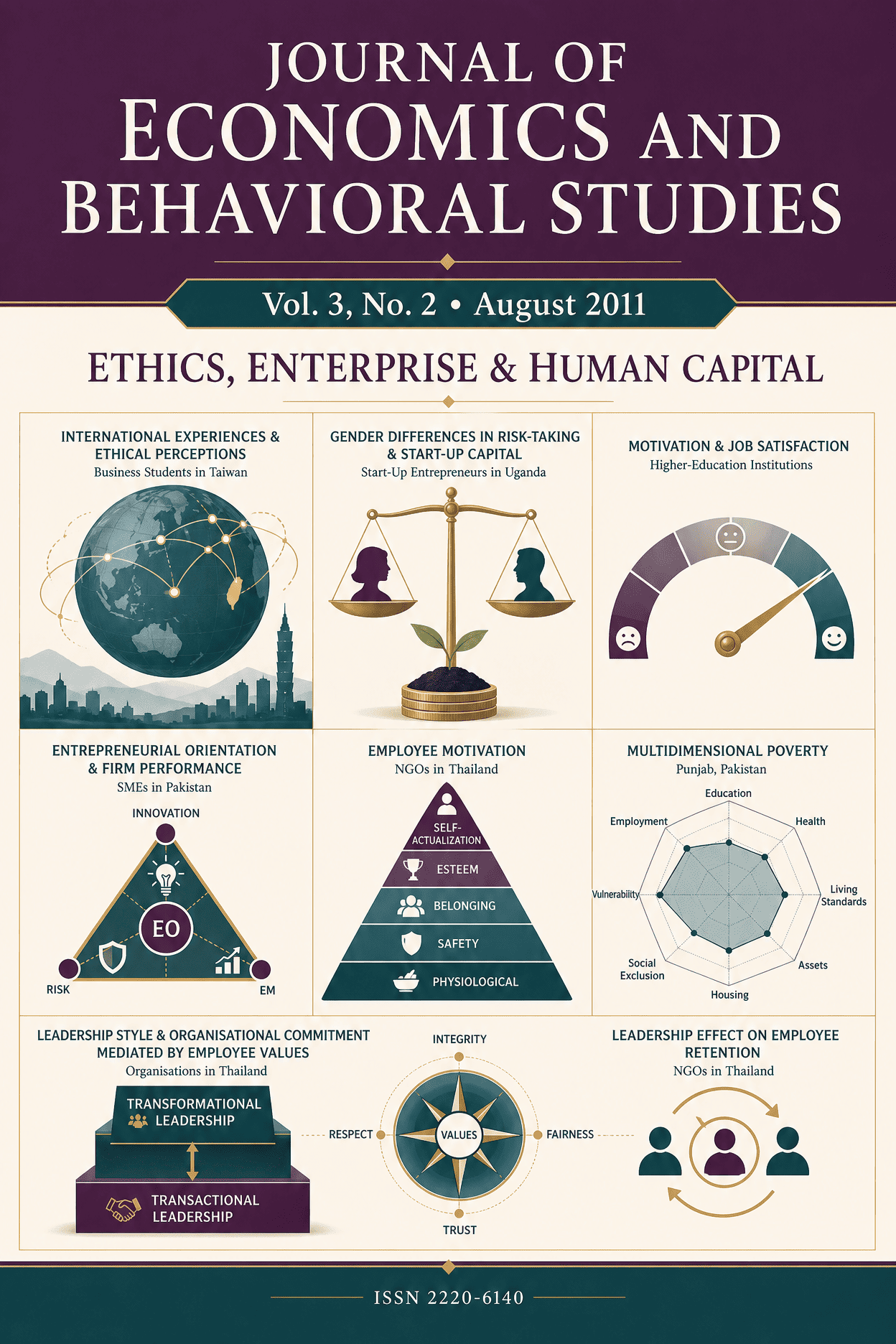
Articles

  • Article 1 in this issue

    An Empirical Study on the Association between International Experiences and Ethical Perceptions

    • Author: Yi-Hui Ho

    International experiences have gained increasing attentions by business professionals in the era of business globalization. Business ethics has also received substantial attentions due to those unceasing business scandals and their significant impact on stakeholders. As a result, research on business ethics and international experiences has no doubt brought about a growing attention lately. Nevertheless, little empirical research investigated the association between international experiences and ethical perceptions. Therefore, this study intends to explore the relationships between international experiences and ethical perceptions of business students. A questionnaire survey which takes business students in Taiwan as research subjects was used to probe participants’ ethical perceptions and their international experiences. The Multidimensional Ethics Scales is employed to measure students’ ethical perceptions, and an international experience questionnaire was developed to determine students’ international experiences. The findings reveal significant relationships exist between international experiences and ethical perceptions of business students. The study can promote further understanding of the associations of international experiences and ethical perceptions of future business professionals. Furthermore, the results of the study can help higher education institutions and international businesses to realize the possible impact of international experiences on ethical perceptions for business students.

    Pages 76-82

    PDF - An Empirical Study on the Association between International Experiences and Ethical Perceptions (opens in a new tab)
  • Article 2 in this issue

    Risk Taking and Start-up Capital: Exploring Gender differences in Uganda, through an International Comparison

    • Author: Laura Orobia, Arthur Sserwanga, Gerrit Rooks

    This study sought to explain the gender differences with respect to risk taking behaviour and startup capital in Uganda, comparing with other countries. The start-up capital of businesses run by females is ostensibly smaller than those run by males in Uganda and in any other country. A number of reasons have been forwarded to explain this variance. Some researchers have linked the size of start-up capital to the risk taking behaviour among other factors. However there is insufficient local or Ugandan empirical research into this difference, given that much of the empirical research are based on western data sets. Data for this study was from the Global Entrepreneurship Monitor (GEM) 2003. A causal research design was used to establish the relationship between risk taking attitude and start up capital. A comparative design was also employed to compare the findings of Uganda with other GEM countries, Chi-square tests, and a two way analysis of variances were used to analyse the data. There are gender differences with respect to risk taking behaviour across all countries under study. However, the gender gap is wider in other countries than Uganda. On the whole, Uganda women are less risk averse as compared to those in other countries. The start-up capital requirement of Ugandan men is more than their female counterparts. In addition, Ugandan men invested more personal start up capital when they are risk averse. Among other recommendations, policy makers should sensitise females about viability of business start ups and encourage women access to ownership of property.

    Pages 83-93

    PDF - Risk Taking and Start-up Capital: Exploring Gender differences in Uganda, through an International Comparison (opens in a new tab)
  • Article 3 in this issue

    Relationship between Motivation and Job Satisfaction: A Study of Higher Educational Institutions

    • Author: Ishfaq Ahmed, Talat Islam

    Managing human beings is pivotal part of the management process. Like other business units educational institutes consider human resource as their most vital asset, which might offer them greater returns and consider them a route towards their success. To be successful, organizations should motivate its employees on iterative basis. One way to motivate employees is through satisfying their needs. If employee’s needs are met, they will offer better returns in shape of greater importance. This study is aimed to find the impact of motivated employees on their job satisfaction. This study considers three facets of motivation or job satisfaction i.e. compensation, recognition and working conditions. For this study 269 faculty members were selected from five universities of Pakistan. Questionnaire was used for the data collection. Findings of the study specify the positive and significant relationship among working conditions, recognition and compensation on motivation. Further more motivated employees were found to be satisfied with their job.

    Pages 94-100

    PDF - Relationship between Motivation and Job Satisfaction: A Study of Higher Educational Institutions (opens in a new tab)
  • Article 4 in this issue

    Impact of Entrepreneurial Orientation, Entrepreneurial Management and Environmental Dynamism on Firm’s Financial Performance

    • Author: Imran Hameed, Bakhtiar Ali

    Entrepreneurial Orientation (EO) involves business mindset and behavior. The firm and industry context of entrepreneurship has always fascinated researchers for inquiry. The main aim of this study is to establish an association of factors such as EO characteristics (innovativeness and risk-taking), Entrepreneurial Management (EM), and Environmental Dynamism (ED) with firm’s financial performance. The objective also includes examining the moderating impact of EM and ED respectively on the link between EO characteristics and firm performance. This investigation covered small-to-medium enterprises (SMEs) in Pakistan from the cities of Islamabad and Lahore, and constituted a diverse sample of entrepreneurs from various sectors. Results reveal direct positive, individual relationships of innovativeness, risk-taking, and EM with firm’s financial performance. As far as moderating influence is concerned, EM and ED could not establish any significant interaction between EO characteristics and firm performance. Interestingly, from the contextual landscape of this study, risk-taking and EM have proved to be stronger, more consistent and stable predictors of performance compared with innovativeness. The EO dimension of innovativeness exhibits dual results of either strong or very weak predictor to performance, hence implying vulnerability. In fact, running full regression, the impact of innovativeness on performance gets diminished in the presence of risk-taking and EM. The investigation also reveals that when controlling for ED the analytical framework shows a slightly better degree of association between predictor and criterion variables. Under the context of this study it, therefore, concludes that SME managers should rely more on risk-taking dimension of EO compared with innovativeness especially in executing entrepreneurial management (EM) approaches.

    Pages 101-114

    PDF - Impact of Entrepreneurial Orientation, Entrepreneurial Management and Environmental Dynamism on Firm’s Financial Performance (opens in a new tab)
  • Article 5 in this issue

    Empirical Analysis of Determinants of Economic Growth: Evidence from SAARC Countries

    • Author: Muhammad Akram, Shahid Manzoor, Syed Shabihul Hassan, Muhammad Farhan, Hassan Mobeen Alam

    This study investigates the factors that determine and enhance economic growth. The factors to determine the economic growth of South Asian Association for Regional Cooperation (SAARC) countries are foreign direct investment, total debt, gross domestic investment and inflation. Simple ordinary least square is applied to analyze the determinates of economic growth with the help of panel data for 39 years with annual frequency from 1971 to 2009. The economic growth may gain boost by the factors not only by these but also many others. In this study foreign direct investment and inflation are found having inverse relationship with economic growth while gross domestic investment and total debt are found positively associated with economic growth. This study may prove useful contribution for policy making for South Asian countries.

    Pages 115-121

    PDF - Empirical Analysis of Determinants of Economic Growth: Evidence from SAARC Countries (opens in a new tab)
  • Article 6 in this issue

    Investor’s Dilemma: Fundamentals or Biasness in Investment Decision

    • Author: Mehtab Arshad Butt, Rozeena Saddar, Haroon Shafi, Kashif-Ur-Rehman, Rana Rashid Rehman, Hafiz Muhammad Shoaib

    In the present world Investment decision is most important phenomena. Investment is current sacrifice for future benefits, So while making investment decisions we have to keep different things in mind. Investment decisions are influenced not only by their fundamentals but also depend on different factors. One factor is the biasness of any investor to their investment, biasness depends on the cognition and emotions, because some investors use them as heuristic for the investment decision instead of fundamentals. Keeping this in view, this paper shows how cognitive biasness (i.e. Representativeness, Adjustment and Anchoring, Leniency) effects the investment decisions over the fundamentals. This study also show different types of investors which depicts significant relation of Representativeness, Adjustment and Anchoring, Leniency with investment decisions over fundamentals, and explain under which biasness an investor become more optimistic and moderate for investment decisions. While considering Representativeness biasness over fundamentals investor become more optimistic, In Adjustment and Anchoring biasness investor show moderate behavior about investment decision, and In Leniency biasness investor also take investment decision over optimistically.

    Pages 122-127

    PDF - Investor’s Dilemma: Fundamentals or Biasness in Investment Decision (opens in a new tab)
  • Article 7 in this issue

    Need and Employees Motivation to Work for NGOs in Thailand

    • Author: Matchakarn Ya-Anan, Chanchai Bunchapattanasukda

    This study aims to discuss and explain the level of need and motivation of working employees to work for NGOs in Thailand. How comment can motivate employees to perform as required or to stay in the organization by need. How it can encourage and develop human resource for NGOs in Thailand. Indepth interview was used to collect data from employees of NGOs in Bangkok, Prachuabkireekun Province, Rachaburee Province, Nakornrachasrima Province, Phuket Province, Chiangrai Province, and Chiangmai Province. The data was divided into 11 males and 18 female employees. From the results it is found that, the average of age is 34 years old, working period is 4.5 years, the level need (%) of physical needs is 62.06%, social needs is 52.58%, self-actualization needs is 51.41%, esteem needs is 51.09%, safety need is 46.84%. From the results it is concluded that different stages of maturity in strategic and operational human resource management exist.

    Pages 128-132

    PDF - Need and Employees Motivation to Work for NGOs in Thailand (opens in a new tab)
  • Article 8 in this issue

    Multidimensional Poverty in Pakistan: Case of Punjab Province

    • Author: Masood Sarwar Awan, Muhammad Waqas, Muhammad Amir Aslam

    This paper applies Alkire & Foster (2007) approach for measuring the multidimensional poverty. The data set used in the study is Multiple Indicator Cluster Survey 2003-04 of Punjab, Pakistan. Eight dimensions used in the study are Housing, Water, Sanitation, Electricity, Assets, Education, Expenditure, and Land. Results shows that at cut off K=2; Rajanpur, Muzaffargarh, Rahimyar Khan, Kasur, Okara and Lodhran respectively are the most multidimensionally poor districts of Punjab whereas, Gunj Buksh Town Lahore, Ravi Town Lahore, Cantt Town Lahore, Sialkot, Rawalpindi, Allama Iqbal Town Lahore, Gujranwala and Jhelum are the least deprived Towns/Districts of Punjab province. Dimension wise breakdown shows that Land deprivation, expenditure, sanitation, housing and education are respectively the major contributors among overall multidimensional poverty.

    Pages 133-144

    PDF - Multidimensional Poverty in Pakistan: Case of Punjab Province (opens in a new tab)
  • Article 9 in this issue

    Impact of Leadership Style on Organization Commitment: In A Mediating Role of Employee Values

    • Author: M. Suleman Sabir, Adil Sohail, Muhammad Asif Khan

    This paper aims to how leadership ship style effects the organization commitment of the employees, when the organization culture is reflecting the employee’s values in the organization. This paper is a conceptual based paper which gives theoretical evidence to support the idea. The paper also gives a brief overview of transactional leadership and transformational leadership. The results of the paper suggest that the leadership style is a strong dimension of organization commitment when organization culture of the organization represents the employees’ values in the organization. Employees are more satisfied if the organization will meet their expectations which are the part of that organization culture, so they are more committed with the organization. The paper is not giving any empirical evidence of the model. Further studies can be carried out by replacing transactional leadership with servant leadership.

    Pages 145-152

    PDF - Impact of Leadership Style on Organization Commitment: In A Mediating Role of Employee Values (opens in a new tab)
  • Article 10 in this issue

    Leadership Effect on the Retention of Nongovernmental Organizations (NGOs) Employees in Thailand

    • Author: Matchakarn Ya-Anan, Chanchai Bunchapattanasukda

    This study examines the affect of leadership on the retention of employees in NGOs. Four Thai NGOs representing a variety of organizational types were selected as a case study: the Paveenahongsakul Foundation, the Duang Prateep Foundation, the Potektueng Foundation, and the Chaipattana Foundation. They all work largely in the field of social and community development, with specific interests varying from: literacy, education, health, child and women welfare, environment, advocacy, animal welfare, volunteer promotion, etc. All of these NGOs are large enough to require skilled employees and an executive staff that is concerned about retaining these employees. This research aims to understand and critique the success factors for employee retention and examine if these factors hold true against the broad diversity of NGOs. In particular this study focuses on how leadership, which maintains the mission and vision of the NGO, impacts employee retention and what effect employee changeover has on maintaining mission and vision.

    Pages 153-156

    PDF - Leadership Effect on the Retention of Nongovernmental Organizations (NGOs) Employees in Thailand (opens in a new tab)