Abstract
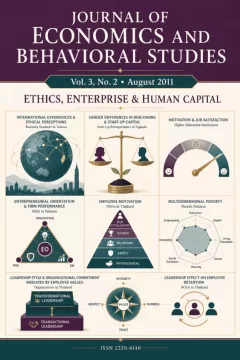
This study sought to explain the gender differences with respect to risk taking behaviour and startup capital in Uganda, comparing with other countries. The start-up capital of businesses run by females is ostensibly smaller than those run by males in Uganda and in any other country. A number of reasons have been forwarded to explain this variance. Some researchers have linked the size of start-up capital to the risk taking behaviour among other factors. However there is insufficient local or Ugandan empirical research into this difference, given that much of the empirical research are based on western data sets. Data for this study was from the Global Entrepreneurship Monitor (GEM) 2003. A causal research design was used to establish the relationship between risk taking attitude and start up capital. A comparative design was also employed to compare the findings of Uganda with other GEM countries, Chi-square tests, and a two way analysis of variances were used to analyse the data. There are gender differences with respect to risk taking behaviour across all countries under study. However, the gender gap is wider in other countries than Uganda. On the whole, Uganda women are less risk averse as compared to those in other countries. The start-up capital requirement of Ugandan men is more than their female counterparts. In addition, Ugandan men invested more personal start up capital when they are risk averse. Among other recommendations, policy makers should sensitise females about viability of business start ups and encourage women access to ownership of property.
Keywords
References
- Bates, T (1990). Self-Employment Trends among Mexican Americans, Working Papers, 90-9, Centre for Economic Studies, U.S. Census Bureau.
- Bates, T. (1995). Small Businesses Do Appear To Benefit from State/Local Government Economic Development Assistance, Working Papers, 95-2, Centre for Economic Studies, U.S. Census Bureau.
- Bates, T. (1997). Survival Patterns Among Newcomers to Franchising, Working Papers 97-1, Centre for Economic Studies, U.S. Census Bureau.
- Bayard, K., Judith H., David N., & Troske. K. (1999). Why Are Racial and Ethnic Wage Gaps Larger for Men than for Women? Exploring the Role of Segregation Using the New Worker- Establishment Characteristics Database. In John C. Haltiwanger, Julia I. Lane, James R. Spletzer, Jules J.M. Theeuwes, and Kenneth R. Troske, eds. The Creation and Analysis of Employer-Employee Matched Data (Amsterdam: Elsevier Science B.V.), 175-203.
- Brophy, D. (1989). Financing Women-Owned Entrepreneurial Firms. In Women-Owned Businesses, (Ed). O. Hagan, C. Rivchun & D. Sexton. New York: Praeger.
- Caird, S. (1988). A review of methods of measuring enterprising attributes. Durham, UK: Durham University Business School.
- Carrington, W. J & Troske, K. R. (1998). Sex segregation in U.S. manufacturing, Industrial and Labor Relations Review, ILR School, Cornell University, 51(3), 445-464.
- Carter, N. & Rosa, P. (1998). The financing of male and female owned businesses, Entrepreneurship & Regional Development, 10, 225-241.
- Cavalluzzo, K. S., Cavalluzzo, L. C. & Wolken, J. D. (2002), Competition, small business financing, and discrimination: Evidence from a new survey, Journal of Business, 75(4), 641-680.
- Chittenden, F., Hall, G. & Hutchinson, P. (1996). Small firm growth, access to capital markets and financial structure: review of issues and an empirical investigation. Small Business Economics, 8, 59-67.
- Dunn, T. & Holtz-Eakin, H. (1996). Financial Capital, Human Capital, and the Transition to Self-Employment: Evidence from Intergenerational Links, Metropolitan Studies Occasional Paper No. 181, Center for Policy Research, Syracuse University.
- Dyer, J. S. & Sarin, R. K. (1982), Relative risk aversion, Management science, 28, 875-886.
- El-Namaki, M. S. S. (1990) A cross-country Examination of Barriers to Women Entry and Continuity in Business and Efforts Aimed at Barrier Waving Maastricht. ASTRO/RVB Proceedings on a Conference on Industrial and Trade Policies for 1990s: Implications for LDCs.
- Evans, D. S. & Jovanovic, B. (1989). An Estimated Model of Entrepreneurial Choice under Liquidity Constraints. Journal of Political Economy, 97(8), 8-27.
- Evans, D. S. & Leighton, L. (1989). Why Do Smaller Firms Pay Less?, Journal of Human Resources, University of Wisconsin Press, 24(2), 299-318.
- Fischer, M. J. & Massey, D.S. (2000). Residential Segregation and Ethnic Enterprise in U.S. Metropolitan Areas. Social Problems 47, 408.
- Groshen, E. L. (1991). Rising inequality in a salary survey: another piece of the puzzle, Working Paper, 9121, Federal Reserve Bank of Cleveland.
- Hawawini, G. & Viallet, C. (1999). Finance for Executives, South Western College Publishing, USA.
- Henning, N., & Jardim, A. (1977). The managerial woman. New York: Anchor Books.
- Hertz, D. & Thomas, H. (1984). Practical Risk Analysis through case Histories, Wiley, Chichester.
- Hisrich, R.D. & Brush, C.G. (1987). Women entrepreneurs: A longitudinal study, in: N.C. Churchill, J.A. Hornaday, B.A. Kirchhoff, O.J. Krasner and K.H. Vesper (Eds), Frontiers of Entrepreneurship Research, 187-199.
- Holtz-Eakin, D., Joulfaian, D. & Rosen, H. (1994). Sticking It Out: Entrepreneurial Survival and Liquidity Constraints, Journal of Political Economy, 102, 53-75.
- Keinan, G., Meir, E. & Gome-Nemirovosky, T. (1984). Measurements of risk takers personality. Psychological Reports, 55, 163-67.
- Kotey, B. (1999). Debt financing and factors internal to the business, International Small Business Journal, 17(3), 11-29.
- Levinson, M. R. (1990). Risk taking and personality. Journal of personality and social psychology, 58, 1073-80.
- Liles, P. R. (1981). Who are entrepreneurs? In Gorb, P., Dowell, P. and Wilson, P. (Eds), Small Business Perspectives, Armstrong Publishing/ London Business School, London, 33-50.
- Master, R. & Meir, R. (1998). Sex differences and risk-taking propensity of entrepreneurs. Journal of Small Business Management, 26(1), 1-35.
- Michaelas, N., Chittenden, F. & Poutziouris, P. (1999). Financial Policy and Capital Structure Choice in U.K. SMEs: Empirical Evidence from Company Panel Data, Small Business Economics, 12, 113-130.
- Myers, S. C. (1984). The Capital Structure Puzzle. Journal of Finance, 34(3), 575-592.
- Pettit, R., & Singer, R. (1985). Small Business Finance: A Research Agenda. Financial Management, 14, 47-60.
- Reily, K. T. & Wirjanto, T. S. (1999). The Proportion of Females in the Establishment: Discrimination, Preferences and Technology, Canadian Public Policy, University of Toronto Press, 25(1), 73-94.
- Reynolds, P. D. (2000). National Panel Study of U.S. Business Start-Ups: Background and Methodology. In Advances in Entrepreneurship, Firm Emergence, and Growth, ed. J. Katz (4). Stamford, CT: JAI Press.
- Reynolds, P. D., Hay, M., Camp, M. S., & Autio, E. (2002) AND (2003). Global Entrepreneurship Monitor: Executive Report. Kauffman Centre for Entrepreneurial Leadership, Kansas City, MO.
- Scherer, R. F., Brodzinski, J. D., & Wiebe, F. A. (1990). Entrepreneur Career Selection and Gender: A Socialization Approach. Journal of Small Business Management, 28(2), 37-44.
- Schwartz, E. (1976). Entrepreneurship: A new female frontier. Journal of Contemporary Business, 5(1), 47-76.
- Sexton, D. & Bowman, N. (1990). Female and Male entrepreneurs: psychological characteristics and their role in gender- related discrimination. Journal of Business Venturing, 5(1), 29-36.
- Sitkin, S. B. & Weingart, L. R. (1995). Determinants of Risky Decision-Making Behavior: A Test of the Mediating Role of Risk Perceptions and Propensity. Academy of Management Journal 38(6), 1573-1592.
- Stevenson, L. (1984). An Investigation of the Entrepreneurial Experience of Women. Implications for Small Business Policy in Canada. Nova Scotia. Acadia University.
- Verheul, I. & Thurik, R. (2001). Start up capital: Does Gender Matter? Small Business Economics, 16, 329-345.
- Walter, T., Balunywa, W., Rosa, P., Sserwanga, A., Barabas, S., & Namatovu, R. (2003). Global Enterprenuership Monitor: GEM Uganda 2003 Executive Report.
- Walter, T., Balunywa, W., Rosa, P., Sserwanga, A., Barabas, S., Namatovu, R. & Kyejjusa, S. (2004). Global Enterprenuership Monitor: GEM Uganda 2004 Executive Report.
- Weber, E. U. & Milliam, R. A. (2000). Perceived risk attitudes: Relating risk perception to risky choice, Management Science. 43, 123-144.
- Wijst, D. Van der & Thurik, A.R (1993). Determinants of small firm debt ratios: an analysis of retail panel data, Small Business Economics, 5(1), 55-65.
- Yates, J.F., Stone, E.R., 1992. In: Yates, J.F. (Ed.), the Risk Construct in Risk-Taking Behavior. Wiley, Chichester, 1-25.
- Zoltan, J., Arenius, P., Hay, M. & Minniti, M. (2004). Global Entrepreneurship Monitor: GEM 2004 Executive Report.
Downloads
No downloads have been recorded for this article yet. Figures appear here once readers begin downloading the full text.
How to Cite
Share this article
License
Author (s) should affirm that the material has not been published previously. It has not been submitted and it is not under consideration by any other journal. At the same time author (s) need to execute a publication permission agreement to assume the responsibility of the submitted content and any omissions and errors therein. After submission of revised paper in the light of suggestions of the reviewers, the editorial team edits and formats manuscripts to bring uniformity and standardization in published material.
This work will be licensed under Creative Commons Attribution 4.0 International (CC BY 4.0) and under condition of the license, users are free to read, copy, remix, transform, redistribute, download, print, search or link to the full texts of articles and even build upon their work as long as they credit the author for the original work. Moreover, as per journal policy author (s) hold and retain copyrights without any restrictions.
Keywords
Section
Published
Submissions
Have research to publish? Journal of Economics and Behavioral Studies welcomes submissions.
Make a Submission