Abstract
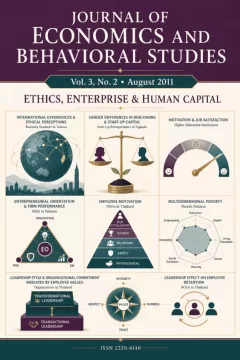
This paper applies Alkire & Foster (2007) approach for measuring the multidimensional poverty. The data set used in the study is Multiple Indicator Cluster Survey 2003-04 of Punjab, Pakistan. Eight dimensions used in the study are Housing, Water, Sanitation, Electricity, Assets, Education, Expenditure, and Land. Results shows that at cut off K=2; Rajanpur, Muzaffargarh, Rahimyar Khan, Kasur, Okara and Lodhran respectively are the most multidimensionally poor districts of Punjab whereas, Gunj Buksh Town Lahore, Ravi Town Lahore, Cantt Town Lahore, Sialkot, Rawalpindi, Allama Iqbal Town Lahore, Gujranwala and Jhelum are the least deprived Towns/Districts of Punjab province. Dimension wise breakdown shows that Land deprivation, expenditure, sanitation, housing and education are respectively the major contributors among overall multidimensional poverty.
Keywords
References
- Alkire, S., & Foster, J. (2007). Counting and Multidimensional Poverty Measures. OPHI working paper series, (7).
- Arif, G. M. (2003). Poverty Dynamics in Pakistan: Evidence from the Two Panel Household Survey. Pakistan Human Condition Report 2003. Islamabad: CRPRID.
- Arif, G. M. (2006). Poverty, Economic Growth, and Inequality: A Review of Pakistan’s Poverty Literature. Background Paper prepared for Asian Development Bank.
- Atkinson, A. B., & Bourguignon, F. (1982). The comparison of multi-dimensional distribution of economic status. The Review of Economic Studies, 49(2), 183-201.
- Betti G., Cheli B., Lemmi A. & Verma V. (2007). The Fuzzy Approach to Multidimensional Poverty: the Case of Italy in the 1990s, in Kakwani N. and Silber J. (eds.), Quantitative Approaches to Multidimensional Poverty Measurement, Palgrave Macmillan, 30-48.
- Bourguignon, F., & Chakravarty, S. R. (2003). The measurement of multidimensional poverty. Journal of Economic Inequality , 1(1), 25-49.
- Cerioli, A. & Zani, S. (1990). A Fuzzy Approach to Measurement of Poverty, in C. Dagum and M. Zenga (eds), Income and wealth distribution, inequality and poverty: studies in contemporary economics. Berlin: Springer Verlag, 272-84.
- Chakravarty, S. R. (1983). A new index of poverty. Mathematical Social Sciences, 6(3), 307-313.
- Deutsch, J. & Silber, J. (2005). Measuring Multidimensional Poverty: An Empirical Comparison of Various Approaches. The Review of Income and Wealth, 51(1), 145-174.
- Federal Bureau of Statistics (FBS). (2006). Pakistan Social and Living standard Measurement Survey 2005-06, Islamabad: Government of Pakistan.
- Foster, J. E., Greer, J. & Thorbecke, E. (1984). A Class of Decomposable Poverty Indices. Econometrica , 52(1), 761-766.
- Government of Pakistan. (2008). Poverty Reduction Strategy Paper II. http://www.finance.gov.pk.
- Lovell, C. A. K., Richardson, S., Travers, P., & Wood, L. (1994). Resources and Functioning: A New View of Inequality in Australia, in: Eichhorn, W. (ed.), Models and Measurement of Welfare and Inequality, Springer-Verlag, Heidelberg, 1994.
- Massoumi, E. & Lugo, M. A. (2007). The information basis of multivariate poverty assessments', in (N. Kakwani and J. Silber, eds.), The Many Dimensions of Poverty, Palgrave-MacMillan.
- Malik, S. J. (2005). Agricultural Growth and Rural Poverty: A Review of the Evidence. Pakistan Resident Mission Working Paper No. 2. Islamabad: ADB.
- Miceli, D. (1997). Mesure de la pauvreté. Théorie et Application à la Suisse. Thèse de doctorat ès sciences économiques et sociale, Université de Genève.
- Sen, A. K. (1976). Poverty: An ordinal approach to measurement. Econometrica , 44(2), 219-231.
- Sen, A. K. (1976). Development as freedom (1st edn.; New York: Knopf Press).
- Theil, H. (1967). Economics and Information Theory. Amsterdam: North Holland.
- Tsui, K. (1999), Multidimensional Inequality and Multidimensional Generalized Entropy Measures: An Axiomatic Approach. Social Choice & Welfare, 16(1) 145-157.
- Tsui, K. (2002). Multidimensional poverty indices. Social Choice & Welfare , 19(1), 69-93.
- Watts, H. W. (1969). An Economic Definition of Poverty, in D. P. Moynihan (ed.), On Understanding Poverty, New York: Basic Books.
- Zadeh, L. A. (1965). Fuzzy sets. Information and Control, 8,338-353.
Downloads
No downloads have been recorded for this article yet. Figures appear here once readers begin downloading the full text.
How to Cite
Share this article
License
Author (s) should affirm that the material has not been published previously. It has not been submitted and it is not under consideration by any other journal. At the same time author (s) need to execute a publication permission agreement to assume the responsibility of the submitted content and any omissions and errors therein. After submission of revised paper in the light of suggestions of the reviewers, the editorial team edits and formats manuscripts to bring uniformity and standardization in published material.
This work will be licensed under Creative Commons Attribution 4.0 International (CC BY 4.0) and under condition of the license, users are free to read, copy, remix, transform, redistribute, download, print, search or link to the full texts of articles and even build upon their work as long as they credit the author for the original work. Moreover, as per journal policy author (s) hold and retain copyrights without any restrictions.
Keywords
Section
Published
Submissions
Have research to publish? Journal of Economics and Behavioral Studies welcomes submissions.
Make a Submission