Abstract
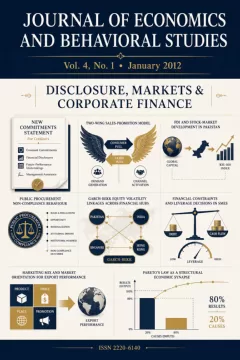
Much has been written lately concerning the failure of several major corporations to report their financial statuses accurately. Enron, Global Crossing, IBM and others have failed to provide accurate information to their investors and to provide full disclosure of liabilities that would influence the valuation. The present paper is focusing on creditors as a main group of accounting information users, which have been neglected, in field of information presentation. To solve this problem we introduce a new financial statement called “the commitments statement”. In the beginning, we point out financial reporting goals and users informational needs. Then, we mention the issue, which creditors’ informational needs have not been well provided; and the reasons are explained. We continue with inspection of providing information related to solvency and recognition of financial flexibility of entities. Finally, we introduce “the commitments statement” and explain how to provide this statement. We end with the conclusion section.
Keywords
References
- Abu-Nassar, M. & Rutherford, B, A. (1995). Preparer’s attitudes to financial reporting in less developed countries with moderately sophisticated capital markets: The case of Jordan. The International Journal of Accounting , 30 (2), 129–138.
- Atkinson, S. A. (2002). Ethics in financial reporting and the corporate communication professional. Corporate Communications: An International Journal , 7(4), 212–218.
- Amir, E. & Lev, B. (1996). Value-relevance of nonfinancial information: The wireless communications industry. Journal of Accounting and Economics , 22(1-3), 3-30.
- Francis, J., Schipper, K. & Vincent, L. (2002). Earning announcements and competing information. Journal of Accounting and Economics , 33, 13–342.
- Claire, M. (2003). Financial reporting on the Internet by leading Japanese companies. Corporate Communications. An International Journal , 8(1), 23 – 34.
- Frank, T. & Jesper D, S. (2008). Has financial statement information become less relevant? Longitudinal evidence from Denmark. Journal of management , 24(4), 375–387.
- Michael, P. & Laura, S. (1999). The conceptual underwear of financial reporting. Accounting, Auditing & Accountability Journal , 12(4), 489 – 501.
- Ngangan, K., Saudagaran, S, M. & Clarke, F, L. (2005). Cultural influences on indigenous users’ perception of the importance of disclosure items: Empirical evidence from Papua New Guinea. Advances in International Accounting , 18, 27-51.
- Nicholls, D. & Ahmed, K. (1995). Disclosure quality in corporate annual reports of non-financial companies in Bangladesh. Research in Accounting in Emerging Economies , 3 , 149–170.
- Richard, B. (2003). The revolution ahead in financial reporting: reporting financial performance. Balance Sheet , 11(4), 19–23.
- McCartney, S. (2004). The use of usefulness: An examination of the user needs approach to the financial reporting conceptual framework. Journal of Applied Accounting Research , 7(2), 52 – 79.
- Wallace, R. S. O. (1988). Corporate financial reporting in Nigeria. Accounting and Business Research , 18 , 352–362.
Downloads
No downloads have been recorded for this article yet. Figures appear here once readers begin downloading the full text.
How to Cite
Share this article
License
Copyright (c) 2012 Saeid Jabbarzadeh Kangarlouei, Sherko Hormozi, Rezgar Talebpour Asl, Asghar azizi (Author)

This work is licensed under a Creative Commons Attribution 4.0 International License.
Author (s) should affirm that the material has not been published previously. It has not been submitted and it is not under consideration by any other journal. At the same time author (s) need to execute a publication permission agreement to assume the responsibility of the submitted content and any omissions and errors therein. After submission of revised paper in the light of suggestions of the reviewers, the editorial team edits and formats manuscripts to bring uniformity and standardization in published material.
This work will be licensed under Creative Commons Attribution 4.0 International (CC BY 4.0) and under condition of the license, users are free to read, copy, remix, transform, redistribute, download, print, search or link to the full texts of articles and even build upon their work as long as they credit the author for the original work. Moreover, as per journal policy author (s) hold and retain copyrights without any restrictions.
Keywords
Section
Published
Submissions
Have research to publish? Journal of Economics and Behavioral Studies welcomes submissions.
Make a Submission