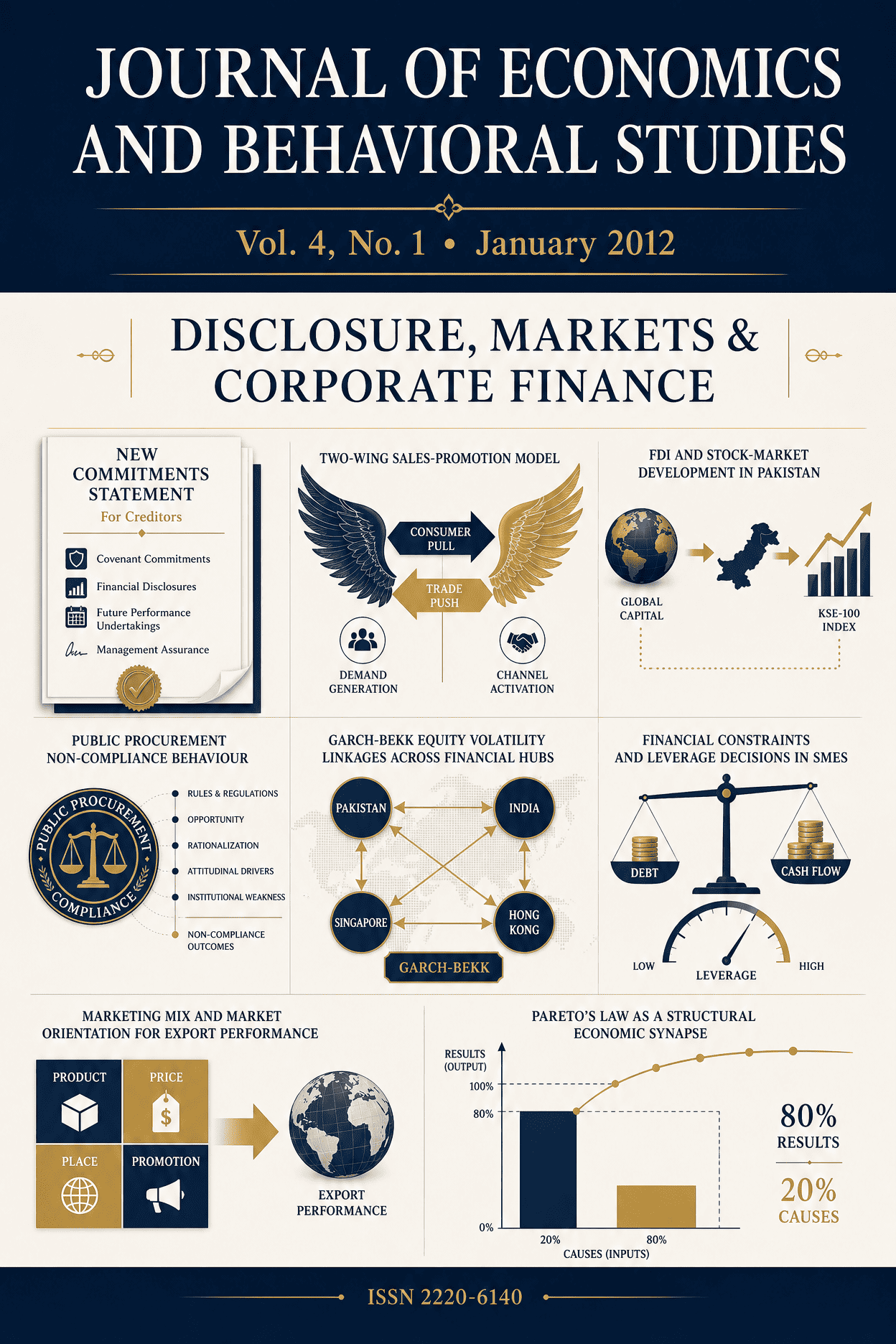
Articles

  • Article 1 in this issue

    The Commitments Statement: A New Statement for Creditors

    • Author: Saeid Jabbarzadeh Kangarlouei, Sherko Hormozi, Rezgar Talebpour Asl, Asghar azizi

    Much has been written lately concerning the failure of several major corporations to report their financial statuses accurately. Enron, Global Crossing, IBM and others have failed to provide accurate information to their investors and to provide full disclosure of liabilities that would influence the valuation. The present paper is focusing on creditors as a main group of accounting information users, which have been neglected, in field of information presentation. To solve this problem we introduce a new financial statement called “the commitments statement”. In the beginning, we point out financial reporting goals and users informational needs. Then, we mention the issue, which creditors’ informational needs have not been well provided; and the reasons are explained. We continue with inspection of providing information related to solvency and recognition of financial flexibility of entities. Finally, we introduce “the commitments statement” and explain how to provide this statement. We end with the conclusion section.

    Pages 1-11

    PDF - The Commitments Statement: A New Statement for Creditors (opens in a new tab)
  • Article 2 in this issue

    Two Wing Models of Sales Promotion: Theorization and Examination

    • Author: Imran Anwar Mir, Kashif Ur Rehman

    Sales promotion is an important and frequently used marketing tool to influence the consumers’ purchase intentions directly. This research study introduces a two-wing model of sales promotion to show the comparative impact of different formats and benefit levels of instant price discounts and next off purchase promotions on the consumer perceptions and purchase intentions of the promoted products. The uniqueness of this model is that it separately tests the impact of different types and formats of instant price discounts and next off purchase promotions on the consumers’ overall perceptions and purchase intentions of the products under sale. The empirical testing of this model reveals some important findings that can help marketers to develop result oriented sales promotion techniques in Asian markets. Since, this model has been tested in an Asian context only. To know its multi-cultural application it needs to be tested in diverse cultural contexts.

    Pages 12-25

    PDF - Two Wing Models of Sales Promotion: Theorization and Examination (opens in a new tab)
  • Article 3 in this issue

    The Role of FDI on Stock Market Development: The Case of Pakistan

    • Author: Ali Raza, Nasir Iqbal, Zeshan Ahmed, Mohammad Ahmed, Tanvir Ahmed

    The purpose of this study is to empirically analyze the role of foreign direct investment in developing host country’s stock markets and to examine whether they are related or not. The key interest turns around the admiring role of FDI in Stock market development of Pakistan. Our work also aims to investigate the effect of foreign direct investment along with domestic savings, exchange rate and inflation in developing Pakistan stock markets in a rapidly changing political environment. This study applies Ordinary Least Square (OLS) method of regression by using annual time series data for the period 1988-2009 in case of Pakistan to estimate empirical relationships among variables. The results disclose a positive impact of foreign direct investment along with other explanatory variables in developing Stock markets of Pakistan. The study findings can be used to help government policy makers to encourage FDI and take various steps to provide incentives and save foreign investors interest in a volatile political environment that prevailing in the country. Adequate facility of infrastructure can enhance FDI. The volatility of exchange rate and inflation rate should also be minimized through monitory policy while domestic savings must also be encouraged in the country through appropriate and encouraging saving policies. Our effort exclusively study development of Stock markets in Pakistan with special reference to foreign direct investment and other variables. Our study depicts a closer relationship between FDI and Stock Market Development.

    Pages 26-33

    PDF - The Role of FDI on Stock Market Development: The Case of Pakistan (opens in a new tab)
  • Article 4 in this issue

    Antecedents and Consequences of Public Procurement Non-compliance Behavior

    • Author: Benjamin R Tukamuhabwa

    This paper proposes a conceptualization of the antecedents and consequences of compliance/ noncompliance behaviour in public procurement. It was motivated by the paucity of studies on public procurement compliance in Uganda, despite the evidently rampant non-complaint behaviour exhibited and a realization by recent researchers that less research has been conducted on organizational misbehaviors and non-compliance in purchasing and supply management. There are also scanty (if any) studies that have incorporated antecedents and consequences of public procurement compliance in a comprehensive single framework such as proposed in this study. Through a review of existing scholarly works, documents, records and reports, a conceptual frame work was developed in which media publicity, enforcement, records management, organizational culture, political interference, professionalism, organizational incentives, perceived rule legitimacy, moral obligation, social influence, familiarity with rules and top management support were identified as antecedents while cognitive dissonance, low employee motivation, low corruption, better corporate governance and low service delivery were established as consequences. It is hoped that future researchers will utilize the current proposed conceptual model to conduct empirical studies on public procurement compliance in Uganda and other geographical contexts. This will provide practical implications that will assist to avert the unbridled squander of colossal amount of money through flouting public procurement procedures.

    Pages 34-46

    PDF - Antecedents and Consequences of Public Procurement Non-compliance Behavior (opens in a new tab)
  • Article 5 in this issue

    Volatility Linkages between Equity Markets of Pakistan, India, Singapore and Hong Kong: A GARCH BEKK Approach

    • Author: Muhammad Junaid Iqbal, Sadia Rafique, Afsheen Abrar, Nagina Jamil, Abid Ali Shah, Ahsan-ul-Haq Satti

    The purpose of current study is to explore the volatility linkages between four Asian equity markets, which arePakistan (Karachi Stock Exchange), India (Bombay Stock Exchange), Hong Kong (Hang Sang Index) and Singapore (Strait Time Index). We estimate Multivariate GARCH BEKK model using weekly returns from January 2000 to August 2011.Direct evidences of linkages are found among all markets with respect to conditional mean returns and volatility.Own volatility spillover is found greater than cross volatility spillover in all emerging and developed economies.The insinuation of this study is that overseas investors may take advantage from the decrease of uncertainty by accumulating the stocks in the emerging markets to their investment portfolio.

    Pages 47-54

    PDF - Volatility Linkages between Equity Markets of Pakistan, India, Singapore and Hong Kong: A GARCH BEKK Approach (opens in a new tab)
  • Article 6 in this issue

    Financial Constraints and Leverage Decisions in Small and Medium-Sized Firms

    • Author: Harshana Kasseeah

    This paper studies the leverage decisions of small and medium-sized manufacturing firms in the UK. The relationship between debt and cash flow is studied in the light of both internal and overall financial constraints. Internal financial constraints are defined as those constraints internal to the firm that influence its financing decisions. These measures include the cash flow and profitability of the firm. Overall financial constraints account for both internal financial constraints and external financial constraints, which in turn are accounted for by conventionally used measures of financial constraints such as the size of the firm measured by the real assets and the riskiness of the firm. Results obtained indicate that firms follow a financial hierarchy when deciding what sources of finance to use. Internal financial constraints measured by the availability of internal funds are important factors that affect the relationship between debt and cash flow.

    Pages 55-65

    PDF - Financial Constraints and Leverage Decisions in Small and Medium-Sized Firms (opens in a new tab)
  • Article 7 in this issue

    The Impact of Marketing Mix and Market Orientation on Export Performance

    • Author: Muhammad Usman, Irfan Ullah, Muhammad Bilal Kayani, Faisal Haroon, Muhammad Aslam Khan

    The study focuses on the marketing mix and market orientation on export performance due to the significance of foreign businesses. Theory posits that marketing mix and market orientation have a positive impact on export performance. Although the paper is conceptual base and the model proposed is required to check their reliability that firm with size, information system, and commitment with availability of market mix and market orientation formally. However, with the modification of technology enhances the export performance in a better way. The authors concluded that the practical implementation of export’s marketing strategies identically facilitated the companies for future success.

    Pages 66-71

    PDF - The Impact of Marketing Mix and Market Orientation on Export Performance (opens in a new tab)
  • Article 8 in this issue

    Pareto’s Law As Structural Economic Synapse

    • Author: Alexandru Trifu

    Starting from the observations of Italian economist Vilfredo Pareto, in the early days of XX-th century, refering to personal income distribution, we are coming to understand that it is not enough heightens the wealth of a nations, so that collective welfare to increase. It requires that the wealth created to be equitably distributed and not equally. Today, the famous Paretian Principle 80/20 demonstrates that we must wisely use the resources (i.e. 20%), enhance productivity, competitiveness and sustainability of the entities on the markets, so as to maintain the favourable results in 80 % ratio, but also to be overcome. Due to the elements composing the concept of Pareto’s Law, but mainly to the practical use of the theoretical pattern of an ex-post nature, we consider it a true synapse within economics, in order to facilitate an well-functioning of the society and economy and to motivate a rising of productivity in all domains.

    Pages 72-74

    PDF - Pareto’s Law As Structural Economic Synapse (opens in a new tab)